 Français
 English

| ELK.No | ES13832 |
| Product name | QOR rabbit pAb |
| Reactivity | Human; Mouse;Rat |
| Applications | WB;ELISA;IHC |
| Other name | |
| Size | 100μL |
| Unit price ($) | 248 |
| Human gene ID | 1429 |
| Human Swiss-Prot | Q08257 |
| Source | Rabbit |
| Isotype | IgG |
| Target | QOR |
| Fields | |
| Gene name | CRYZ |
| Protein name | QOR |
| Human gene link | View Human Gene |
| Human Swiss link | View Human Swiss-Prot |
| Mouse gene ID | 12972 |
| Mouse gene link | View Mouse Gene |
| Mouse Swiss-Prot | P47199 |
| Mouse Swiss link | View Mouse Swiss-Prot |
| Rat gene ID | 362061 |
| Rat gene link | View Rat Gene |
| Rat Swiss-Prot | Q6AYT0 |
| Rat Swiss link | View Rat Swiss-Prot |
| Immunogen | Synthesized peptide derived from human QOR AA range: 275-325 |
| Specificity | This antibody detects endogenous levels of QOR at Human/Mouse/Rat |
| Formulation | Liquid in PBS containing 50% glycerol, 0.5% BSA and 0.02% sodium azide. |
| Clonality | Polyclonal |
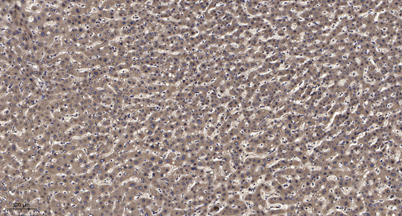
| Dilution | WB 1:500-2000;IHC-p 1:50-300; ELISA 2000-20000 |
| Purification | The antibody was affinity-purified from rabbit serum by affinity-chromatography using specific immunogen. |
| Concentration | 1 mg/ml |
| Storage stability | -20°C/1 year |
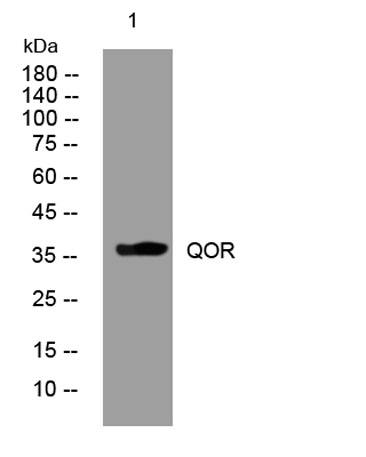
| Molecular Weight (Da) | 36kD |
| Observed band (KD) | |
| Background | Crystallins are separated into two classes: taxon-specific, or enzyme, and ubiquitous. The latter class constitutes the major proteins of vertebrate eye lens and maintains the transparency and refractive index of the lens. The former class is also called phylogenetically-restricted crystallins. This gene encodes a taxon-specific crystallin protein which has NADPH-dependent quinone reductase activity distinct from other known quinone reductases. It lacks alcohol dehydrogenase activity although by similarity it is considered a member of the zinc-containing alcohol dehydrogenase family. Unlike other mammalian species, in humans, lens expression is low. Alternatively spliced transcript variants encoding different isoforms have been found for this gene. One pseudogene is known to exist. [provided by RefSeq, Sep 2008], |
| Function | catalytic activity:NADPH + 2 quinone = NADP(+) + 2 semiquinone.,caution:The sequence shown here is derived from an Ensembl automatic analysis pipeline and should be considered as preliminary data.,function:Does not have alcohol dehydrogenase activity. Binds NADP and acts through a one-electron transfer process. Orthoquinones are the best substrates. May act in the detoxification of xenobiotics.,similarity:Belongs to the zinc-containing alcohol dehydrogenase family. Quinone oxidoreductase subfamily.,subunit:Homotetramer.,tissue specificity:Only very low amounts in the lens., |
| Subcellular location | Cytoplasm . |
| Expression | Only very low amounts in the lens. |

Use collapsible tabs for more detailed information that will help customers make a purchasing decision.
Ex: Shipping and return policies, size guides, and other common questions.