 Français
 English

| ELK.No | ES13846 |
| Product name | PYGM rabbit pAb |
| Reactivity | Human; Mouse;Rat |
| Applications | WB |
| Other name | |
| Size | 100μL |
| Unit price ($) | 248 |
| Human gene ID | 5837 |
| Human Swiss-Prot | P11217 |
| Source | Rabbit |
| Isotype | IgG |
| Target | PYGM |
| Fields | >>Starch and sucrose metabolism;>>Metabolic pathways;>>Necroptosis;>>Insulin signaling pathway;>>Glucagon signaling pathway;>>Insulin resistance |
| Gene name | PYGM |
| Protein name | PYGM |
| Human gene link | View Human Gene |
| Human Swiss link | View Human Swiss-Prot |
| Mouse gene ID | 19309 |
| Mouse gene link | View Mouse Gene |
| Mouse Swiss-Prot | Q9WUB3 |
| Mouse Swiss link | View Mouse Swiss-Prot |
| Rat gene ID | |
| Rat gene link | |
| Rat Swiss-Prot | P09812 |
| Rat Swiss link | View Rat Swiss-Prot |
| Immunogen | Synthesized peptide derived from human PYGM AA range: 426-476 |
| Specificity | This antibody detects endogenous levels of PYGM at Human/Mouse/Rat |
| Formulation | Liquid in PBS containing 50% glycerol, 0.5% BSA and 0.02% sodium azide. |
| Clonality | Polyclonal |
| Dilution | WB 1:500-2000 |
| Purification | The antibody was affinity-purified from rabbit serum by affinity-chromatography using specific immunogen. |
| Concentration | 1 mg/ml |
| Storage stability | -20°C/1 year |
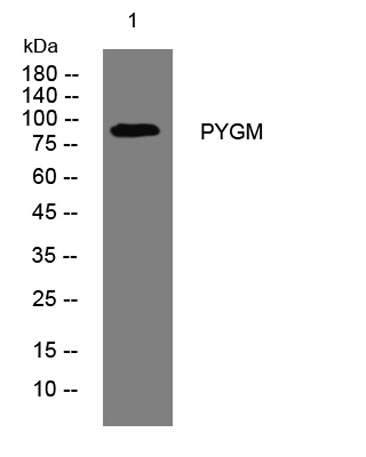
| Molecular Weight (Da) | 93kD |
| Observed band (KD) | |
| Background | This gene encodes a muscle enzyme involved in glycogenolysis. Highly similar enzymes encoded by different genes are found in liver and brain. Mutations in this gene are associated with McArdle disease (myophosphorylase deficiency), a glycogen storage disease of muscle. Alternative splicing results in multiple transcript variants.[provided by RefSeq, Sep 2009], |
| Function | catalytic activity:(1,4-alpha-D-glucosyl)(n) + phosphate = (1,4-alpha-D-glucosyl)(n-1) + alpha-D-glucose 1-phosphate.,cofactor:Pyridoxal phosphate.,disease:Defects in PYGM are the cause of glycogen storage disease type 5 (GSD5) [MIM:232600]; also known as McArdle disease. GSD5 is a metabolic disorder resulting in myopathy characterized by exercise intolerance, cramps, muscle weakness and recurrent myoglobinuria.,enzyme regulation:Activity of phosphorylase is controlled both by allosteric means (through the noncovalent binding of metabolites) and by covalent modification. Thus AMP allosterically activates, whereas ATP, ADP, and glucose-6-phosphate allosterically inhibit, phosphorylase B.,function:Phosphorylase is an important allosteric enzyme in carbohydrate metabolism. Enzymes from different sources differ in their regulatory mechanisms and in their natural substrates. However, all know |
| Subcellular location | cytoplasm,cytosol,extracellular exosome, |
| Expression |

Use collapsible tabs for more detailed information that will help customers make a purchasing decision.
Ex: Shipping and return policies, size guides, and other common questions.