 Français
 English

| ELK.No | ES13861 |
| Product name | PTPRH rabbit pAb |
| Reactivity | Human;Rat;Mouse; |
| Applications | WB |
| Other name | |
| Size | 100μL |
| Unit price ($) | 248 |
| Human gene ID | 5794 |
| Human Swiss-Prot | Q9HD43 |
| Source | Rabbit |
| Isotype | IgG |
| Target | PTPRH |
| Fields | |
| Gene name | PTPRH SAP1 |
| Protein name | PTPRH |
| Human gene link | View Human Gene |
| Human Swiss link | View Human Swiss-Prot |
| Mouse gene ID | |
| Mouse gene link | |
| Mouse Swiss-Prot | |
| Mouse Swiss link | |
| Rat gene ID | |
| Rat gene link | |
| Rat Swiss-Prot | |
| Rat Swiss link | |
| Immunogen | Synthesized peptide derived from human PTPRH AA range: 1031-1081 |
| Specificity | This antibody detects endogenous levels of PTPRH at Human |
| Formulation | Liquid in PBS containing 50% glycerol, 0.5% BSA and 0.02% sodium azide. |
| Clonality | Polyclonal |
| Dilution | WB 1:500-2000 |
| Purification | The antibody was affinity-purified from rabbit serum by affinity-chromatography using specific immunogen. |
| Concentration | 1 mg/ml |
| Storage stability | -20°C/1 year |
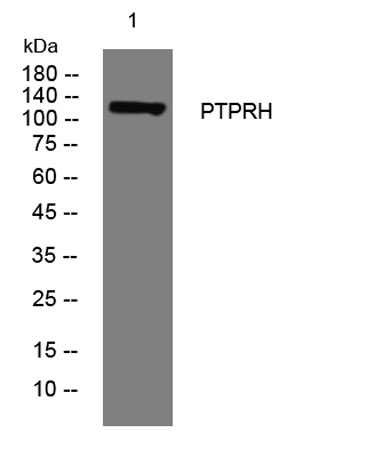
| Molecular Weight (Da) | 123kD |
| Observed band (KD) | |
| Background | The protein encoded by this gene is a member of the protein tyrosine phosphatase (PTP) family. PTPs are known to be signaling molecules that regulate a variety of cellular processes including cell growth, differentiation, mitotic cycle, and oncogenic transformation. This PTP possesses an extracellular region, a single transmembrane region, and a single intracytoplasmic catalytic domain, and thus represents a receptor-type PTP. The extracellular region contains eight fibronectin type III-like repeats and multiple N-glycosylation sites. The gene was shown to be expressed primarily in brain and liver, and at a lower level in heart and stomach. It was also found to be expressed in several cancer cell lines, but not in the corresponding normal tissues. Alternative splicing results in multiple transcript variants. [provided by RefSeq, Jun 2009], |
| Function | catalytic activity:Protein tyrosine phosphate + H(2)O = protein tyrosine + phosphate.,domain:The cytoplasmic domain mediates the interaction with LCK.,domain:The extracellular domain mediates homodimerization. One or more cysteines in the extracelllular domain is essential for the formation of dimers probably by forming a disulfide bond.,enzyme regulation:Regulated by reversible dimerization. Dimerization reduces its catalytic activity.,function:May contribute to contact inhibition of cell growth and motility by mediating the dephosphorylation of focal adhesion-associated substrates and thus negatively regulating integrin-promoted signaling processes. Induces apoptotic cell death by at least two distinct mechanisms: inhibition of cell survival signaling mediated by PI 3-kinase, Akt, and ILK and activation of a caspase-dependent proapoptotic pathway. Inhibits the basal activity of LCK and |
| Subcellular location | Cell projection, microvillus membrane ; Single-pass type I membrane protein . Apical cell membrane ; Single-pass type I membrane protein . Cytoplasm . Colocalizes with CEACAM20 at the apical brush border of intestinal cells. . |
| Expression | Expressed at high levels in the brain, spleen and liver and at lower levels in the heart and stomach. Expressed in pancreatic and colorectal cancer cells, but not in normal pancreas or colon. Expression in hepatocellular carcinoma is related to the differentiation status of the tumor and expression is inversely related to tumor aggressiveness. |

Use collapsible tabs for more detailed information that will help customers make a purchasing decision.
Ex: Shipping and return policies, size guides, and other common questions.