 Français
 English

| ELK.No | ES13879 |
| Product name | PSME1 rabbit pAb |
| Reactivity | Human; Mouse;Rat |
| Applications | WB |
| Other name | |
| Size | 50μL |
| Unit price ($) | 148 |
| Human gene ID | 5720 |
| Human Swiss-Prot | Q06323 |
| Source | Rabbit |
| Isotype | IgG |
| Target | PSME1 |
| Fields | >>Proteasome;>>Antigen processing and presentation |
| Gene name | PSME1 IFI5111 |
| Protein name | PSME1 |
| Human gene link | View Human Gene |
| Human Swiss link | View Human Swiss-Prot |
| Mouse gene ID | 19186 |
| Mouse gene link | View Mouse Gene |
| Mouse Swiss-Prot | P97371 |
| Mouse Swiss link | View Mouse Swiss-Prot |
| Rat gene ID | |
| Rat gene link | |
| Rat Swiss-Prot | Q63797 |
| Rat Swiss link | View Rat Swiss-Prot |
| Immunogen | Synthesized peptide derived from human PSME1 AA range: 60-110 |
| Specificity | This antibody detects endogenous levels of PSME1 at Human/Mouse/Rat |
| Formulation | Liquid in PBS containing 50% glycerol, 0.5% BSA and 0.02% sodium azide. |
| Clonality | Polyclonal |
| Dilution | WB 1:500-2000 |
| Purification | The antibody was affinity-purified from rabbit serum by affinity-chromatography using specific immunogen. |
| Concentration | 1 mg/ml |
| Storage stability | -20°C/1 year |
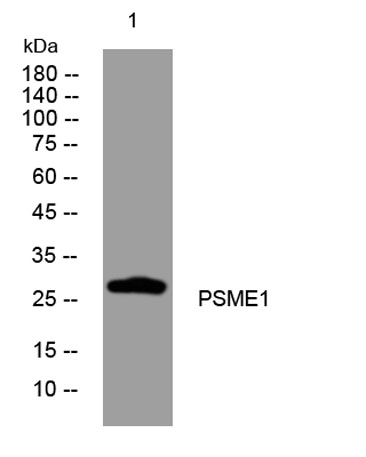
| Molecular Weight (Da) | 27kD |
| Observed band (KD) | |
| Background | The 26S proteasome is a multicatalytic proteinase complex with a highly ordered structure composed of 2 complexes, a 20S core and a 19S regulator. The 20S core is composed of 4 rings of 28 non-identical subunits; 2 rings are composed of 7 alpha subunits and 2 rings are composed of 7 beta subunits. The 19S regulator is composed of a base, which contains 6 ATPase subunits and 2 non-ATPase subunits, and a lid, which contains up to 10 non-ATPase subunits. Proteasomes are distributed throughout eukaryotic cells at a high concentration and cleave peptides in an ATP/ubiquitin-dependent process in a non-lysosomal pathway. An essential function of a modified proteasome, the immunoproteasome, is the processing of class I MHC peptides. The immunoproteasome contains an alternate regulator, referred to as the 11S regulator or PA28, that replaces the 19S regulator. Three subunits (alpha, beta and gamma) of the 11S regulator have been identified. This gene encodes the alpha subunit of the 11S regulator, one of the two 11S subunits that is induced by gamma-interferon. Three alpha and three beta subunits combine to form a heterohexameric ring. Alternative splicing results in multiple transcript variants. [provided by RefSeq, Jul 2013], |
| Function | caution:The sequence shown here is derived from an Ensembl automatic analysis pipeline and should be considered as preliminary data.,function:Implicated in immunoproteasome assembly and required for efficient antigen processing. The PA28 activator complex enhances the generation of class I binding peptides by altering the cleavage pattern of the proteasome.,induction:By interferon gamma.,similarity:Belongs to the PA28 family.,subunit:Heterodimer of PSME1 and PSME2, which forms a hexadimeric ring. PSME1 can form homoheptamers., |
| Subcellular location | proteasome complex,nucleoplasm,cytoplasm,cytosol,proteasome activator complex,extracellular exosome, |
| Expression |

Use collapsible tabs for more detailed information that will help customers make a purchasing decision.
Ex: Shipping and return policies, size guides, and other common questions.