 Français
 English
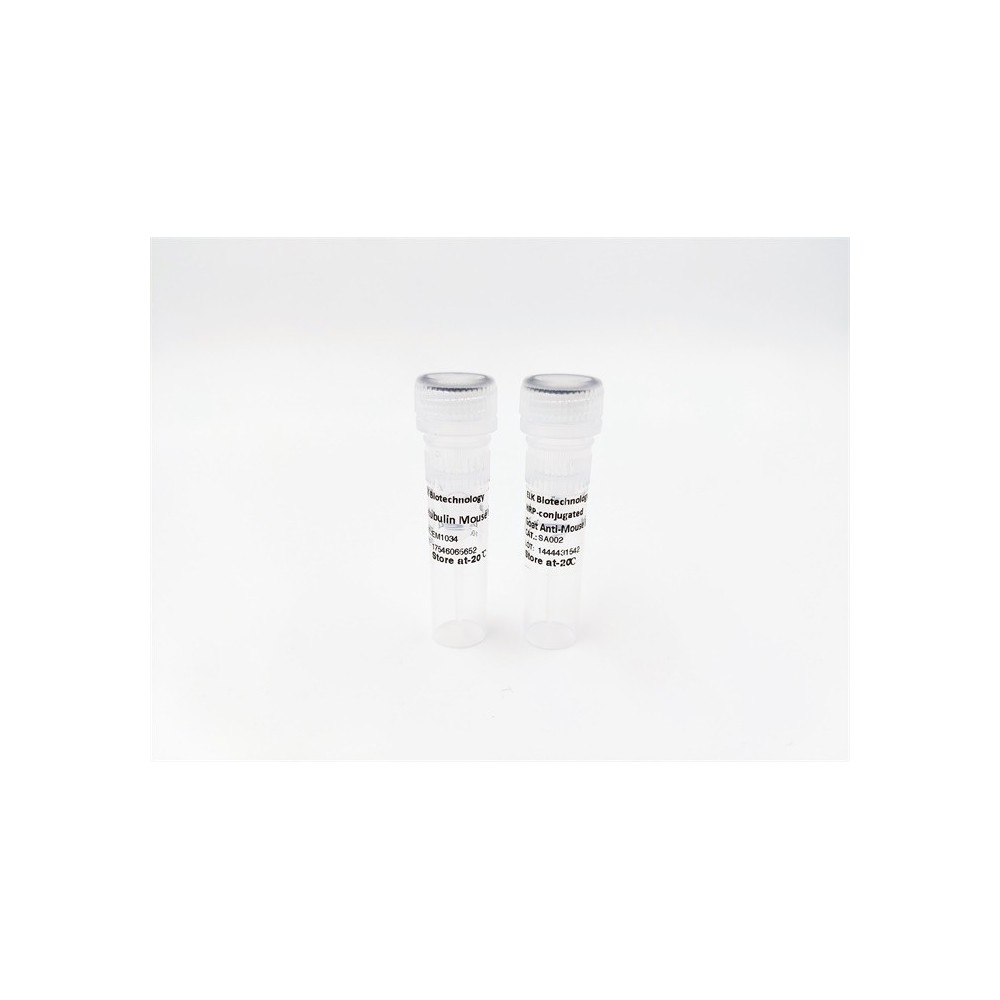

| ELK.No | ES13882 |
| Product name | PSMD1 rabbit pAb |
| Reactivity | Human; Mouse;Rat |
| Applications | WB |
| Other name | 26S proteasome non-ATPase regulatory subunit 1 (26S proteasome regulatory subunit RPN2) (26S proteasome regulatory subunit S1) (26S proteasome subunit p112) |
| Size | 100μL |
| Unit price ($) | 248 |
| Human gene ID | 5707 |
| Human Swiss-Prot | Q99460 |
| Source | Rabbit |
| Isotype | IgG |
| Target | PSMD1 |
| Fields | >>Proteasome;>>Alzheimer disease;>>Parkinson disease;>>Amyotrophic lateral sclerosis;>>Huntington disease;>>Spinocerebellar ataxia;>>Prion disease;>>Pathways of neurodegeneration - multiple diseases;>>Epstein-Barr virus infection |
| Gene name | PSMD1 |
| Protein name | PSMD1 |
| Human gene link | View Human Gene |
| Human Swiss link | View Human Swiss-Prot |
| Mouse gene ID | 70247 |
| Mouse gene link | View Mouse Gene |
| Mouse Swiss-Prot | Q3TXS7 |
| Mouse Swiss link | View Mouse Swiss-Prot |
| Rat gene ID | 83806 |
| Rat gene link | View Rat Gene |
| Rat Swiss-Prot | O88761 |
| Rat Swiss link | View Rat Swiss-Prot |
| Immunogen | Synthesized peptide derived from human PSMD1 AA range: 192-242 |
| Specificity | This antibody detects endogenous levels of PSMD1 at Human/Mouse/Rat |
| Formulation | Liquid in PBS containing 50% glycerol, 0.5% BSA and 0.225% sodium azide. |
| Clonality | Polyclonal |
| Dilution | WB 1:500-2000 |
| Purification | The antibody was affinity-purified from rabbit serum by affinity-chromatography using specific immunogen. |
| Concentration | 1 mg/ml |
| Storage stability | -20°C/1 year |
| Molecular Weight (Da) | |
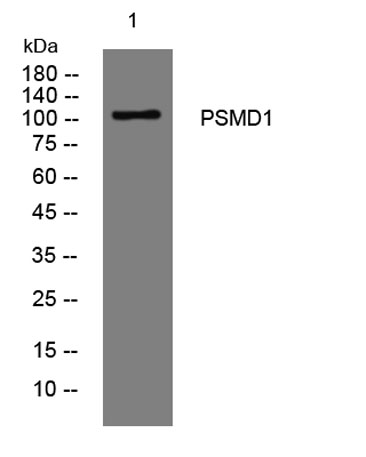
| Observed band (KD) | 105kD |
| Background | The 26S proteasome is a multicatalytic proteinase complex with a highly ordered structure composed of 2 complexes, a 20S core and a 19S regulator. The 20S core is composed of 4 rings of 28 non-identical subunits; 2 rings are composed of 7 alpha subunits and 2 rings are composed of 7 beta subunits. The 19S regulator is composed of a base, which contains 6 ATPase subunits and 2 non-ATPase subunits, and a lid, which contains up to 10 non-ATPase subunits. Proteasomes are distributed throughout eukaryotic cells at a high concentration and cleave peptides in an ATP/ubiquitin-dependent process in a non-lysosomal pathway. An essential function of a modified proteasome, the immunoproteasome, is the processing of class I MHC peptides. This gene encodes the largest non-ATPase subunit of the 19S regulator lid, which is responsible for substrate recognition and binding. Alternatively spliced transcript variants have been found for this gene.[provided by RefSeq, Jul 2010], |
| Function | function:Acts as a regulatory subunit of the 26 proteasome which is involved in the ATP-dependent degradation of ubiquitinated proteins.,sequence caution:Contaminating sequence. Potential poly-A sequence.,similarity:Belongs to the proteasome subunit S1 family.,similarity:Contains 10 PC repeats.,subunit:Interacts with ADRM1., |
| Subcellular location | proteasome complex,nucleus,nucleoplasm,cytosol,proteasome regulatory particle,proteasome regulatory particle, base subcomplex,membrane,integral component of membrane,proteasome accessory complex,proteasome storage granule,extracellular exosome, |
| Expression | Cervix,Epithelium,Hepatocyte,Liver,Lymph,Placenta,Testis,Uterus, |

Use collapsible tabs for more detailed information that will help customers make a purchasing decision.
Ex: Shipping and return policies, size guides, and other common questions.