 Français
 English
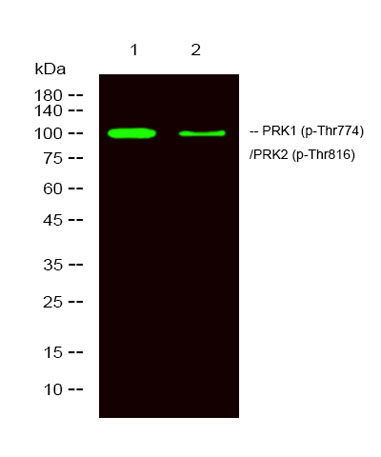
PRK1 (phospho-Thr774)/PRK2 (phospho-Thr816) rabbit pAb
AO-06-ES13956-50

| ELK.No | ES13956 |
| Product name | PRK1 (phospho-Thr774)/PRK2 (phospho-Thr816) rabbit pAb |
| Reactivity | Human;Mouse;Rat |
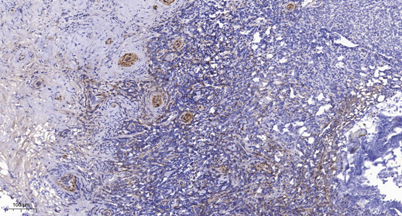
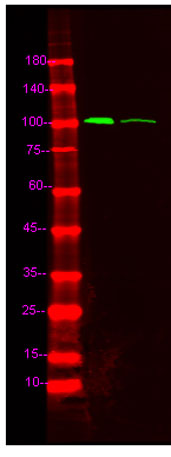
| Applications | WB;ELISA;IHC |
| Other name | Serine/threonine-protein kinase N1 (EC 2.7.11.13) (Protease-activated kinase 1) (PAK-1) (Protein kinase C-like 1) (Protein kinase C-like PKN) (Protein kinase PKN-alpha) (Protein-kinase C-related kinase 1) (Serine-threonine protein kinase N) |
| Size | 50μL |
| Unit price ($) | 148 |
| Human gene ID | 5585 |
| Human Swiss-Prot | Q16512 |
| Source | Rabbit |
| Isotype | IgG |
| Target | PRK1 |
| Fields | >>PI3K-Akt signaling pathway;>>NOD-like receptor signaling pathway;>>Salmonella infection;>>Yersinia infection |
| Gene name | |
| Protein name | PRK1 (Thr774)/PRK2 (Thr816) |
| Human gene link | View Human Gene |
| Human Swiss link | View Human Swiss-Prot |
| Mouse gene ID | 320795 |
| Mouse gene link | View Mouse Gene |
| Mouse Swiss-Prot | P70268 |
| Mouse Swiss link | View Mouse Swiss-Prot |
| Rat gene ID | 29355 |
| Rat gene link | View Rat Gene |
| Rat Swiss-Prot | Q63433 |
| Rat Swiss link | View Rat Swiss-Prot |
| Immunogen | Synthesized phosho peptide around human PRK1 (Thr774) and PRK2 (Thr816) |
| Specificity | This antibody detects endogenous levels of Human Mouse Rat PRK1 (phospho-Thr774) or PRK2 (phospho-Thr816) |
| Formulation | Liquid in PBS containing 50% glycerol, 0.5% BSA and 0.02% sodium azide. |
| Clonality | Polyclonal |
| Dilution | WB 1:500-2000;IHC-p 1:50-300; ELISA 2000-20000 |
| Purification | The antibody was affinity-purified from rabbit serum by affinity-chromatography using specific immunogen. |
| Concentration | 1 mg/ml |
| Storage stability | -20°C/1 year |
| Molecular Weight (Da) | |
| Observed band (KD) | 103kD |
| Background | protein kinase N1(PKN1) Homo sapiens The protein encoded by this gene belongs to the protein kinase C superfamily. This kinase is activated by Rho family of small G proteins and may mediate the Rho-dependent signaling pathway. This kinase can be activated by phospholipids and by limited proteolysis. The 3-phosphoinositide dependent protein kinase-1 (PDPK1/PDK1) is reported to phosphorylate this kinase, which may mediate insulin signals to the actin cytoskeleton. The proteolytic activation of this kinase by caspase-3 or related proteases during apoptosis suggests its role in signal transduction related to apoptosis. Alternatively spliced transcript variants encoding distinct isoforms have been observed. [provided by RefSeq, Jul 2008], |
| Function | catalytic activity:ATP + a protein = ADP + a phosphoprotein.,domain:The C1 domain does not bind the diacylglycerol (DAG).,enzyme regulation:Activated by lipids, particularly cardiolipin and to a lesser extent by other acidic phospholipids. Two specific sites, Thr-774 (activation loop of the kinase domain) and Ser-916 (turn motif), need to be phosphorylated for its full activation.,function:Can phosphorylate ribosomal protein S6. Mediates GTPase Rho dependent intracellular signaling.,PTM:Activated by limited proteolysis with trypsin.,PTM:Autophosphorylated; preferably on serine.,similarity:Belongs to the protein kinase superfamily.,similarity:Belongs to the protein kinase superfamily. AGC Ser/Thr protein kinase family. PKC subfamily.,similarity:Contains 1 AGC-kinase C-terminal domain.,similarity:Contains 1 C2 domain.,similarity:Contains 1 protein kinase domain.,similarity:Contains 3 REM ( |
| Subcellular location | Cytoplasm . Nucleus . Endosome . Cell membrane ; Peripheral membrane protein . Cleavage furrow . Midbody . Associates with chromatin in a ligand-dependent manner. Localization to endosomes is mediated via its interaction with RHOB. Association to the cell membrane is dependent on Ser-377 phosphorylation. Accumulates during telophase at the cleavage furrow and finally concentrates around the midbody in cytokinesis. . |
| Expression | Found ubiquitously. Expressed in heart, brain, placenta, lung, skeletal muscle, kidney and pancreas. Expressed in numerous tumor cell lines, especially in breast tumor cells. |

Use collapsible tabs for more detailed information that will help customers make a purchasing decision.
Ex: Shipping and return policies, size guides, and other common questions.