 Français
 English

| ELK.No | ES14063 |
| Product name | PLOD1 rabbit pAb |
| Reactivity | Human; Mouse;Rat |
| Applications | WB;ELISA;IHC |
| Other name | |
| Size | 50μL |
| Unit price ($) | 148 |
| Human gene ID | 5351 |
| Human Swiss-Prot | Q02809 |
| Source | Rabbit |
| Isotype | IgG |
| Target | PLOD1 |
| Fields | >>Lysine degradation;>>Metabolic pathways |
| Gene name | PLOD1 LLH PLOD |
| Protein name | PLOD1 |
| Human gene link | View Human Gene |
| Human Swiss link | View Human Swiss-Prot |
| Mouse gene ID | 18822 |
| Mouse gene link | View Mouse Gene |
| Mouse Swiss-Prot | Q9R0E2 |
| Mouse Swiss link | View Mouse Swiss-Prot |
| Rat gene ID | |
| Rat gene link | |
| Rat Swiss-Prot | Q63321 |
| Rat Swiss link | View Rat Swiss-Prot |
| Immunogen | Synthesized peptide derived from human PLOD1 AA range: 551-601 |
| Specificity | This antibody detects endogenous levels of PLOD1 at Human/Mouse/Rat |
| Formulation | Liquid in PBS containing 50% glycerol, 0.5% BSA and 0.02% sodium azide. |
| Clonality | Polyclonal |
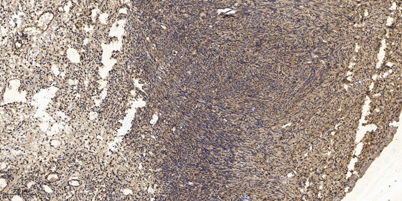
| Dilution | WB 1:500-2000;IHC-p 1:50-300; ELISA 2000-20000 |
| Purification | The antibody was affinity-purified from rabbit serum by affinity-chromatography using specific immunogen. |
| Concentration | 1 mg/ml |
| Storage stability | -20°C/1 year |
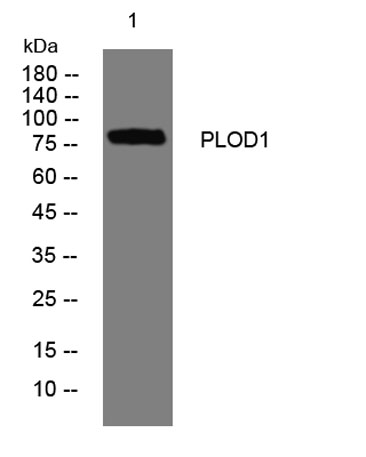
| Molecular Weight (Da) | 80kD |
| Observed band (KD) | |
| Background | Lysyl hydroxylase is a membrane-bound homodimeric protein localized to the cisternae of the endoplasmic reticulum. The enzyme (cofactors iron and ascorbate) catalyzes the hydroxylation of lysyl residues in collagen-like peptides. The resultant hydroxylysyl groups are attachment sites for carbohydrates in collagen and thus are critical for the stability of intermolecular crosslinks. Some patients with Ehlers-Danlos syndrome type VI have deficiencies in lysyl hydroxylase activity. Two transcript variants encoding different isoforms have been found for this gene. [provided by RefSeq, Oct 2015], |
| Function | catalytic activity:Procollagen L-lysine + 2-oxoglutarate + O(2) = procollagen 5-hydroxy-L-lysine + succinate + CO(2).,cofactor:Ascorbate.,cofactor:Iron.,disease:Defects in PLOD1 are the cause of Ehlers-Danlos syndrome type 6 (EDS6) [MIM:225400]. EDS is a connective tissue disorder characterized by hyperextensible skin, atrophic cutaneous scars due to tissue fragility and joint hyperlaxity. EDS6 is characterized by the presence of ocular complications, particularly retinal detachment.,disease:Defects in PLOD1 are the cause of Nevo syndrome [MIM:601451]. This is a rare, autosomal recessive disorder characterized by increased perinatal length, kyphosis, muscular hypotonia, and joint laxity. Nevo syndrome and EDS-VI have similar clinical phenotypes. Some authors consider that both syndromes are the same clinical entity.,function:Forms hydroxylysine residues in -Xaa-Lys-Gly- sequences in coll |
| Subcellular location | Rough endoplasmic reticulum membrane; Peripheral membrane protein; Lumenal side. |
| Expression |

Use collapsible tabs for more detailed information that will help customers make a purchasing decision.
Ex: Shipping and return policies, size guides, and other common questions.