 Français
 English

| ELK.No | ES14151 |
| Product name | PGDH rabbit pAb |
| Reactivity | Human; Mouse;Rat |
| Applications | WB |
| Other name | |
| Size | 50μL |
| Unit price ($) | 148 |
| Human gene ID | 3248 |
| Human Swiss-Prot | P15428 |
| Source | Rabbit |
| Isotype | IgG |
| Target | PGDH |
| Fields | >>Transcriptional misregulation in cancer |
| Gene name | HPGD PGDH1 |
| Protein name | PGDH |
| Human gene link | View Human Gene |
| Human Swiss link | View Human Swiss-Prot |
| Mouse gene ID | 15446 |
| Mouse gene link | View Mouse Gene |
| Mouse Swiss-Prot | Q8VCC1 |
| Mouse Swiss link | View Mouse Swiss-Prot |
| Rat gene ID | 79242 |
| Rat gene link | View Rat Gene |
| Rat Swiss-Prot | O08699 |
| Rat Swiss link | View Rat Swiss-Prot |
| Immunogen | Synthesized peptide derived from human PGDH AA range: 192-242 |
| Specificity | This antibody detects endogenous levels of PGDH at Human/Mouse/Rat |
| Formulation | Liquid in PBS containing 50% glycerol, 0.5% BSA and 0.02% sodium azide. |
| Clonality | Polyclonal |
| Dilution | WB 1:500-2000 |
| Purification | The antibody was affinity-purified from rabbit serum by affinity-chromatography using specific immunogen. |
| Concentration | 1 mg/ml |
| Storage stability | -20°C/1 year |
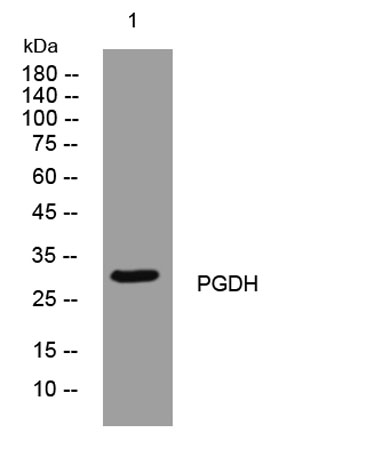
| Molecular Weight (Da) | 29kD |
| Observed band (KD) | |
| Background | This gene encodes a member of the short-chain nonmetalloenzyme alcohol dehydrogenase protein family. The encoded enzyme is responsible for the metabolism of prostaglandins, which function in a variety of physiologic and cellular processes such as inflammation. Mutations in this gene result in primary autosomal recessive hypertrophic osteoarthropathy and cranioosteoarthropathy. Multiple transcript variants encoding different isoforms have been found for this gene. [provided by RefSeq, Mar 2009], |
| Function | catalytic activity:(5Z,13E,15S)-11-alpha,15-dihydroxy-9-oxoprost-5,13-dienoate + NAD(+) = (5Z,13E)-11-alpha-hydroxy-9,15-dioxoprost-5,13-dienoate + NADH.,disease:Defects in HPGD are the cause of cranioosteoarthropathy (COA) [MIM:259100]. Clinical features include infantile onset of swelling of the joints, digital clubbing, hyperhidrosis, delayed closure of the fontanels, periostosis, and variable patent ductus arteriosus. Pachydermia is not a prominent feature.,disease:Defects in HPGD are the cause of primary hypertrophic osteoathropathy autosomal recessive (PHOAR) [MIM:259100]; also known as pachydermoperiostosis autosomal recessive. Primary hypertrophic osteoarthropathy is characterized by digital clubbing, osterarthropathy, variable features of pachydermia, delayed closure of the fontanels, and congenital heart disease.,function:Inactivation of prostaglandins.,similarity:Belongs to th |
| Subcellular location | Cytoplasm. |
| Expression | Detected in colon epithelium (at protein level). |

Use collapsible tabs for more detailed information that will help customers make a purchasing decision.
Ex: Shipping and return policies, size guides, and other common questions.