 Français
 English
HDAC2 (phospho Ser394) rabbit pAb
AO-06-ES1417-100

| ELK.No | ES1417 |
| Product name | HDAC2 (phospho Ser394) rabbit pAb |
| Reactivity | Human;Mouse;Rat;Monkey |
| Applications | WB;ELISA |
| Other name | HDAC2; Histone deacetylase 2; HD2 |
| Size | 100μL |
| Unit price ($) | 248 |
| Human gene ID | 3066 |
| Human Swiss-Prot | Q92769 |
| Source | Rabbit |
| Isotype | IgG |
| Target | HDAC2 |
| Fields | >>Cell cycle;>>Longevity regulating pathway - multiple species;>>Notch signaling pathway;>>Neutrophil extracellular trap formation;>>Thyroid hormone signaling pathway;>>Huntington disease;>>Amphetamine addiction;>>Alcoholism;>>Human papillomavirus infection;>>Epstein-Barr virus infection;>>Pathways in cancer;>>Transcriptional misregulation in cancer;>>Viral carcinogenesis;>>MicroRNAs in cancer;>>Chronic myeloid leukemia |
| Gene name | HDAC2 |
| Protein name | Histone deacetylase 2 |
| Human gene link | View Human Gene |
| Human Swiss link | View Human Swiss-Prot |
| Mouse gene ID | 15182 |
| Mouse gene link | View Mouse Gene |
| Mouse Swiss-Prot | P70288 |
| Mouse Swiss link | View Mouse Swiss-Prot |
| Rat gene ID | |
| Rat gene link | |
| Rat Swiss-Prot | |
| Rat Swiss link | |
| Immunogen | The antiserum was produced against synthesized peptide derived from human HDAC2 around the phosphorylation site of Ser394. AA range:360-409 |
| Specificity | Phospho-HDAC2 (S394) Polyclonal Antibody detects endogenous levels of HDAC2 protein only when phosphorylated at S394. |
| Formulation | Liquid in PBS containing 50% glycerol, 0.5% BSA and 0.02% sodium azide. |
| Clonality | Polyclonal |
| Dilution | Western Blot: 1/500 - 1/2000. ELISA: 1/20000. Not yet tested in other applications. |
| Purification | The antibody was affinity-purified from rabbit antiserum by affinity-chromatography using epitope-specific immunogen. |
| Concentration | 1 mg/ml |
| Storage stability | -20°C/1 year |
| Molecular Weight (Da) | |
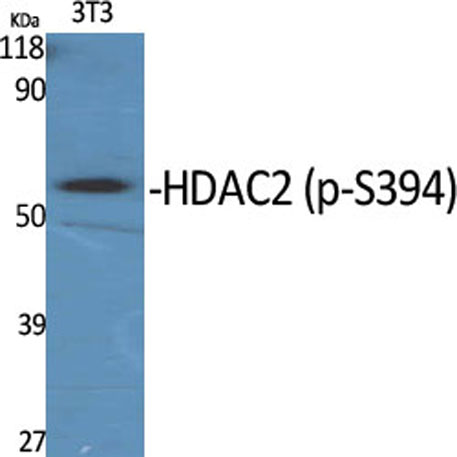
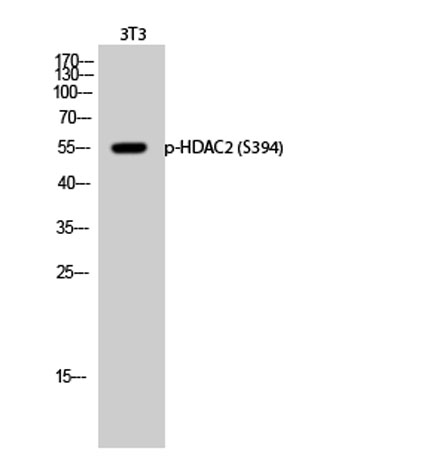
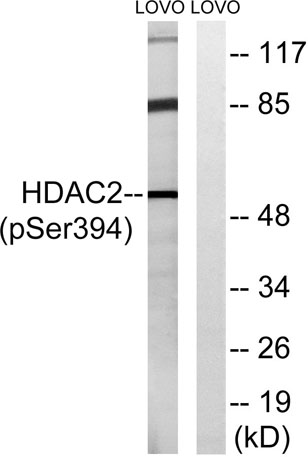
| Observed band (KD) | 55kD |
| Background | This gene product belongs to the histone deacetylase family. Histone deacetylases act via the formation of large multiprotein complexes, and are responsible for the deacetylation of lysine residues at the N-terminal regions of core histones (H2A, H2B, H3 and H4). This protein forms transcriptional repressor complexes by associating with many different proteins, including YY1, a mammalian zinc-finger transcription factor. Thus, it plays an important role in transcriptional regulation, cell cycle progression and developmental events. Alternative splicing results in multiple transcript variants. [provided by RefSeq, Apr 2010], |
| Function | catalytic activity:Hydrolysis of an N(6)-acetyl-lysine residue of a histone to yield a deacetylated histone.,function:Forms transcriptional repressor complexes by associating with MAD, SIN3, YY1 and N-COR. Interacts in the late S-phase of DNA-replication with DNMT1 in the other transcriptional repressor complex composed of DNMT1, DMAP1, PCNA, CAF1.,function:Responsible for the deacetylation of lysine residues on the N-terminal part of the core histones (H2A, H2B, H3 and H4). Histone deacetylation gives a tag for epigenetic repression and plays an important role in transcriptional regulation, cell cycle progression and developmental events. Histone deacetylases act via the formation of large multiprotein complexes.,sequence caution:Intron retention.,similarity:Belongs to the histone deacetylase family. Type 1 subfamily.,subunit:Interacts with the non-histone region of H2AFY (By similarity |
| Subcellular location | Nucleus . Cytoplasm . |
| Expression | Widely expressed; lower levels in brain and lung. |

Use collapsible tabs for more detailed information that will help customers make a purchasing decision.
Ex: Shipping and return policies, size guides, and other common questions.