 Français
 English

| ELK.No | ES14318 |
| Product name | P4HA3 rabbit pAb |
| Reactivity | Human; Mouse;Rat |
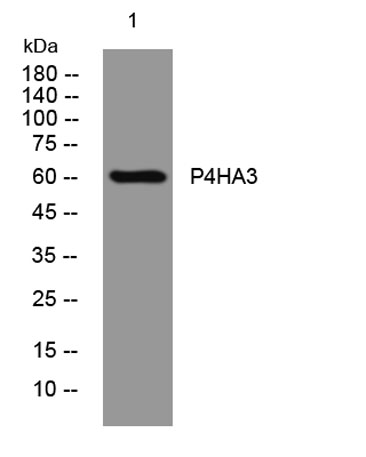
| Applications | WB |
| Other name | |
| Size | 50μL |
| Unit price ($) | 148 |
| Human gene ID | 283208 |
| Human Swiss-Prot | Q7Z4N8 |
| Source | Rabbit |
| Isotype | IgG |
| Target | P4HA3 |
| Fields | >>Arginine and proline metabolism;>>Metabolic pathways |
| Gene name | P4HA3 UNQ711/PRO1374 |
| Protein name | P4HA3 |
| Human gene link | View Human Gene |
| Human Swiss link | View Human Swiss-Prot |
| Mouse gene ID | |
| Mouse gene link | |
| Mouse Swiss-Prot | Q6W3F0 |
| Mouse Swiss link | View Mouse Swiss-Prot |
| Rat gene ID | 361612 |
| Rat gene link | View Rat Gene |
| Rat Swiss-Prot | Q6W3E9 |
| Rat Swiss link | View Rat Swiss-Prot |
| Immunogen | Synthesized peptide derived from human P4HA3 AA range: 211-261 |
| Specificity | This antibody detects endogenous levels of P4HA3 at Human/Mouse/Rat |
| Formulation | Liquid in PBS containing 50% glycerol, 0.5% BSA and 0.02% sodium azide. |
| Clonality | Polyclonal |
| Dilution | WB 1:500-2000 |
| Purification | The antibody was affinity-purified from rabbit serum by affinity-chromatography using specific immunogen. |
| Concentration | 1 mg/ml |
| Storage stability | -20°C/1 year |
| Molecular Weight (Da) | 60kD |
| Observed band (KD) | |
| Background | This gene encodes a component of prolyl 4-hydroxylase, a key enzyme in collagen synthesis composed of two identical alpha subunits and two beta subunits. The encoded protein is one of several different types of alpha subunits and provides the major part of the catalytic site of the active enzyme. In collagen and related proteins, prolyl 4-hydroxylase catalyzes the formation of 4-hydroxyproline that is essential to the proper three-dimensional folding of newly synthesized procollagen chains. Alternative splicing results in multiple transcript variants. [provided by RefSeq, Jan 2014], |
| Function | catalytic activity:Procollagen L-proline + 2-oxoglutarate + O(2) = procollagen trans-4-hydroxy-L-proline + succinate + CO(2).,cofactor:Ascorbate.,cofactor:Binds 1 Fe(2+) ion per subunit.,function:Catalyzes the post-translational formation of 4-hydroxyproline in -Xaa-Pro-Gly- sequences in collagens and other proteins.,PTM:N-glycosylation plays no role in the catalytic activity.,similarity:Belongs to the P4HA family.,similarity:Contains 1 PKHD (prolyl/lysyl hydroxylase) domain.,similarity:Contains 1 TPR repeat.,subunit:Heterotetramer of two alpha-3 chains and two beta chains (the beta chain is the multi-functional PDI).,tissue specificity:Highly expressed in placenta, liver and fetal skin. Weakly expressed in fetal epiphyseal cartilage, fetal liver, fibroblast, lung and skeletal muscle. Expressed also in fibrous cap of carotid atherosclerotic lesions., |
| Subcellular location | Endoplasmic reticulum lumen . |
| Expression | Highly expressed in placenta, liver and fetal skin. Weakly expressed in fetal epiphyseal cartilage, fetal liver, fibroblast, lung and skeletal muscle. Expressed also in fibrous cap of carotid atherosclerotic lesions. |

Use collapsible tabs for more detailed information that will help customers make a purchasing decision.
Ex: Shipping and return policies, size guides, and other common questions.