 Français
 English

| ELK.No | ES13271 |
| Product name | S12A3 rabbit pAb |
| Reactivity | Human; Mouse;Rat |
| Applications | WB |
| Other name | |
| Size | 50μL |
| Unit price ($) | 148 |
| Human gene ID | 6559 |
| Human Swiss-Prot | P55017 |
| Source | Rabbit |
| Isotype | IgG |
| Target | S12A3 |
| Fields | |
| Gene name | SLC12A3 TSC |
| Protein name | S12A3 |
| Human gene link | View Human Gene |
| Human Swiss link | View Human Swiss-Prot |
| Mouse gene ID | 20497 |
| Mouse gene link | View Mouse Gene |
| Mouse Swiss-Prot | P59158 |
| Mouse Swiss link | View Mouse Swiss-Prot |
| Rat gene ID | 54300 |
| Rat gene link | View Rat Gene |
| Rat Swiss-Prot | P55018 |
| Rat Swiss link | View Rat Swiss-Prot |
| Immunogen | Synthesized peptide derived from human S12A3 AA range: 947-997 |
| Specificity | This antibody detects endogenous levels of S12A3 at Human/Mouse/Rat |
| Formulation | Liquid in PBS containing 50% glycerol, 0.5% BSA and 0.02% sodium azide. |
| Clonality | Polyclonal |
| Dilution | WB 1:500-2000 |
| Purification | The antibody was affinity-purified from rabbit serum by affinity-chromatography using specific immunogen. |
| Concentration | 1 mg/ml |
| Storage stability | -20°C/1 year |
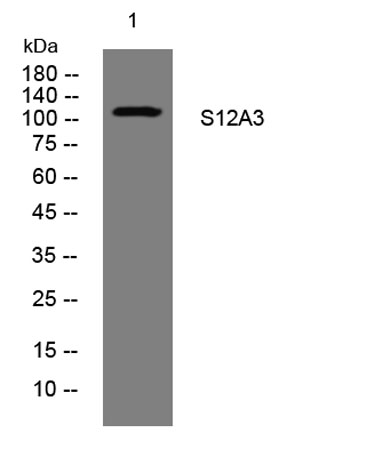
| Molecular Weight (Da) | 112kD |
| Observed band (KD) | |
| Background | This gene encodes a renal thiazide-sensitive sodium-chloride cotransporter that is important for electrolyte homeostasis. This cotransporter mediates sodium and chloride reabsorption in the distal convoluted tubule. Mutations in this gene cause Gitelman syndrome, a disease similar to Bartter's syndrome, that is characterized by hypokalemic alkalosis combined with hypomagnesemia, low urinary calcium, and increased renin activity associated with normal blood pressure. This cotransporter is the target for thiazide diuretics that are used for treating high blood pressure. Multiple transcript variants encoding different isoforms have been found for this gene. [provided by RefSeq, Jul 2008], |
| Function | disease:Defects in SLC12A3 are the cause of Gitelman syndrome (GS) [MIM:263800]. GS is an autosomal recessive disorder characterized by hypokalemic alkalosis in combination with hypomagnesemia, low urinary calcium, and increased renin activity associated with normal blood pressure. Patients are often asymptomatic or present transient periods of muscular weakness and tetany, usually accompanied by abdominal pain, vomiting and fever. The phenotype is highly heterogeneous in terms of age at onset and severity. Cardinal features such as hypocalciuria and hypomagnesemia might also change during the life cycle of a given patient. GS has overlapping features with Bartter syndrome.,function:Electrically silent transporter system. Mediates sodium and chloride reabsorption.,similarity:Belongs to the SLC12A transporter family.,tissue specificity:Predominant in kidney., |
| Subcellular location | Cell membrane ; Multi-pass membrane protein . Apical cell membrane ; Multi-pass membrane protein . |
| Expression | Predominantly expressed in the kidney (at protein level) (PubMed:29993276, PubMed:8812482). Localizes to the distal convoluted tubules (at protein level)(PubMed:29993276). Not detected in normal aorta, but abundantly expressed in fatty streaks and advanced atherosclerotic lesions (at protein level) (PubMed:26099046). |

Use collapsible tabs for more detailed information that will help customers make a purchasing decision.
Ex: Shipping and return policies, size guides, and other common questions.
