 Français
 English

| ELK.No | ES13323 |
| Product name | RSPO4 rabbit pAb |
| Reactivity | Human; Mouse |
| Applications | WB |
| Other name | |
| Size | 100μL |
| Unit price ($) | 248 |
| Human gene ID | 343637 |
| Human Swiss-Prot | Q2I0M5 |
| Source | Rabbit |
| Isotype | IgG |
| Target | RSPO4 |
| Fields | >>Wnt signaling pathway |
| Gene name | RSPO4 C20orf182 |
| Protein name | RSPO4 |
| Human gene link | View Human Gene |
| Human Swiss link | View Human Swiss-Prot |
| Mouse gene ID | 228770 |
| Mouse gene link | View Mouse Gene |
| Mouse Swiss-Prot | Q8BJ73 |
| Mouse Swiss link | View Mouse Swiss-Prot |
| Rat gene ID | |
| Rat gene link | |
| Rat Swiss-Prot | |
| Rat Swiss link | |
| Immunogen | Synthesized peptide derived from human RSPO4 AA range: 43-93 |
| Specificity | This antibody detects endogenous levels of RSPO4 at Human/Mouse |
| Formulation | Liquid in PBS containing 50% glycerol, 0.5% BSA and 0.02% sodium azide. |
| Clonality | Polyclonal |
| Dilution | WB 1:500-2000 |
| Purification | The antibody was affinity-purified from rabbit serum by affinity-chromatography using specific immunogen. |
| Concentration | 1 mg/ml |
| Storage stability | -20°C/1 year |
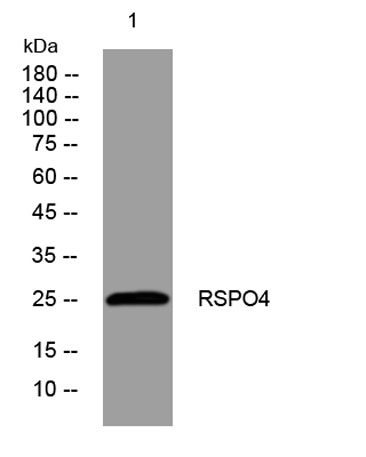
| Molecular Weight (Da) | 26kD |
| Observed band (KD) | |
| Background | This gene encodes a member of the R-spondin family of proteins that share a common domain organization consisting of a signal peptide, cysteine-rich/furin-like domain, thrombospondin domain and a C-terminal basic region. The encoded protein may be involved in activation of Wnt/beta-catenin signaling pathways. Mutations in this gene are associated with anonychia congenital. Alternate splicing results in multiple transcript variants.[provided by RefSeq, Sep 2009], |
| Function | disease:Defects in RSPO4 are the cause of anonychia [MIM:206800]. This is a rare autosomal recessive conditions in which the only presenting phenotype is the absence or severe hypoplasia of all fingernails and toenails.,domain:The FU repeat is required for activation and stabilization of beta-catenin.,function:Activator of the beta-catenin signaling cascade, leading to TCF-dependent gene activation. Acts both in the canonical Wnt/beta-catenin-dependent pathway, possibly via a direct interaction with Wnt proteins, and in a Wnt-independent beta catenin pathway through a receptor signaling pathway that may not use frizzled/LRP receptors.,miscellaneous:Upon injection into mice, it induces rapid onset of crypt cell proliferation involving beta-catenin stabilization. It also displays efficacy in a model of chemotherapy-induced intestinal mucositis.,PTM:Tyr-112 may be phosphorylated; however as |
| Subcellular location | Secreted . |
| Expression |

Use collapsible tabs for more detailed information that will help customers make a purchasing decision.
Ex: Shipping and return policies, size guides, and other common questions.
