 Français
 English


| ELK.No | ES14472 |
| Product name | NOD1 rabbit pAb |
| Reactivity | Human; Mouse |
| Applications | WB |
| Other name | Nucleotide-binding oligomerization domain-containing protein 1 (Caspase recruitment domain-containing protein 4) |
| Size | 100μL |
| Unit price ($) | 248 |
| Human gene ID | 10392 |
| Human Swiss-Prot | Q9Y239 |
| Source | Rabbit |
| Isotype | IgG |
| Target | NOD1 |
| Fields | >>NOD-like receptor signaling pathway;>>Epithelial cell signaling in Helicobacter pylori infection;>>Shigellosis;>>Salmonella infection;>>Pertussis |
| Gene name | NOD1 CARD4 |
| Protein name | NOD1 |
| Human gene link | View Human Gene |
| Human Swiss link | View Human Swiss-Prot |
| Mouse gene ID | 107607 |
| Mouse gene link | View Mouse Gene |
| Mouse Swiss-Prot | Q8BHB0 |
| Mouse Swiss link | View Mouse Swiss-Prot |
| Rat gene ID | |
| Rat gene link | |
| Rat Swiss-Prot | |
| Rat Swiss link | |
| Immunogen | Synthesized peptide derived from human NOD1 AA range: 290-340 |
| Specificity | This antibody detects endogenous levels of NOD1 at Human/Mouse |
| Formulation | Liquid in PBS containing 50% glycerol, 0.5% BSA and 0.224% sodium azide. |
| Clonality | Polyclonal |
| Dilution | WB 1:500-2000 |
| Purification | The antibody was affinity-purified from rabbit serum by affinity-chromatography using specific immunogen. |
| Concentration | 1 mg/ml |
| Storage stability | -20°C/1 year |
| Molecular Weight (Da) | |
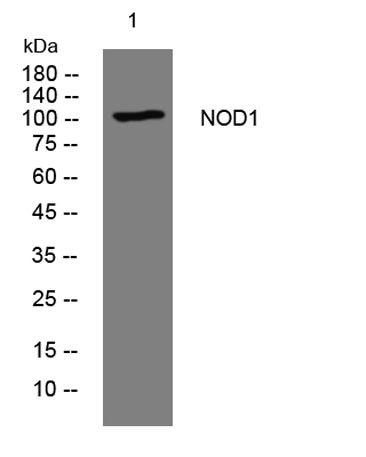
| Observed band (KD) | 105kD |
| Background | This gene encodes a member of the NOD (nucleotide-binding oligomerization domain) family. This member is a cytosolic protein. It contains an N-terminal caspase recruitment domain (CARD), a centrally located nucleotide-binding domain (NBD), and 10 tandem leucine-rich repeats (LRRs) in its C terminus. The CARD is involved in apoptotic signaling, LRRs participate in protein-protein interactions, and mutations in the NBD may affect the process of oligomerization and subsequent function of the LRR domain. This protein is an intracellular pattern-recognition receptor (PRR) that initiates inflammation in response to a subset of bacteria through the detection of bacterial diaminopimelic acid. Multiple alternatively spliced transcript variants differring in the 5' UTR have been described, but the full-length nature of these variants has not been determined. [provided by RefSeq, Oct 2009], |
| Function | function:Enhances caspase-9-mediated apoptosis. Induces NF-kappa-B activity via RIPK2 and IKK-gamma. Confers responsiveness to intracellular bacterial lipopolysaccharides (LPS).,similarity:Contains 1 CARD domain.,similarity:Contains 1 NACHT domain.,similarity:Contains 9 LRR (leucine-rich) repeats.,subunit:Self-associates. Binds to caspase-9 and RIPK2 by CARD-CARD interaction.,tissue specificity:Highly expressed in adult heart, skeletal muscle, pancreas, spleen and ovary. Also detected in placenta, lung, liver, kidney, thymus, testis, small intestine and colon., |
| Subcellular location | Cytoplasm. Cell membrane . Apical cell membrane. Basolateral cell membrane. Detected in the cytoplasm and at the cell membrane. Following bacterial infection, localizes to bacterial entry sites in the cell membrane. Recruited to the basolateral and apical membranes in polarized epithelial cells. |
| Expression | Highly expressed in adult heart, skeletal muscle, pancreas, spleen and ovary. Also detected in placenta, lung, liver, kidney, thymus, testis, small intestine and colon. |

Use collapsible tabs for more detailed information that will help customers make a purchasing decision.
Ex: Shipping and return policies, size guides, and other common questions.