 Français
 English


| ELK.No | ES15013 |
| Product name | MCCA rabbit pAb |
| Reactivity | Human; Mouse;Rat |
| Applications | WB;IHC |
| Other name | |
| Size | 100μL |
| Unit price ($) | 248 |
| Human gene ID | 56922 |
| Human Swiss-Prot | Q96RQ3 |
| Source | Rabbit |
| Isotype | IgG |
| Target | MCCA |
| Fields | >>Valine, leucine and isoleucine degradation;>>Metabolic pathways |
| Gene name | MCCC1 MCCA |
| Protein name | MCCA |
| Human gene link | View Human Gene |
| Human Swiss link | View Human Swiss-Prot |
| Mouse gene ID | 72039 |
| Mouse gene link | View Mouse Gene |
| Mouse Swiss-Prot | Q99MR8 |
| Mouse Swiss link | View Mouse Swiss-Prot |
| Rat gene ID | 294972 |
| Rat gene link | View Rat Gene |
| Rat Swiss-Prot | Q5I0C3 |
| Rat Swiss link | View Rat Swiss-Prot |
| Immunogen | Synthesized peptide derived from human MCCA AA range: 620-670 |
| Specificity | This antibody detects endogenous levels of MCCA at Human/Mouse/Rat |
| Formulation | Liquid in PBS containing 50% glycerol, 0.5% BSA and 0.02% sodium azide. |
| Clonality | Polyclonal |
| Dilution | WB 1:500-2000;IHC-p 1:50-300 |
| Purification | The antibody was affinity-purified from rabbit serum by affinity-chromatography using specific immunogen. |
| Concentration | 1 mg/ml |
| Storage stability | -20°C/1 year |
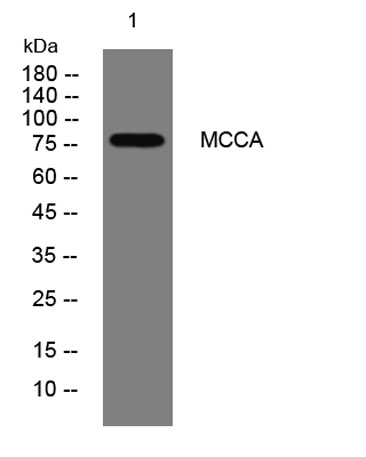
| Molecular Weight (Da) | 80kD |
| Observed band (KD) | |
| Background | This gene encodes the large subunit of 3-methylcrotonyl-CoA carboxylase. This enzyme functions as a heterodimer and catalyzes the carboxylation of 3-methylcrotonyl-CoA to form 3-methylglutaconyl-CoA. Mutations in this gene are associated with 3-Methylcrotonylglycinuria, an autosomal recessive disorder of leucine catabolism. [provided by RefSeq, Jul 2008], |
| Function | catalytic activity:ATP + 3-methylcrotonoyl-CoA + HCO(3)(-) = ADP + phosphate + 3-methylglutaconyl-CoA.,cofactor:Biotin.,disease:Defects in MCCC1 are the cause of methylcrotonoyl-CoA carboxylase deficiency type 1 (MCC1 deficiency) [MIM:210200]. MCC1 deficiency is an autosomal recessive disorder of leucine catabolism. The phenotype is variable, ranging from neonatal onset with severe neurological involvement to asymptomatic adults. There is a characteristic organic aciduria with massive excretion of 3-hydroxyisovaleric acid and 3-methylcrotonylglycine, usually in combination with a severe secondary carnitine deficiency.,pathway:Amino-acid degradation; L-leucine degradation; HMG-CoA from 3-isovaleryl-CoA: step 2/3.,similarity:Contains 1 ATP-grasp domain.,similarity:Contains 1 biotin carboxylation domain.,similarity:Contains 1 biotinyl-binding domain.,subunit:Probably a dodecamer composed of |
| Subcellular location | Mitochondrion matrix . |
| Expression |

Use collapsible tabs for more detailed information that will help customers make a purchasing decision.
Ex: Shipping and return policies, size guides, and other common questions.