 Français
 English


| ELK.No | ES15053 |
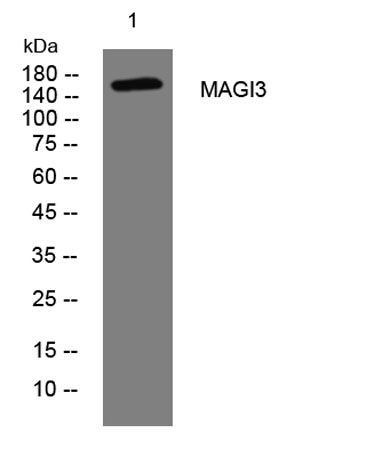
| Product name | MAGI3 rabbit pAb |
| Reactivity | Human; Mouse;Rat |
| Applications | WB |
| Other name | |
| Size | 50μL |
| Unit price ($) | 148 |
| Human gene ID | 260425 |
| Human Swiss-Prot | Q5TCQ9 |
| Source | Rabbit |
| Isotype | IgG |
| Target | MAGI3 |
| Fields | >>Rap1 signaling pathway |
| Gene name | MAGI3 KIAA1634 |
| Protein name | MAGI3 |
| Human gene link | View Human Gene |
| Human Swiss link | View Human Swiss-Prot |
| Mouse gene ID | 99470 |
| Mouse gene link | View Mouse Gene |
| Mouse Swiss-Prot | Q9EQJ9 |
| Mouse Swiss link | View Mouse Swiss-Prot |
| Rat gene ID | 245903 |
| Rat gene link | View Rat Gene |
| Rat Swiss-Prot | Q9JK71 |
| Rat Swiss link | View Rat Swiss-Prot |
| Immunogen | Synthesized peptide derived from human MAGI3 AA range: 927-977 |
| Specificity | This antibody detects endogenous levels of MAGI3 at Human/Mouse/Rat |
| Formulation | Liquid in PBS containing 50% glycerol, 0.5% BSA and 0.02% sodium azide. |
| Clonality | Polyclonal |
| Dilution | WB 1:500-2000 |
| Purification | The antibody was affinity-purified from rabbit serum by affinity-chromatography using specific immunogen. |
| Concentration | 1 mg/ml |
| Storage stability | -20°C/1 year |
| Molecular Weight (Da) | 166kD |
| Observed band (KD) | |
| Background | |
| Function | function:Acts as a scaffolding protein at cell-cell junctions, thereby regulating various cellular and signaling processes. Cooperates with PTEN to modulate the kinase activity of AKT1. Its interaction with PTPRB and tyrosine phosphorylated proteins suggests that it may link receptor tyrosine phosphatase with its substrates at the plasma membrane. In polarized epithelial cells, involved in efficient trafficking of TGFA to the cell surface. Regulates the ability of LPAR2 to activate ERK and RhoA pathways. Regulates the JNK signaling cascade via its interaction with FZD4 and VANGL2.,miscellaneous:MAGI3 PDZ domains are used to design peptide ligands that bind and inhibit PDZ domains.,PTM:Ubiquitinated following interaction with HPV E6 protein, leading to its degradation by the proteasome. Degradation is independent of E6AP ubiquitin ligase complex.,sequence caution:Translation N-terminally |
| Subcellular location | Cell membrane; Peripheral membrane protein. Cell junction, tight junction. Nucleus . Concentrates in specific sites at the plasma membrane and in the nucleus. In epithelial cells, it localizes at tight junctions (By similarity). . |
| Expression | Widely expressed. |

Use collapsible tabs for more detailed information that will help customers make a purchasing decision.
Ex: Shipping and return policies, size guides, and other common questions.