 Français
 English


| ELK.No | ES15306 |
| Product name | KIF5A rabbit pAb |
| Reactivity | Human; Mouse;Rat |
| Applications | WB;ELISA;IHC |
| Other name | |
| Size | 100μL |
| Unit price ($) | 248 |
| Human gene ID | 3798 |
| Human Swiss-Prot | Q12840 |
| Source | Rabbit |
| Isotype | IgG |
| Target | KIF5A |
| Fields | >>Endocytosis;>>Dopaminergic synapse;>>Alzheimer disease;>>Parkinson disease;>>Amyotrophic lateral sclerosis;>>Huntington disease;>>Prion disease;>>Pathways of neurodegeneration - multiple diseases;>>Salmonella infection;>>Non-small cell lung cancer |
| Gene name | KIF5A NKHC1 |
| Protein name | KIF5A |
| Human gene link | View Human Gene |
| Human Swiss link | View Human Swiss-Prot |
| Mouse gene ID | 16572 |
| Mouse gene link | View Mouse Gene |
| Mouse Swiss-Prot | P33175 |
| Mouse Swiss link | View Mouse Swiss-Prot |
| Rat gene ID | 314906 |
| Rat gene link | View Rat Gene |
| Rat Swiss-Prot | Q6QLM7 |
| Rat Swiss link | View Rat Swiss-Prot |
| Immunogen | Synthesized peptide derived from human KIF5A AA range: 213-263 |
| Specificity | This antibody detects endogenous levels of KIF5A at Human/Mouse/Rat |
| Formulation | Liquid in PBS containing 50% glycerol, 0.5% BSA and 0.02% sodium azide. |
| Clonality | Polyclonal |
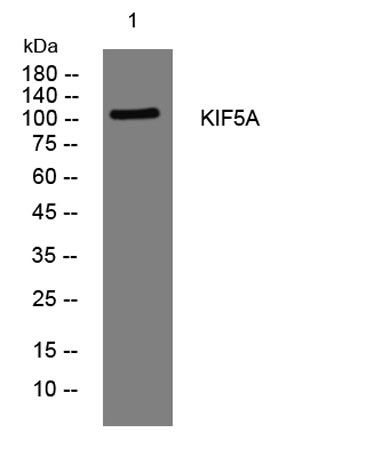
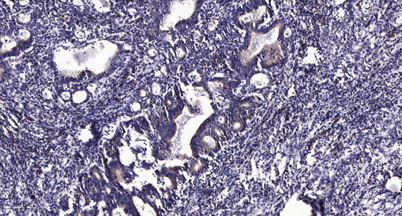
| Dilution | WB 1:500-2000;IHC-p 1:50-300; ELISA 2000-20000 |
| Purification | The antibody was affinity-purified from rabbit serum by affinity-chromatography using specific immunogen. |
| Concentration | 1 mg/ml |
| Storage stability | -20°C/1 year |
| Molecular Weight (Da) | 114kD |
| Observed band (KD) | |
| Background | This gene encodes a member of the kinesin family of proteins. Members of this family are part of a multisubunit complex that functions as a microtubule motor in intracellular organelle transport. Mutations in this gene cause autosomal dominant spastic paraplegia 10. [provided by RefSeq, Jul 2008], |
| Function | disease:Defects in KIF5A are the cause of spastic paraplegia type 10 (SPG10) [MIM:604187]. SPG10 is a form of autosomal dominant hereditary spastic paraplegia (AD-HSP). HSP is a group of inherited degenerative spinal cord disorders characterized by a slow, gradual, progressive weakness and spasticity (stiffness) of the legs. Rate of progression and the severity of symptoms is quite variable. Initial symptoms may include difficulty with balance, weakness and stiffness in the legs, muscle spasms, and dragging the toes when walking. In some forms of the disorder, bladder symptoms (such as incontinence) may appear, or the weakness and stiffness may spread to other parts of the body.,domain:Composed of three structural domains: a large globular N-terminal domain which is responsible for the motor activity of kinesin (it hydrolyzes ATP and binds microtubule), a central alpha-helical coiled coi |
| Subcellular location | Cytoplasm, perinuclear region . Cytoplasm, cytoskeleton . Perikaryon . Concentrated in the cell body of the neurons, particularly in the perinuclear region. . |
| Expression | Distributed throughout the CNS but is highly enriched in subsets of neurons. |

Use collapsible tabs for more detailed information that will help customers make a purchasing decision.
Ex: Shipping and return policies, size guides, and other common questions.