 Français
 English

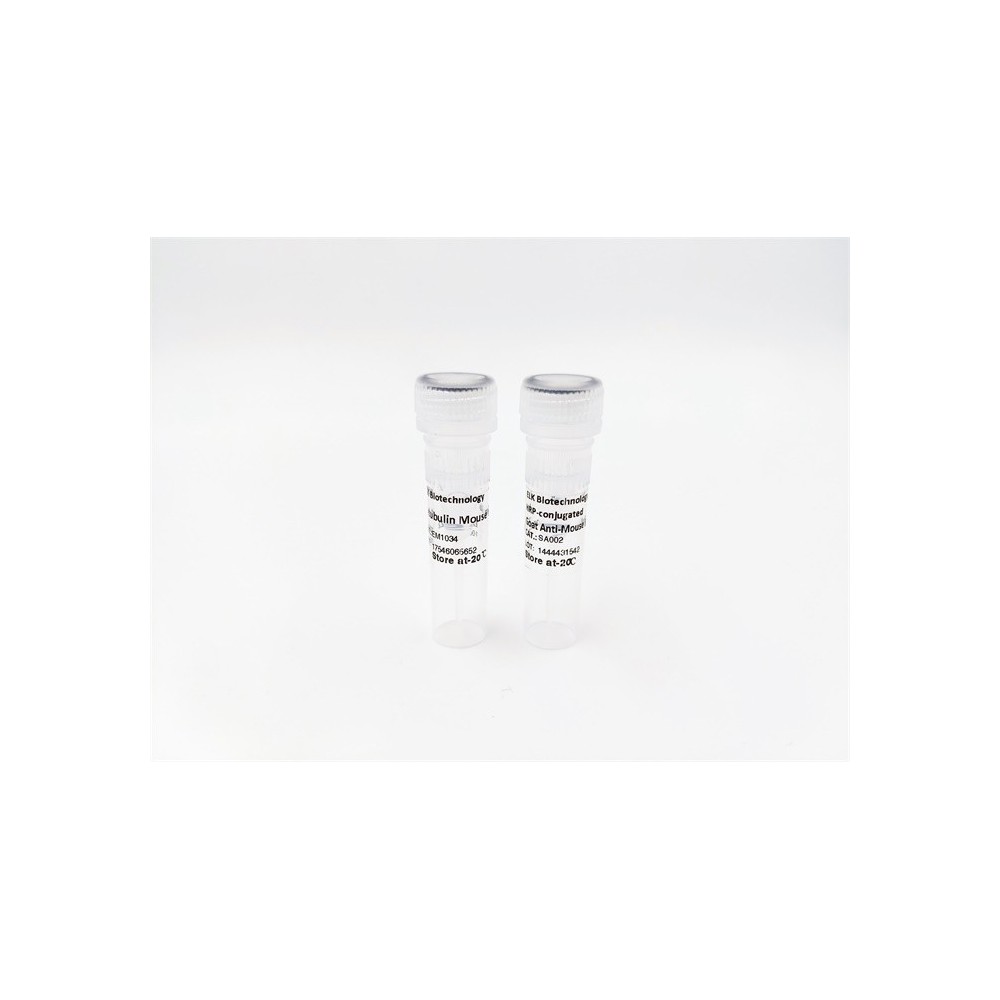
MLK3 (phospho Ser674) rabbit pAb
AO-06-ES1535-50

| ELK.No | ES1535 |
| Product name | MLK3 (phospho Ser674) rabbit pAb |
| Reactivity | Human;Mouse;Rat |
| Applications | WB;IHC |
| Other name | MAP3K11; MLK3; PTK1; SPRK; Mitogen-activated protein kinase kinase kinase 11; Mixed lineage kinase 3; Src-homology 3 domain-containing proline-rich kinase |
| Size | 50μL |
| Unit price ($) | 148 |
| Human gene ID | 4296 |
| Human Swiss-Prot | Q16584 |
| Source | Rabbit |
| Isotype | IgG |
| Target | MLK3 |
| Fields | >>MAPK signaling pathway;>>Non-alcoholic fatty liver disease |
| Gene name | MAP3K11 |
| Protein name | Mitogen-activated protein kinase kinase kinase 11 |
| Human gene link | View Human Gene |
| Human Swiss link | View Human Swiss-Prot |
| Mouse gene ID | 26403 |
| Mouse gene link | View Mouse Gene |
| Mouse Swiss-Prot | Q80XI6 |
| Mouse Swiss link | View Mouse Swiss-Prot |
| Rat gene ID | 309168 |
| Rat gene link | View Rat Gene |
| Rat Swiss-Prot | Q66HA1 |
| Rat Swiss link | View Rat Swiss-Prot |
| Immunogen | Synthesized phospho-peptide around the phosphorylation site of human MLK3 (phospho Ser674) |
| Specificity | Phospho-MLK3 (S674) Polyclonal Antibody detects endogenous levels of MLK3 protein only when phosphorylated at S674. |
| Formulation | Liquid in PBS containing 50% glycerol, 0.5% BSA and 0.02% sodium azide. |
| Clonality | Polyclonal |
| Dilution | WB 1:500-2000;IHC-p 1:50-300 |
| Purification | The antibody was affinity-purified from rabbit antiserum by affinity-chromatography using epitope-specific immunogen. |
| Concentration | 1 mg/ml |
| Storage stability | -20°C/1 year |
| Molecular Weight (Da) | 93kD |
| Observed band (KD) | |
| Background | The protein encoded by this gene is a member of the serine/threonine kinase family. This kinase contains a SH3 domain and a leucine zipper-basic motif. This kinase preferentially activates MAPK8/JNK kinase, and functions as a positive regulator of JNK signaling pathway. This kinase can directly phosphorylate, and activates IkappaB kinase alpha and beta, and is found to be involved in the transcription activity of NF-kappaB mediated by Rho family GTPases and CDC42. [provided by RefSeq, Jul 2008], |
| Function | catalytic activity:ATP + a protein = ADP + a phosphoprotein.,cofactor:Magnesium.,enzyme regulation:Homodimerization via the leucine zipper domains is required for autophosphorylation and subsequent activation.,function:Activates the JUN N-terminal pathway. Required for serum-stimulated cell proliferation and for mitogen and cytokine activation of MAPK14 (p38), MAPK3 (ERK) and MAPK8 (JNK1). Plays a role in mitogen-stimulated phosphorylation and activation of BRAF, but does not phosphorylate BRAF directly. Influences microtubule organization during the cell cycle.,PTM:Autophosphorylation on serine and threonine residues within the activation loop plays a role in enzyme activation. Thr-277 is likely to be the main autophosphorylation site. Phosphorylation of Ser-555 and Ser-556 is induced by CDC42.,similarity:Belongs to the protein kinase superfamily. STE Ser/Thr protein kinase family. MAP |
| Subcellular location | Cytoplasm, cytoskeleton, microtubule organizing center, centrosome . Location is cell cycle dependent. |
| Expression | Expressed in a wide variety of normal and neoplastic tissues including fetal lung, liver, heart and kidney, and adult lung, liver, heart, kidney, placenta, skeletal muscle, pancreas and brain. |



Use collapsible tabs for more detailed information that will help customers make a purchasing decision.
Ex: Shipping and return policies, size guides, and other common questions.