 Français
 English

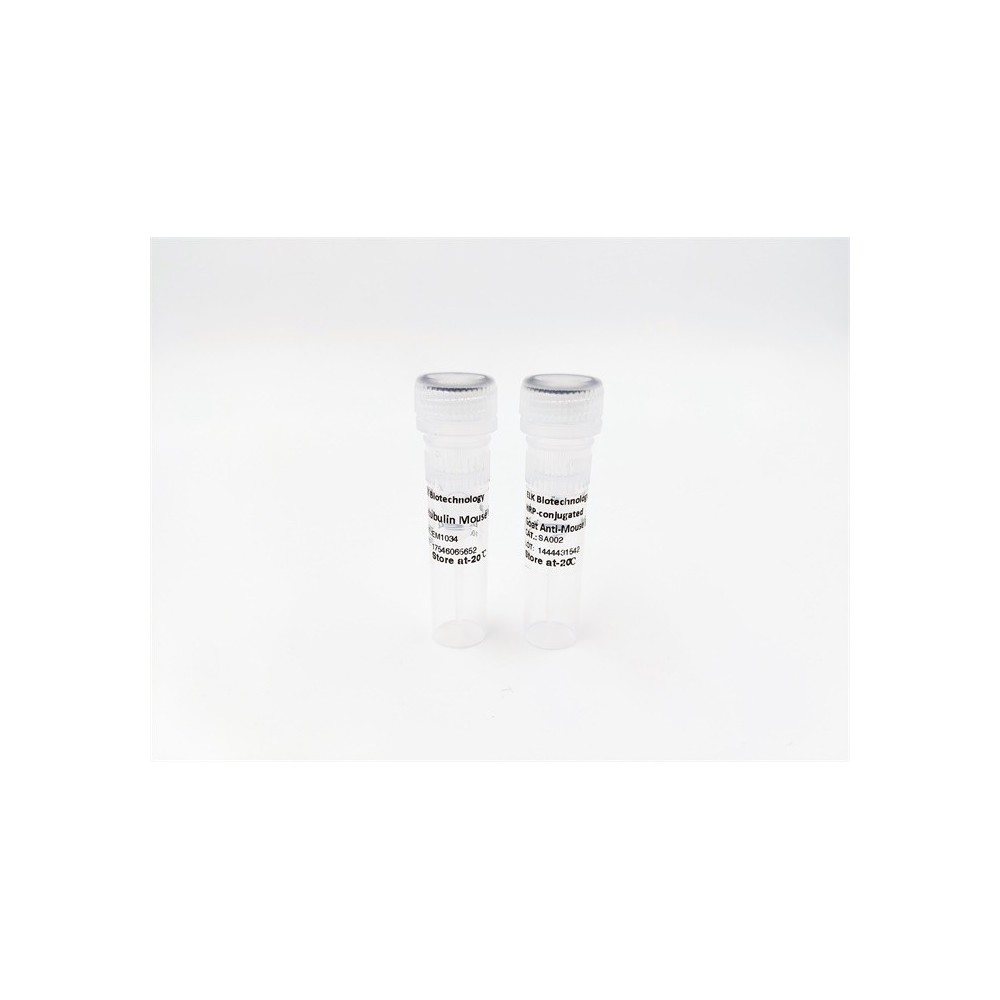

| ELK.No | ES15353 |
| Product name | KBTBA rabbit pAb |
| Reactivity | Human;Rat |
| Applications | WB;IHC |
| Other name | |
| Size | 100μL |
| Unit price ($) | 248 |
| Human gene ID | 10324 |
| Human Swiss-Prot | O60662 |
| Source | Rabbit |
| Isotype | IgG |
| Target | KBTBA |
| Fields | |
| Gene name | KBTBD10 KRP1 |
| Protein name | KBTBA |
| Human gene link | View Human Gene |
| Human Swiss link | View Human Swiss-Prot |
| Mouse gene ID | |
| Mouse gene link | |
| Mouse Swiss-Prot | |
| Mouse Swiss link | |
| Rat gene ID | 117537 |
| Rat gene link | View Rat Gene |
| Rat Swiss-Prot | Q9ER30 |
| Rat Swiss link | View Rat Swiss-Prot |
| Immunogen | Synthesized peptide derived from human KBTBA AA range: 268-318 |
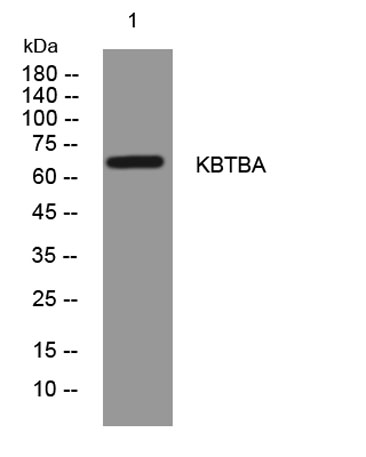
| Specificity | This antibody detects endogenous levels of KBTBA at Human/Rat |
| Formulation | Liquid in PBS containing 50% glycerol, 0.5% BSA and 0.02% sodium azide. |
| Clonality | Polyclonal |
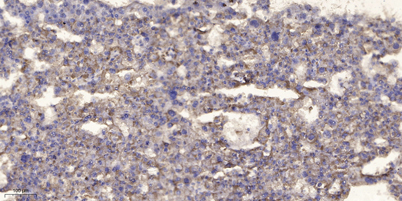
| Dilution | WB 1:500-2000;IHC-p 1:50-300 |
| Purification | The antibody was affinity-purified from rabbit serum by affinity-chromatography using specific immunogen. |
| Concentration | 1 mg/ml |
| Storage stability | -20°C/1 year |
| Molecular Weight (Da) | 67kD |
| Observed band (KD) | |
| Background | This gene is a member of the kelch-like family. The encoded protein contains a BACK domain, a BTB/POZ domain, and 5 Kelch repeats. This protein is thought to function in skeletal muscle development and maintenance. Mutations in this gene have been associated with nemaline myopathy (NM), a rare congenital muscle disorder. [provided by RefSeq, Mar 2015], |
| Function | function:Required for pseudopod elongation in transformed cells. Substrate-specific adapter of an E3 ubiquitin-protein ligase complex which mediates the ubiquitination and subsequent proteasomal degradation of target proteins.,pathway:Protein modification; protein ubiquitination.,PTM:Ubiquitinated and probably targeted for proteasome-independent degradation.,similarity:Contains 1 BTB (POZ) domain.,similarity:Contains 5 Kelch repeats.,subcellular location:Predominantly cytoplasmic but can co-localize with F-actin at the membrane ruffle-like structures at the tips of transformation-specific pseudopodia.,subunit:Interacts with NRAP (By similarity). Part of a complex that contains CUL3, RBX1 and KBTBD10.,tissue specificity:Sarcomeric muscle., |
| Subcellular location | Cytoplasm . Cytoplasm, cytoskeleton . Cell projection, pseudopodium . Cell projection, ruffle . Cytoplasm, myofibril, sarcomere, M line . Sarcoplasmic reticulum membrane . Endoplasmic reticulum membrane . Predominantly cytoplasmic but can colocalize with F-actin at the membrane ruffle-like structures at the tips of transformation-specific pseudopodia. . |
| Expression | Sarcomeric muscle. |

Use collapsible tabs for more detailed information that will help customers make a purchasing decision.
Ex: Shipping and return policies, size guides, and other common questions.