 Français
 English

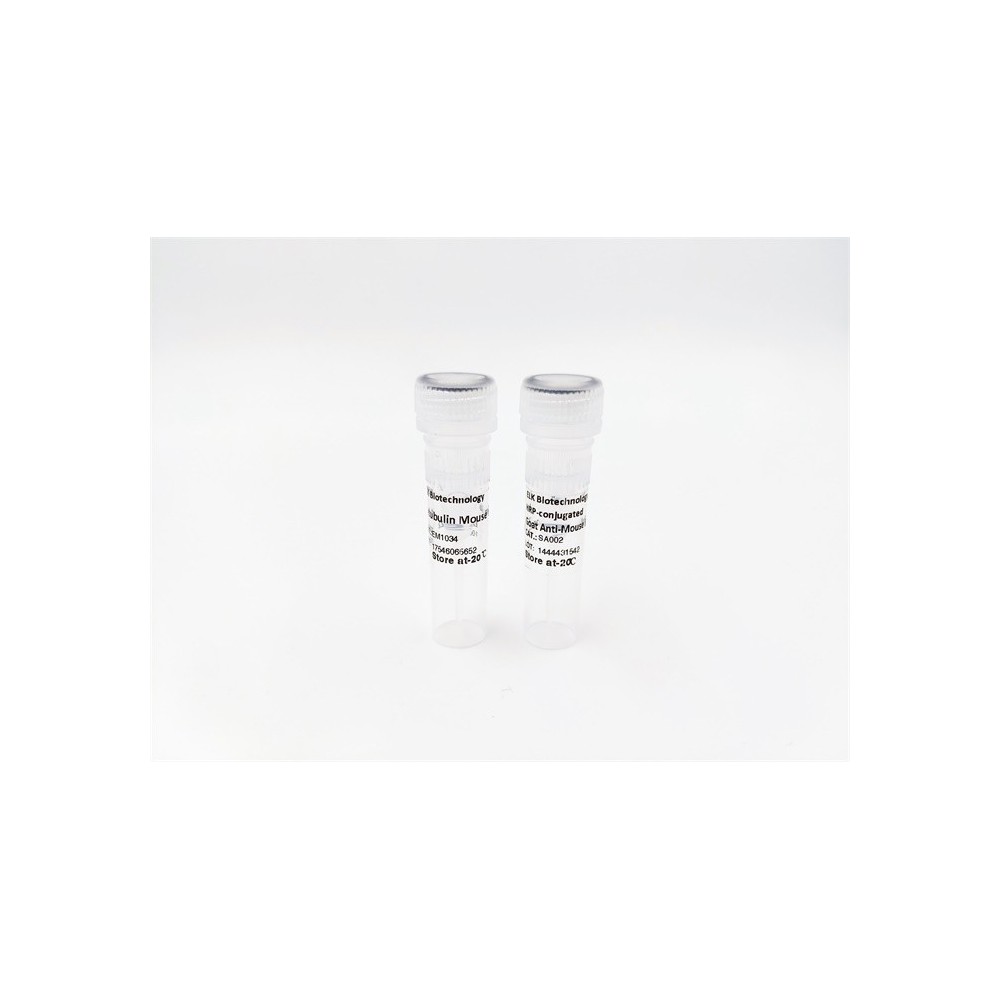
HSP27 (Phospho S78/82) rabbit pAb
AO-06-ES15594-100

| ELK.No | ES15594 |
| Product name | HSP27 (Phospho S78/82) rabbit pAb |
| Reactivity | Human; Mouse; Rat |
| Applications | WB; ELISA |
| Other name | Heat shock protein beta-1 (HspB1;28 kDa heat shock protein;Estrogen-regulated 24 kDa protein;Heat shock 27 kDa protein;HSP 27;Stress-responsive protein 27;SRP27) |
| Size | 100μL |
| Unit price ($) | 248 |
| Human gene ID | 3315 |
| Human Swiss-Prot | P04792 |
| Source | Rabbit |
| Isotype | IgG |
| Target | HSP27 |
| Fields | >>MAPK signaling pathway;>>VEGF signaling pathway;>>Amoebiasis |
| Gene name | HSPB1 HSP27 HSP28 |
| Protein name | HSP27 (Phospho S78/82) |
| Human gene link | |
| Human Swiss link | View Human Swiss-Prot |
| Mouse gene ID | |
| Mouse gene link | |
| Mouse Swiss-Prot | |
| Mouse Swiss link | |
| Rat gene ID | |
| Rat gene link | |
| Rat Swiss-Prot | |
| Rat Swiss link | |
| Immunogen | Synthesized pospho peptide derived from human HSP27 (Phospho S78/82) |
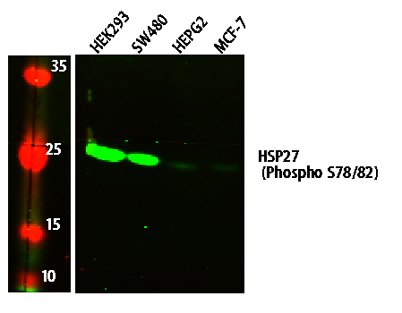
| Specificity | This antibody detects endogenous pospho levels of human HSP27 (Phospho S78/82) |
| Formulation | Liquid in PBS containing 50% glycerol, 0.5% BSA and 0.02% sodium azide. |
| Clonality | Polyclonal |
| Dilution | WB 1:500-2000, ELISA(peptide)1:5000-20000 |
| Purification | The antibody was affinity-purified from mouse ascites by affinity-chromatography using specific immunogen. |
| Concentration | 1 mg/ml |
| Storage stability | -20°C/1 year |
| Molecular Weight (Da) | |
| Observed band (KD) | 27kD |
| Background | The protein encoded by this gene is induced by environmental stress and developmental changes. The encoded protein is involved in stress resistance and actin organization and translocates from the cytoplasm to the nucleus upon stress induction. Defects in this gene are a cause of Charcot-Marie-Tooth disease type 2F (CMT2F) and distal hereditary motor neuropathy (dHMN). [provided by RefSeq, Oct 2008], |
| Function | disease:Defects in HSPB1 are a cause of distal hereditary motor neuronopathy type 2B (HMN2B) [MIM:608634]. Distal hereditary motor neuronopathies constitute a heterogeneous group of neuromuscular disorders caused by selective impairment of motor neurons in the anterior horn of the spinal cord, without sensory deficit in the posterior horn. The overall clinical picture consists of a classical distal muscular atrophy syndrome in the legs without clinical sensory loss. The disease starts with weakness and wasting of distal muscles of the anterior tibial and peroneal compartments of the legs. Later on, weakness and atrophy may expand to the proximal muscles of the lower limbs and/or to the distal upper limbs.,disease:Defects in HSPB1 are the cause of Charcot-Marie-Tooth disease type 2F (CMT2F) [MIM:606595]. CMT2F is a form of Charcot-Marie-Tooth disease, the most common inherited disorder of |
| Subcellular location | Cytoplasm . Nucleus . Cytoplasm, cytoskeleton, spindle . Cytoplasmic in interphase cells. Colocalizes with mitotic spindles in mitotic cells. Translocates to the nucleus during heat shock and resides in sub-nuclear structures known as SC35 speckles or nuclear splicing speckles. . |
| Expression | Detected in all tissues tested: skeletal muscle, heart, aorta, large intestine, small intestine, stomach, esophagus, bladder, adrenal gland, thyroid, pancreas, testis, adipose tissue, kidney, liver, spleen, cerebral cortex, blood serum and cerebrospinal fluid. Highest levels are found in the heart and in tissues composed of striated and smooth muscle. |

Use collapsible tabs for more detailed information that will help customers make a purchasing decision.
Ex: Shipping and return policies, size guides, and other common questions.