 Français
 English

| ELK.No | ES1560 |
| Product name | AASS rabbit pAb |
| Reactivity | Human;Rat;Mouse; |
| Applications | WB;ELISA |
| Other name | AASS; Alpha-aminoadipic semialdehyde synthase; mitochondrial; LKR/SDH |
| Size | 50μL |
| Unit price ($) | 148 |
| Human gene ID | 10157 |
| Human Swiss-Prot | Q9UDR5 |
| Source | Rabbit |
| Isotype | IgG |
| Target | AASS |
| Fields | >>Lysine degradation;>>Metabolic pathways |
| Gene name | AASS |
| Protein name | Alpha-aminoadipic semialdehyde synthase mitochondrial |
| Human gene link | View Human Gene |
| Human Swiss link | View Human Swiss-Prot |
| Mouse gene ID | |
| Mouse gene link | |
| Mouse Swiss-Prot | Q99K67 |
| Mouse Swiss link | View Mouse Swiss-Prot |
| Rat gene ID | |
| Rat gene link | |
| Rat Swiss-Prot | |
| Rat Swiss link | |
| Immunogen | The antiserum was produced against synthesized peptide derived from human AASS. AA range:251-300 |
| Specificity | AASS Polyclonal Antibody detects endogenous levels of AASS protein. |
| Formulation | Liquid in PBS containing 50% glycerol, 0.5% BSA and 0.02% sodium azide. |
| Clonality | Polyclonal |
| Dilution | Western Blot: 1/500 - 1/2000. ELISA: 1/10000. Not yet tested in other applications. |
| Purification | The antibody was affinity-purified from rabbit antiserum by affinity-chromatography using epitope-specific immunogen. |
| Concentration | 1 mg/ml |
| Storage stability | -20°C/1 year |
| Molecular Weight (Da) | |
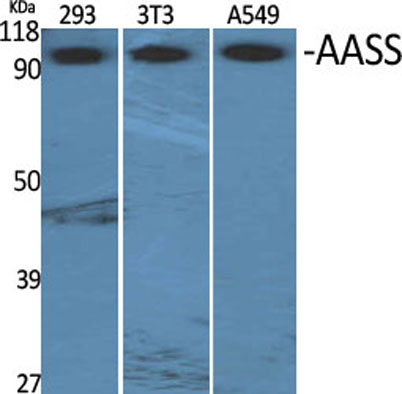
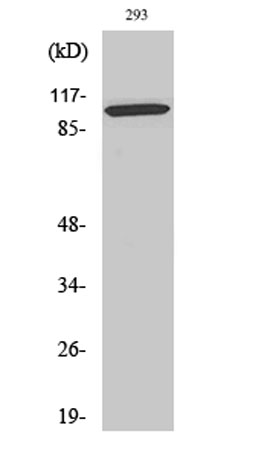
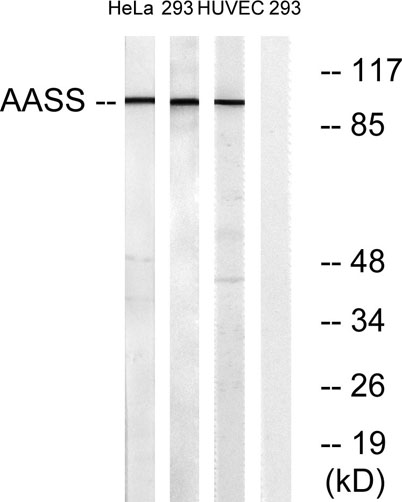
| Observed band (KD) | 102kD |
| Background | This gene encodes a bifunctional enzyme that catalyzes the first two steps in the mammalian lysine degradation pathway. The N-terminal and the C-terminal portions of this enzyme contain lysine-ketoglutarate reductase and saccharopine dehydrogenase activity, respectively, resulting in the conversion of lysine to alpha-aminoadipic semialdehyde. Mutations in this gene are associated with familial hyperlysinemia. [provided by RefSeq, Jul 2008], |
| Function | catalytic activity:N(6)-(L-1,3-dicarboxypropyl)-L-lysine + NAD(+) + H(2)O = L-glutamate + 2-aminoadipate 6-semialdehyde + NADH.,catalytic activity:N(6)-(L-1,3-dicarboxypropyl)-L-lysine + NADP(+) + H(2)O = L-lysine + 2-oxoglutarate + NADPH.,disease:Defects in AASS are the cause of hyperlysinemia [MIM:238700]. Hyperlysinemia is an autosomal recessive condition characterized by hyperlysinemia lysinuria and variable saccharopinuria.,function:Bifunctional enzyme that catalyzes the first two steps in lysine degradation. The N-terminal and the C-terminal contain lysine-ketoglutarate reductase and saccharopine dehydrogenase activity, respectively.,induction:Induced by starvation.,pathway:Amino-acid degradation; L-lysine degradation via saccharopine pathway; glutaryl-CoA from L-lysine: step 1/6.,pathway:Amino-acid degradation; L-lysine degradation via saccharopine pathway; glutaryl-CoA from L-lys |
| Subcellular location | Mitochondrion . |
| Expression | Expressed in all 16 tissues examined with highest expression in the liver. |

Use collapsible tabs for more detailed information that will help customers make a purchasing decision.
Ex: Shipping and return policies, size guides, and other common questions.