 Français
 English

| ELK.No | ES1577 |
| Product name | ACAT-1 rabbit pAb |
| Reactivity | Human;Mouse;Rat |
| Applications | WB;IHC;IF;ELISA |
| Other name | ACAT1; ACAT; MAT; Acetyl-CoA acetyltransferase; mitochondrial; Acetoacetyl-CoA thiolase; T2 |
| Size | 50μL |
| Unit price ($) | 148 |
| Human gene ID | 38 |
| Human Swiss-Prot | P24752 |
| Source | Rabbit |
| Isotype | IgG |
| Target | ACAT-1 |
| Fields | >>Fatty acid degradation;>>Valine, leucine and isoleucine degradation;>>Lysine degradation;>>Tryptophan metabolism;>>Pyruvate metabolism;>>Glyoxylate and dicarboxylate metabolism;>>Butanoate metabolism;>>Terpenoid backbone biosynthesis;>>Metabolic pathways;>>Carbon metabolism;>>Fatty acid metabolism;>>Fat digestion and absorption |
| Gene name | ACAT1 |
| Protein name | Acetyl-CoA acetyltransferase mitochondrial |
| Human gene link | View Human Gene |
| Human Swiss link | View Human Swiss-Prot |
| Mouse gene ID | 110446 |
| Mouse gene link | View Mouse Gene |
| Mouse Swiss-Prot | Q8QZT1 |
| Mouse Swiss link | View Mouse Swiss-Prot |
| Rat gene ID | 25014 |
| Rat gene link | View Rat Gene |
| Rat Swiss-Prot | P17764 |
| Rat Swiss link | View Rat Swiss-Prot |
| Immunogen | The antiserum was produced against synthesized peptide derived from human ACAT1. AA range:221-270 |
| Specificity | ACAT-1 Polyclonal Antibody detects endogenous levels of ACAT-1 protein. |
| Formulation | Liquid in PBS containing 50% glycerol, 0.5% BSA and 0.02% sodium azide. |
| Clonality | Polyclonal |
| Dilution | Western Blot: 1/500 - 1/2000. Immunohistochemistry: 1/100 - 1/300. ELISA: 1/40000. Not yet tested in other applications. |
| Purification | The antibody was affinity-purified from rabbit antiserum by affinity-chromatography using epitope-specific immunogen. |
| Concentration | 1 mg/ml |
| Storage stability | -20°C/1 year |
| Molecular Weight (Da) | |
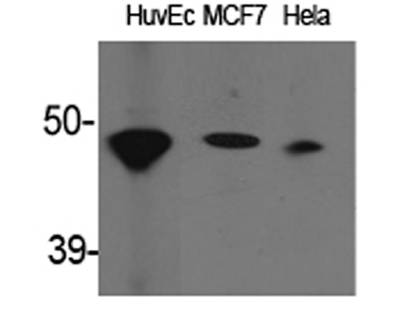
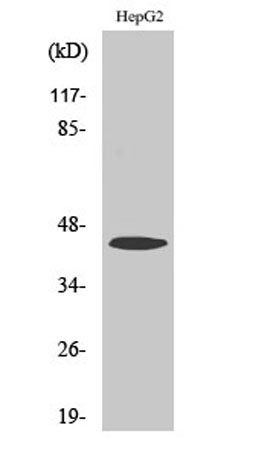
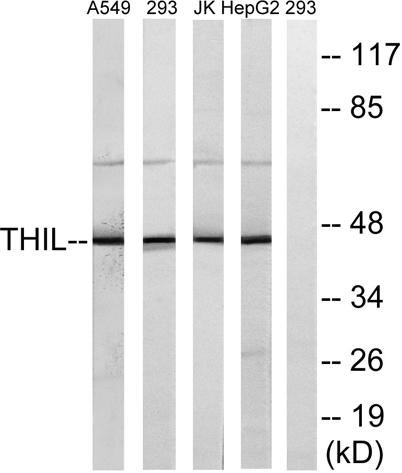
| Observed band (KD) | 45kD |
| Background | This gene encodes a mitochondrially localized enzyme that catalyzes the reversible formation of acetoacetyl-CoA from two molecules of acetyl-CoA. Defects in this gene are associated with 3-ketothiolase deficiency, an inborn error of isoleucine catabolism characterized by urinary excretion of 2-methyl-3-hydroxybutyric acid, 2-methylacetoacetic acid, tiglylglycine, and butanone. [provided by RefSeq, Feb 2009], |
| Function | catalytic activity:2 acetyl-CoA = CoA + acetoacetyl-CoA.,disease:Defects in ACAT1 are a cause of 3-ketothiolase deficiency (3KTD) [MIM:203750]; also known as alpha-methylacetoaceticaciduria. 3KTD is an inborn error of isoleucine catabolism characterized by intermittent ketoacidotic attacks associated with unconsciousness. Some patients die during an attack or are mentally retarded. Urinary excretion of 2-methyl-3-hydroxybutyric acid, 2-methylacetoacetic acid, triglylglycine, butanone is increased. It seems likely that the severity of this disease correlates better with the environmental or acquired factors than with the ACAT1 genotype.,enzyme regulation:Activated by potassium ions, but not sodium ions.,function:Plays a major role in ketone body metabolism.,similarity:Belongs to the thiolase family.,subunit:Homotetramer., |
| Subcellular location | Mitochondrion . |
| Expression | Adipocyte,Brain,Fetal brain cortex, |

Use collapsible tabs for more detailed information that will help customers make a purchasing decision.
Ex: Shipping and return policies, size guides, and other common questions.