 Français
 English

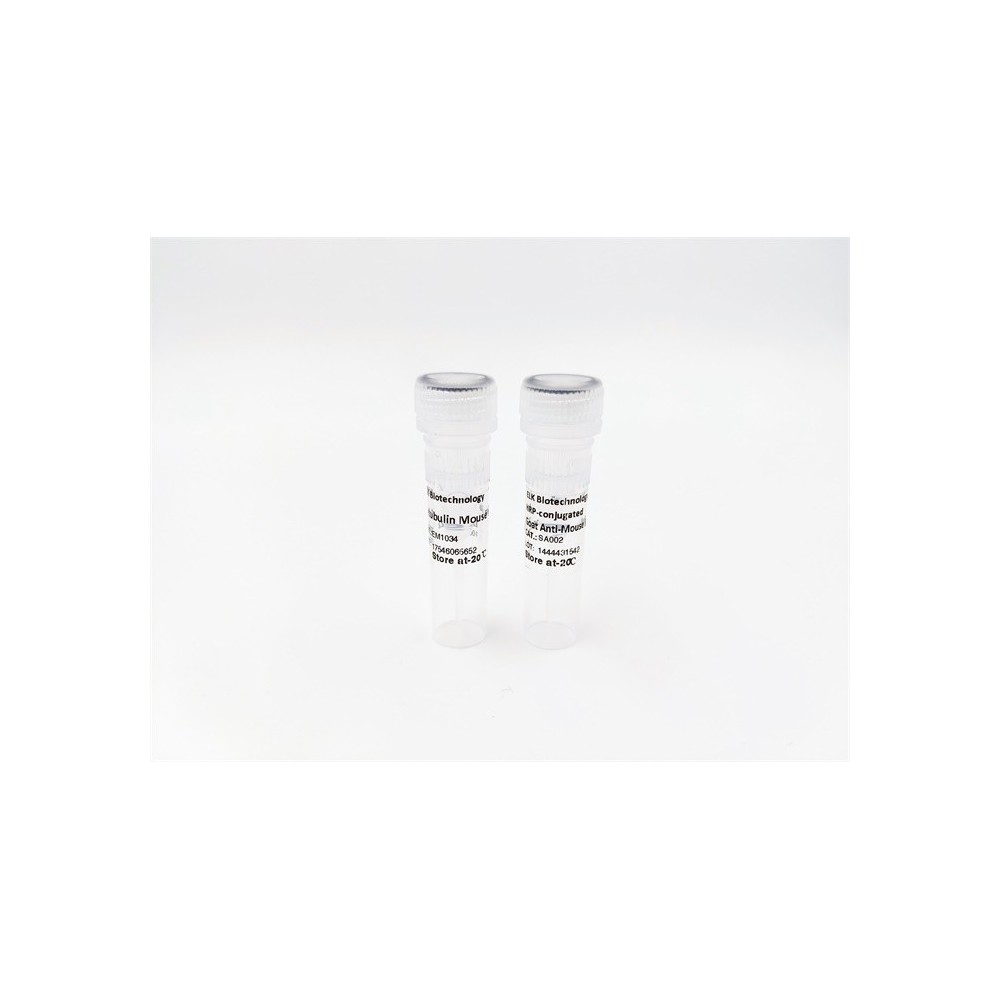

| ELK.No | ES15851 |
| Product name | H17B6 rabbit pAb |
| Reactivity | Human; Mouse;Rat |
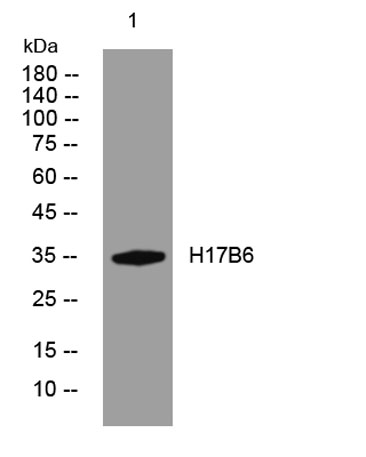
| Applications | WB |
| Other name | |
| Size | 100μL |
| Unit price ($) | 248 |
| Human gene ID | 8630 |
| Human Swiss-Prot | O14756 |
| Source | Rabbit |
| Isotype | IgG |
| Target | H17B6 |
| Fields | >>Steroid hormone biosynthesis;>>Retinol metabolism;>>Metabolic pathways;>>Biosynthesis of cofactors |
| Gene name | HSD17B6 RODH |
| Protein name | H17B6 |
| Human gene link | View Human Gene |
| Human Swiss link | View Human Swiss-Prot |
| Mouse gene ID | 27400 |
| Mouse gene link | View Mouse Gene |
| Mouse Swiss-Prot | Q9R092 |
| Mouse Swiss link | View Mouse Swiss-Prot |
| Rat gene ID | 286964 |
| Rat gene link | View Rat Gene |
| Rat Swiss-Prot | O54753 |
| Rat Swiss link | View Rat Swiss-Prot |
| Immunogen | Synthesized peptide derived from human H17B6 AA range: 28-78 |
| Specificity | This antibody detects endogenous levels of H17B6 at Human/Mouse/Rat |
| Formulation | Liquid in PBS containing 50% glycerol, 0.5% BSA and 0.02% sodium azide. |
| Clonality | Polyclonal |
| Dilution | WB 1:500-2000 |
| Purification | The antibody was affinity-purified from rabbit serum by affinity-chromatography using specific immunogen. |
| Concentration | 1 mg/ml |
| Storage stability | -20°C/1 year |
| Molecular Weight (Da) | 35kD |
| Observed band (KD) | |
| Background | The protein encoded by this gene has both oxidoreductase and epimerase activities and is involved in androgen catabolism. The oxidoreductase activity can convert 3 alpha-adiol to dihydrotestosterone, while the epimerase activity can convert androsterone to epi-androsterone. Both reactions use NAD+ as the preferred cofactor. This gene is a member of the retinol dehydrogenase family. [provided by RefSeq, Aug 2013], |
| Function | catalytic activity:Estradiol-17-beta + NAD(P)(+) = estrone + NAD(P)H.,catalytic activity:Retinol + NAD(+) = retinal + NADH.,catalytic activity:Testosterone + NAD(+) = androst-4-ene-3,17-dione + NADH.,function:NAD-dependent oxidoreductase with broad substrate specificity that shows both oxidative and reductive activity (in vitro). Has 17-beta-hydroxysteroid dehydrogenase activity towards various steroids (in vitro). Converts 5-alpha-androstan-3-alpha,17-beta-diol to androsterone and estradiol to estrone (in vitro). Has 3-alpha-hydroxysteroid dehydrogenase activity towards androsterone (in vitro). Has retinol dehydrogenase activity towards all-trans-retinol (in vitro). Can convert androsterone to epi-androsterone. Androsterone is first oxidized to 5-alpha-androstane-3,17-dione and then reduced to epi-andosterone. Can act on both C-19 and C-21 3-alpha-hydroxysteroids.,similarity:Belongs to |
| Subcellular location | Microsome membrane ; Peripheral membrane protein ; Lumenal side . Early endosome membrane ; Peripheral membrane protein ; Lumenal side . |
| Expression | Detected in liver and prostate (at protein level). Detected in adult liver, lung, brain, placenta, prostate, adrenal gland, testis, mammary gland, spleen, spinal cord and uterus. Detected in caudate nucleus, and at lower levels in amygdala, corpus callosum, hippocampus, substantia nigra and thalamus. Detected in fetal lung, liver and brain. |

Use collapsible tabs for more detailed information that will help customers make a purchasing decision.
Ex: Shipping and return policies, size guides, and other common questions.