 Français
 English

| ELK.No | ES1605 |
| Product name | Adducin β rabbit pAb |
| Reactivity | Human;Mouse;Rat |
| Applications | WB;IF;ELISA |
| Other name | ADD2; ADDB; Beta-adducin; Erythrocyte adducin subunit beta |
| Size | 100μL |
| Unit price ($) | 248 |
| Human gene ID | 119 |
| Human Swiss-Prot | P35612 |
| Source | Rabbit |
| Isotype | IgG |
| Target | Adducin β |
| Fields | |
| Gene name | ADD2 |
| Protein name | Beta-adducin |
| Human gene link | View Human Gene |
| Human Swiss link | View Human Swiss-Prot |
| Mouse gene ID | 11519 |
| Mouse gene link | View Mouse Gene |
| Mouse Swiss-Prot | Q9QYB8 |
| Mouse Swiss link | View Mouse Swiss-Prot |
| Rat gene ID | 24171 |
| Rat gene link | View Rat Gene |
| Rat Swiss-Prot | Q05764 |
| Rat Swiss link | View Rat Swiss-Prot |
| Immunogen | The antiserum was produced against synthesized peptide derived from human ADD2. AA range:471-520 |
| Specificity | Adducin β Polyclonal Antibody detects endogenous levels of Adducin β protein. |
| Formulation | Liquid in PBS containing 50% glycerol, 0.5% BSA and 0.02% sodium azide. |
| Clonality | Polyclonal |
| Dilution | Western Blot: 1/500 - 1/2000. Immunofluorescence: 1/200 - 1/1000. ELISA: 1/5000. Not yet tested in other applications. |
| Purification | The antibody was affinity-purified from rabbit antiserum by affinity-chromatography using epitope-specific immunogen. |
| Concentration | 1 mg/ml |
| Storage stability | -20°C/1 year |
| Molecular Weight (Da) | |
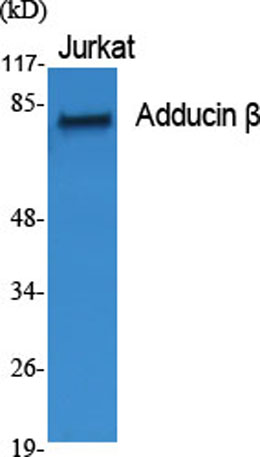
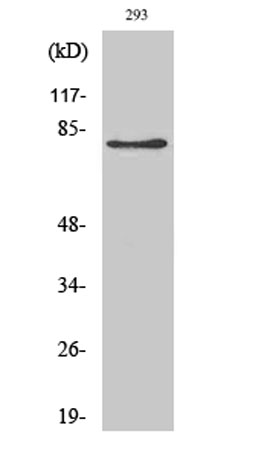
| Observed band (KD) | 81kD |
| Background | adducin 2(ADD2) Homo sapiens Adducins are heteromeric proteins composed of different subunits referred to as adducin alpha, beta and gamma. The three subunits are encoded by distinct genes and belong to a family of membrane skeletal proteins involved in the assembly of spectrin-actin network in erythrocytes and at sites of cell-cell contact in epithelial tissues. While adducins alpha and gamma are ubiquitously expressed, the expression of adducin beta is restricted to brain and hematopoietic tissues. Adducin, originally purified from human erythrocytes, was found to be a heterodimer of adducins alpha and beta. Polymorphisms resulting in amino acid substitutions in these two subunits have been associated with the regulation of blood pressure in an animal model of hypertension. Heterodimers consisting of alpha and gamma subunits have also been described. Structurally, each subunit is comprised of two distinct domains. The amino-terminal region i |
| Function | alternative products:Additional isoforms seem to exist,developmental stage:Fetal kidney expresses isoforms 3, 4, 5, 6 and 7, and fetal liver expresses isoforms 3 and 4.,domain:Each subunit is comprised of three regions: a NH2-terminal protease-resistant globular head region, a short connecting subdomain, and a protease-sensitive tail region.,function:Membrane-cytoskeleton-associated protein that promotes the assembly of the spectrin-actin network. Binds to calmodulin. Calmodulin binds preferentially to the beta subunit.,PTM:The N-terminus is blocked.,similarity:Belongs to the aldolase class II family. Adducin subfamily.,subunit:Heterodimer of an alpha and a beta subunit.,tissue specificity:Expressed mainly in brain, spleen, kidney cortex and medulla, and heart. Also expressed in human umbilical vein endothelial cells, human vascular smooth muscle cells, kidney tubular cells and K562 cell |
| Subcellular location | Cytoplasm, cytoskeleton. Cell membrane; Peripheral membrane protein; Cytoplasmic side. |
| Expression | Expressed mainly in brain, spleen, kidney cortex and medulla, and heart. Also expressed in human umbilical vein endothelial cells, human vascular smooth muscle cells, kidney tubular cells and K-562 cell line. |


Use collapsible tabs for more detailed information that will help customers make a purchasing decision.
Ex: Shipping and return policies, size guides, and other common questions.