 Français
 English


| ELK.No | ES16175 |
| Product name | GLIS2 rabbit pAb |
| Reactivity | Human; Mouse |
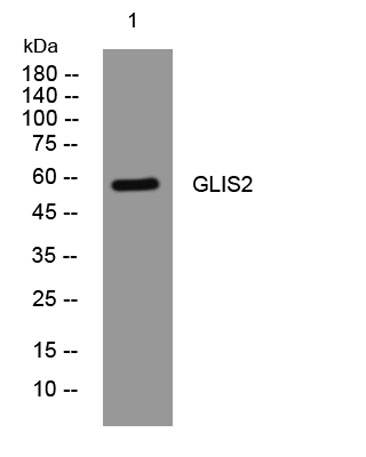
| Applications | WB |
| Other name | |
| Size | 50μL |
| Unit price ($) | 148 |
| Human gene ID | 84662 |
| Human Swiss-Prot | Q9BZE0 |
| Source | Rabbit |
| Isotype | IgG |
| Target | GLIS2 |
| Fields | |
| Gene name | GLIS2 NKL |
| Protein name | GLIS2 |
| Human gene link | View Human Gene |
| Human Swiss link | View Human Swiss-Prot |
| Mouse gene ID | 83396 |
| Mouse gene link | View Mouse Gene |
| Mouse Swiss-Prot | Q8VDL9 |
| Mouse Swiss link | View Mouse Swiss-Prot |
| Rat gene ID | |
| Rat gene link | |
| Rat Swiss-Prot | |
| Rat Swiss link | |
| Immunogen | Synthesized peptide derived from human GLIS2 AA range: 442-492 |
| Specificity | This antibody detects endogenous levels of GLIS2 at Human/Mouse |
| Formulation | Liquid in PBS containing 50% glycerol, 0.5% BSA and 0.02% sodium azide. |
| Clonality | Polyclonal |
| Dilution | WB 1:500-2000 |
| Purification | The antibody was affinity-purified from rabbit serum by affinity-chromatography using specific immunogen. |
| Concentration | 1 mg/ml |
| Storage stability | -20°C/1 year |
| Molecular Weight (Da) | 58kD |
| Observed band (KD) | |
| Background | This gene is a member of the GLI-similar zinc finger protein family and encodes a nuclear transcription factor with five C2H2-type zinc finger domains. The protein encoded by this gene is widely expressed at low levels in the neural tube and peripheral nervous system and likely promotes neuronal differentiation. It is abundantly expressed in the kidney and may have a role in the regulation of kidney morphogenesis. p120 regulates the expression level of this protein and induces the cleavage of this protein's C-terminal zinc finger domain. This protein also promotes the nuclear translocation of p120. Mutations in this gene cause nephronophthisis (NPHP), an autosomal recessive kidney disease characterized by tubular basement membrane disruption, interstitial lymphohistiocytic cell infiltration, and development of cysts at the corticomedullary border of the kidneys.[provided by RefSeq, Jan 2010], |
| Function | disease:Defects in GLIS2 are the cause of nephronophthisis type 7 (NPHP7) [MIM:611498]. NPHP7 is an autosomal recessive disorder resulting in end-stage renal disease during childhood or adolescence. It is a progressive tubulo-interstitial kidney disorder histologically characterized by modifications of the tubules with thickening of the basement membrane, interstitial fibrosis and, in the advanced stages, medullary cysts.,domain:The C2H2-type zinc finger 1 has a major repressor function and is required for CTNNB1 binding.,function:Can act either as a transcription repressor or as a transcription activator, depending on the cell context. Represses the transcriptional activation mediated by CTNNB1 in the Wnt pathway. May act by recruiting the corepressors CTBP1 and HDAC3. May be involved in neuron differentiation.,PTM:C-terminus cleavage is induced by interaction with CTNND1 and enhanced b |
| Subcellular location | Nucleus speckle . Cytoplasm . |
| Expression | Expressed at high levels in kidney and at low levels in heart, lung and placenta. Expressed in colon. |

Use collapsible tabs for more detailed information that will help customers make a purchasing decision.
Ex: Shipping and return policies, size guides, and other common questions.