 Français
 English


| ELK.No | ES16669 |
| Product name | EST3 rabbit pAb |
| Reactivity | Human;Rat;Mouse; |
| Applications | WB |
| Other name | Carboxylesterase 3 (EC 3.1.1.1) (Liver carboxylesterase 31 homolog) |
| Size | 100μL |
| Unit price ($) | 248 |
| Human gene ID | 23491 |
| Human Swiss-Prot | Q6UWW8 |
| Source | Rabbit |
| Isotype | IgG |
| Target | EST3 |
| Fields | |
| Gene name | CES3 UNQ869/PRO1887 |
| Protein name | EST3 |
| Human gene link | View Human Gene |
| Human Swiss link | View Human Swiss-Prot |
| Mouse gene ID | |
| Mouse gene link | |
| Mouse Swiss-Prot | |
| Mouse Swiss link | |
| Rat gene ID | |
| Rat gene link | |
| Rat Swiss-Prot | |
| Rat Swiss link | |
| Immunogen | Synthesized peptide derived from human EST3 AA range: 447-497 |
| Specificity | This antibody detects endogenous levels of EST3 at Human |
| Formulation | Liquid in PBS containing 50% glycerol, 0.5% BSA and 0.193% sodium azide. |
| Clonality | Polyclonal |
| Dilution | WB 1:500-2000 |
| Purification | The antibody was affinity-purified from rabbit serum by affinity-chromatography using specific immunogen. |
| Concentration | 1 mg/ml |
| Storage stability | -20°C/1 year |
| Molecular Weight (Da) | |
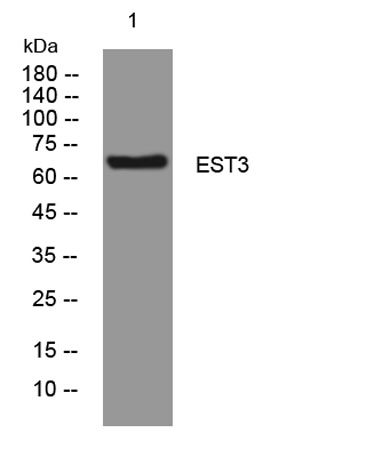
| Observed band (KD) | 65kD |
| Background | This gene encodes a member of the carboxylesterase large family. The family members are responsible for the hydrolysis or transesterification of various xenobiotics, such as cocaine and heroin, and endogenous substrates with ester, thioester, or amide bonds. They may participate in fatty acyl and cholesterol ester metabolism, and may play a role in the blood-brain barrier system. This gene is expressed in several tissues, particularly in colon, trachea and in brain, and the protein participates in colon and neural drug metabolism. Multiple alternatively spliced transcript variants encoding distinct isoforms have been reported, but the biological validity and/or full-length nature of some variants have not been determined.[provided by RefSeq, Jun 2010], |
| Function | catalytic activity:A carboxylic ester + H(2)O = an alcohol + a carboxylate.,function:Involved in the detoxification of xenobiotics and in the activation of ester and amide prodrugs. Shows low catalytic efficiency for hydrolysis of CPT-11 (7-ethyl-10-[4-(1-piperidino)-1-piperidino]-carbonyloxycamptothecin), a prodrug for camptothecin used in cancer therapeutics.,PTM:N-glycosylated.,similarity:Belongs to the type-B carboxylesterase/lipase family.,tissue specificity:Expressed in liver, colon and small intestine., |
| Subcellular location | Endoplasmic reticulum lumen . |
| Expression | Expressed in liver, colon and small intestine. |

Use collapsible tabs for more detailed information that will help customers make a purchasing decision.
Ex: Shipping and return policies, size guides, and other common questions.