 Français
 English

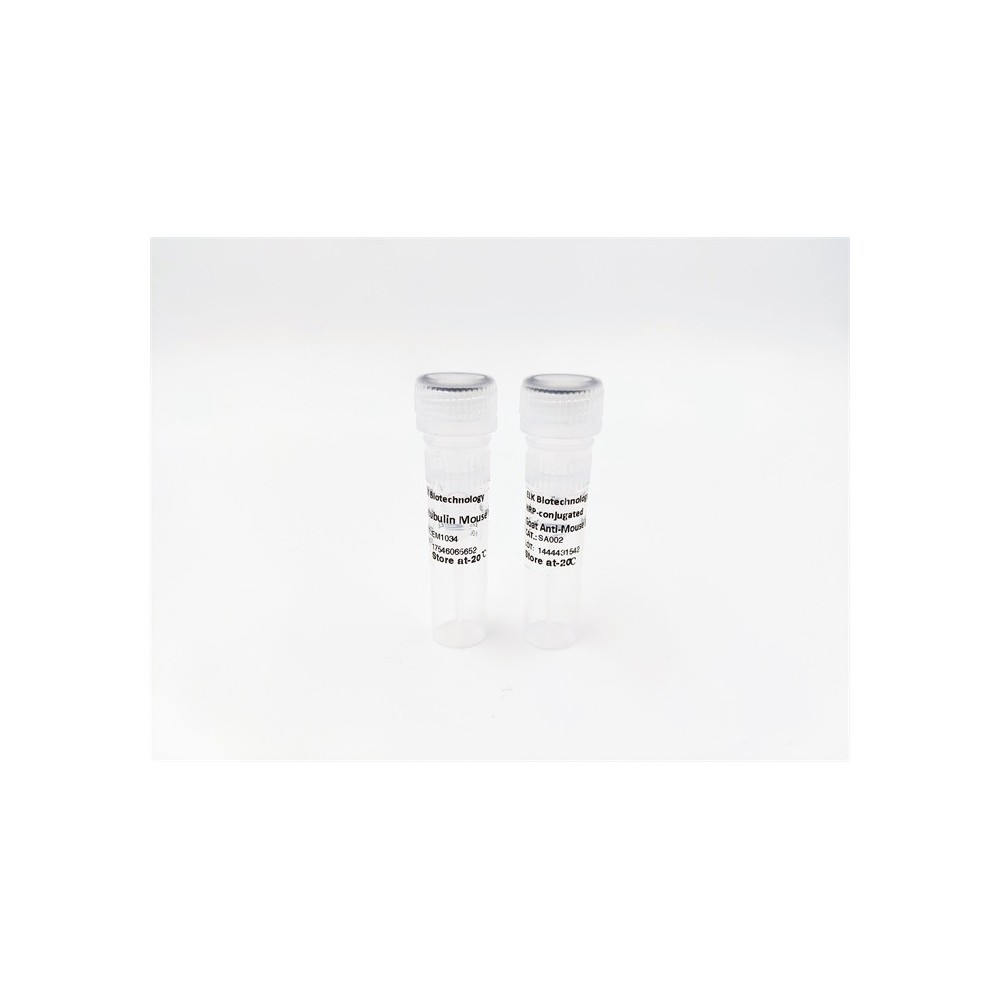

| ELK.No | ES16875 |
| Product name | DUX4 rabbit pAb |
| Reactivity | Human;Rat;Mouse; |
| Applications | WB |
| Other name | |
| Size | 100μL |
| Unit price ($) | 248 |
| Human gene ID | |
| Human Swiss-Prot | Q9UBX2 |
| Source | Rabbit |
| Isotype | IgG |
| Target | DUX4 |
| Fields | |
| Gene name | DUX4 DUX10 |
| Protein name | DUX4 |
| Human gene link | |
| Human Swiss link | View Human Swiss-Prot |
| Mouse gene ID | |
| Mouse gene link | |
| Mouse Swiss-Prot | |
| Mouse Swiss link | |
| Rat gene ID | |
| Rat gene link | |
| Rat Swiss-Prot | |
| Rat Swiss link | |
| Immunogen | Synthesized peptide derived from human DUX4 AA range: 235-285 |
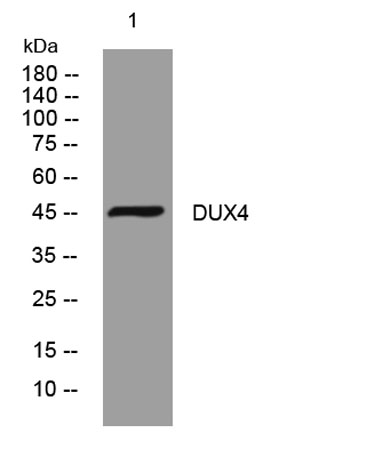
| Specificity | This antibody detects endogenous levels of DUX4 at Human |
| Formulation | Liquid in PBS containing 50% glycerol, 0.5% BSA and 0.02% sodium azide. |
| Clonality | Polyclonal |
| Dilution | WB 1:500-2000 |
| Purification | The antibody was affinity-purified from rabbit serum by affinity-chromatography using specific immunogen. |
| Concentration | 1 mg/ml |
| Storage stability | -20°C/1 year |
| Molecular Weight (Da) | 47kD |
| Observed band (KD) | |
| Background | This gene is located within a D4Z4 repeat array in the subtelomeric region of chromosome 4q. The D4Z4 repeat is polymorphic in length; a similar D4Z4 repeat array has been identified on chromosome 10. Each D4Z4 repeat unit has an open reading frame (named DUX4) that encodes two homeoboxes; the repeat-array and ORF is conserved in other mammals. The encoded protein has been reported to function as a transcriptional activator of paired-like homeodomain transcription factor 1 (PITX1; GeneID 5307). Contraction of the macrosatellite repeat causes autosomal dominant facioscapulohumeral muscular dystrophy (FSHD). Alternative splicing results in multiple transcript variants. [provided by RefSeq, Apr 2015], |
| Function | |
| Subcellular location | [Isoform 1]: Nucleus . Actively transported through the nuclear pore complex (NPC). .; [Isoform 2]: Nucleus . |
| Expression | Isoform 1: Does not seem to be expressed in normal muscle, but is detected in muscle of individuals with FSHD, and also in testis (at protein level) (PubMed:21060811, PubMed:17984056). Isoform 1: Does not seem to be expressed in normal muscle, but in muscle of individuals with FSHD, where it may be toxic to cells (PubMed:21060811, PubMed:17984056). Isoform 2: Detected in skeletal muscle, fibroblasts and testis from healthy individuals (PubMed:21060811). |

Use collapsible tabs for more detailed information that will help customers make a purchasing decision.
Ex: Shipping and return policies, size guides, and other common questions.