 Français
 English

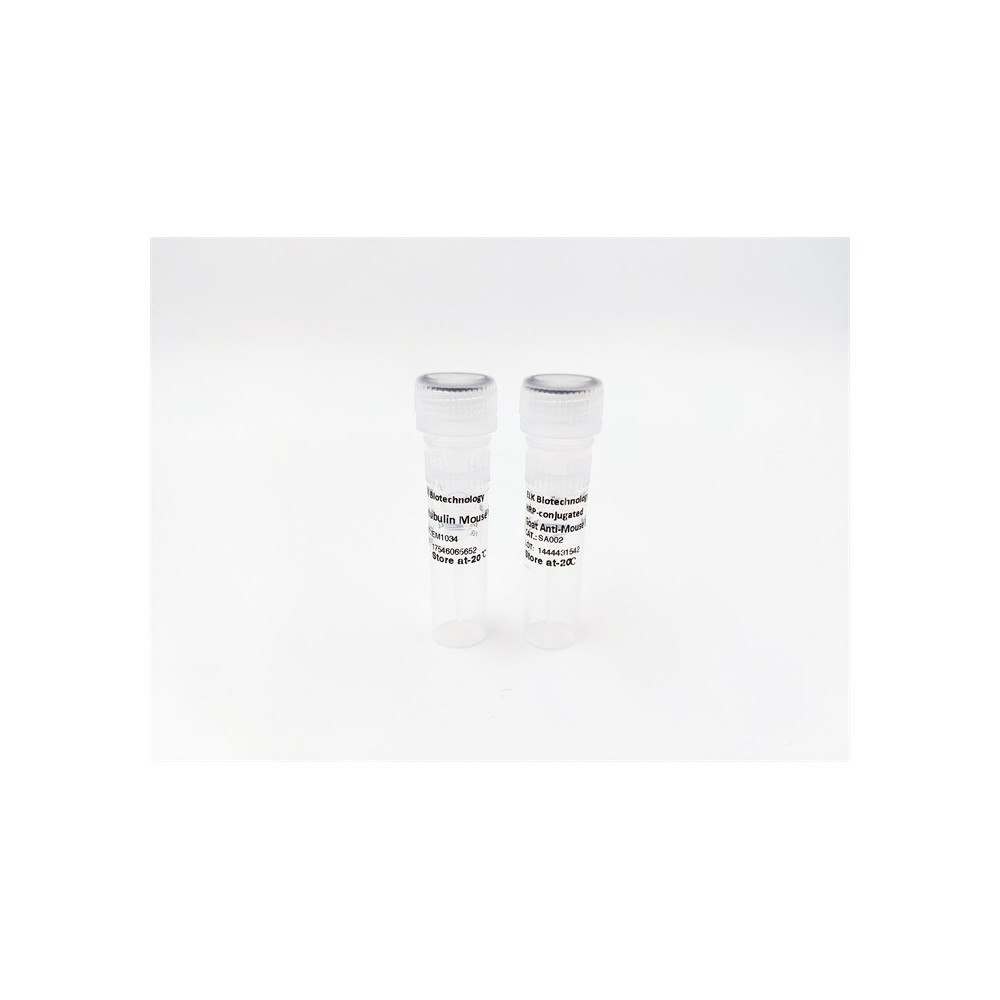

| ELK.No | ES16953 |
| Product name | DGCR8 rabbit pAb |
| Reactivity | Human; Mouse |
| Applications | WB |
| Other name | Microprocessor complex subunit DGCR8 (DiGeorge syndrome critical region 8) |
| Size | 100μL |
| Unit price ($) | 248 |
| Human gene ID | 54487 |
| Human Swiss-Prot | Q8WYQ5 |
| Source | Rabbit |
| Isotype | IgG |
| Target | DGCR8 |
| Fields | |
| Gene name | DGCR8 C22orf12 DGCRK6 LP4941 |
| Protein name | DGCR8 |
| Human gene link | View Human Gene |
| Human Swiss link | View Human Swiss-Prot |
| Mouse gene ID | 94223 |
| Mouse gene link | View Mouse Gene |
| Mouse Swiss-Prot | Q9EQM6 |
| Mouse Swiss link | View Mouse Swiss-Prot |
| Rat gene ID | |
| Rat gene link | |
| Rat Swiss-Prot | |
| Rat Swiss link | |
| Immunogen | Synthesized peptide derived from human DGCR8 AA range: 467-517 |
| Specificity | This antibody detects endogenous levels of DGCR8 at Human/Mouse |
| Formulation | Liquid in PBS containing 50% glycerol, 0.5% BSA and 0.348% sodium azide. |
| Clonality | Polyclonal |
| Dilution | WB 1:500-2000 |
| Purification | The antibody was affinity-purified from rabbit serum by affinity-chromatography using specific immunogen. |
| Concentration | 1 mg/ml |
| Storage stability | -20°C/1 year |
| Molecular Weight (Da) | |
| Observed band (KD) | 85kD |
| Background | This gene encodes a subunit of the microprocessor complex which mediates the biogenesis of microRNAs from the primary microRNA transcript. The encoded protein is a double-stranded RNA binding protein that functions as the non-catalytic subunit of the microprocessor complex. This protein is required for binding the double-stranded RNA substrate and facilitates cleavage of the RNA by the ribonuclease III protein, Drosha. Alternate splicing results in multiple transcript variants. [provided by RefSeq, Jun 2010], |
| Function | disease:May play a part in the etiology of the velocardiofacial/DiGeorge syndrome (VCFS/DGS), a developmental disorder characterized by structural and functional palate anomalies, conotruncal cardiac malformations, immunodeficiency, hypocalcemia, and typical facial anomalies. Most cases result from a deletion of chromosome 22q11.2 (the DiGeorge syndrome chromosome region, or DGCR).,similarity:Contains 1 WW domain.,similarity:Contains 2 DRBM (double-stranded RNA-binding) domains.,tissue specificity:Ubiquitously expressed., |
| Subcellular location | Nucleus . Nucleus, nucleolus . Colocalizes with nucleolin and DROSHA in the nucleolus. Mostly detected in the nucleolus as electron-dense granular patches around the fibrillar center (FC) and granular component (GC). Also detected in the nucleoplasm as small foci adjacent to splicing speckles near the chromatin structure. Localized with DROSHA in GW bodies (GWBs), also known as P-bodies (PubMed:17159994). |
| Expression | Ubiquitously expressed. |


Use collapsible tabs for more detailed information that will help customers make a purchasing decision.
Ex: Shipping and return policies, size guides, and other common questions.