 Français
 English


| ELK.No | ES16978 |
| Product name | DDX21 rabbit pAb |
| Reactivity | Human; Mouse;Rat |
| Applications | WB |
| Other name | |
| Size | 50μL |
| Unit price ($) | 148 |
| Human gene ID | 9188 |
| Human Swiss-Prot | Q9NR30 |
| Source | Rabbit |
| Isotype | IgG |
| Target | DDX21 |
| Fields | |
| Gene name | DDX21 |
| Protein name | DDX21 |
| Human gene link | View Human Gene |
| Human Swiss link | View Human Swiss-Prot |
| Mouse gene ID | 56200 |
| Mouse gene link | View Mouse Gene |
| Mouse Swiss-Prot | Q9JIK5 |
| Mouse Swiss link | View Mouse Swiss-Prot |
| Rat gene ID | 317399 |
| Rat gene link | View Rat Gene |
| Rat Swiss-Prot | Q3B8Q1 |
| Rat Swiss link | View Rat Swiss-Prot |
| Immunogen | Synthesized peptide derived from human DDX21 AA range: 287-337 |
| Specificity | This antibody detects endogenous levels of DDX21 at Human/Mouse/Rat |
| Formulation | Liquid in PBS containing 50% glycerol, 0.5% BSA and 0.02% sodium azide. |
| Clonality | Polyclonal |
| Dilution | WB 1:500-2000 |
| Purification | The antibody was affinity-purified from rabbit serum by affinity-chromatography using specific immunogen. |
| Concentration | 1 mg/ml |
| Storage stability | -20°C/1 year |
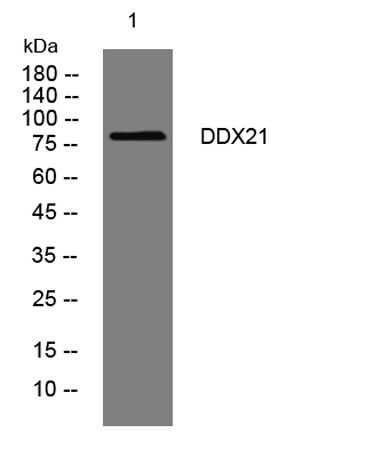
| Molecular Weight (Da) | 86kD |
| Observed band (KD) | |
| Background | DEAD box proteins, characterized by the conserved motif Asp-Glu-Ala-Asp (DEAD), are putative RNA helicases. They are implicated in a number of cellular processes involving alteration of RNA secondary structure such as translation initiation, nuclear and mitochondrial splicing, and ribosome and spliceosome assembly. Based on their distribution patterns, some members of this family are believed to be involved in embryogenesis, spermatogenesis, and cellular growth and division. This gene encodes a DEAD box protein, which is an antigen recognized by autoimmune antibodies from a patient with watermelon stomach disease. This protein unwinds double-stranded RNA, folds single-stranded RNA, and may play important roles in ribosomal RNA biogenesis, RNA editing, RNA transport, and general transcription. [provided by RefSeq, Jul 2008], |
| Function | disease:Autoantigen found in patients with the watermelon stomach disease, which is characterized by prominent stripes of ectatic vascular tissue in the stomach similar to stripes on a watermelon. Chronic gastrointestinal bleeding occurs and approximately half of the patients have associated autoimmune disorders.,domain:The 3 X 5 AA repeats seem to be critical for the RNA folding activity.,domain:The two enzymatic activities reside in two separate domains, the helicase in the N-terminus and the foldase in the C-terminus.,function:Can unwind double-stranded RNA (helicase) and can fold or introduce a secondary structure to a single-stranded RNA (foldase). Functions as cofactor for JUN-activated transcription. Involved in rRNA processing.,similarity:Belongs to the DEAD box helicase family. DDX21/DDX50 subfamily.,similarity:Contains 1 helicase ATP-binding domain.,similarity:Contains 1 helica |
| Subcellular location | Nucleus, nucleolus . Nucleus, nucleoplasm . Cytoplasm, cytosol . Mitochondrion . Present both in nucleolus and nucleoplasm. Interaction with JUN promotes translocation from the nucleolus to the nucleoplasm (PubMed:11823437, PubMed:18180292). Interaction with WDR46 is required for localization to the nucleolus (PubMed:23848194). Colocalizes in the cytosol with DDX1, DHX36 and TICAM1. The multi-helicase-TICAM1 complex may translocate to the mitochondria upon poly(I:C) RNA ligand stimulation (By similarity). . |
| Expression |

Use collapsible tabs for more detailed information that will help customers make a purchasing decision.
Ex: Shipping and return policies, size guides, and other common questions.