 Français
 English

| ELK.No | ES17200 |
| Product name | CST9 rabbit pAb |
| Reactivity | Human; Mouse |
| Applications | WB |
| Other name | |
| Size | 50μL |
| Unit price ($) | 148 |
| Human gene ID | 128822 |
| Human Swiss-Prot | Q5W186 |
| Source | Rabbit |
| Isotype | IgG |
| Target | CST9 |
| Fields | |
| Gene name | CST9 CLM |
| Protein name | CST9 |
| Human gene link | View Human Gene |
| Human Swiss link | View Human Swiss-Prot |
| Mouse gene ID | 13013 |
| Mouse gene link | View Mouse Gene |
| Mouse Swiss-Prot | Q9Z0H6 |
| Mouse Swiss link | View Mouse Swiss-Prot |
| Rat gene ID | |
| Rat gene link | |
| Rat Swiss-Prot | |
| Rat Swiss link | |
| Immunogen | Synthesized peptide derived from human CST9 AA range: 108-158 |
| Specificity | This antibody detects endogenous levels of CST9 at Human/Mouse |
| Formulation | Liquid in PBS containing 50% glycerol, 0.5% BSA and 0.02% sodium azide. |
| Clonality | Polyclonal |
| Dilution | WB 1:500-2000 |
| Purification | The antibody was affinity-purified from rabbit serum by affinity-chromatography using specific immunogen. |
| Concentration | 1 mg/ml |
| Storage stability | -20°C/1 year |
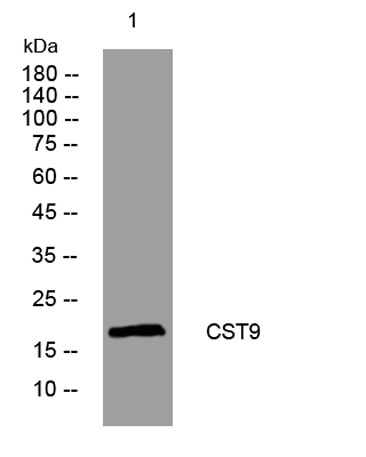
| Molecular Weight (Da) | 17kD |
| Observed band (KD) | |
| Background | The cystatin superfamily encompasses proteins that contain multiple cystatin-like sequences. Some of the members are active cysteine protease inhibitors, while others have lost or perhaps never acquired this inhibitory activity. There are three inhibitory families in the superfamily, including the type 1 cystatins (stefins), type 2 cystatins and the kininogens. The type 2 cystatin proteins are a class of cysteine proteinase inhibitors found in a variety of human fluids and secretions, where they appear to provide protective functions. The cystatin locus on chromosome 20 contains the majority of the type 2 cystatin genes and pseudogenes. This gene is located in the cystatin locus and encodes a secreted protein that may play a role in hematopoietic differentiation or inflammation. [provided by RefSeq, Jul 2008], |
| Function | function:May play a role in hematopoietic differentiation or inflammation.,induction:Up-regulated by LPS, in some cancer cells such as promyelocytic leukemia cells (HL-60) or myelomonocytic leukemia cells (U-937).,similarity:Belongs to the cystatin family.,subcellular location:May be targeted through the Golgi via the secretory pathway.,tissue specificity:Expressed in heart, placenta, lung, liver, skeletal muscle and pancreas. Not expressed in brain. Barely expressed in tumor cell lines except for breast adenocarcinoma MCF-7 cells and U251 cells., |
| Subcellular location | Secreted . May be targeted through the Golgi via the secretory pathway. . |
| Expression | Expressed in heart, placenta, lung, liver, skeletal muscle and pancreas (PubMed:12535658). Not expressed in brain (PubMed:12535658). Expressed in epididymis, kidney, testis, spinal cord, and thymus with a strong expression in epididymis and kidney and a weak expression in the spinal cord and thymus (PubMed:20565543). |

Use collapsible tabs for more detailed information that will help customers make a purchasing decision.
Ex: Shipping and return policies, size guides, and other common questions.