 Français
 English

| ELK.No | ES17225 |
| Product name | CRGA rabbit pAb |
| Reactivity | Human; Mouse;Rat |
| Applications | WB |
| Other name | |
| Size | 100μL |
| Unit price ($) | 248 |
| Human gene ID | 1418 |
| Human Swiss-Prot | P11844 |
| Source | Rabbit |
| Isotype | IgG |
| Target | CRGA |
| Fields | |
| Gene name | CRYGA CRYG1 |
| Protein name | CRGA |
| Human gene link | View Human Gene |
| Human Swiss link | View Human Swiss-Prot |
| Mouse gene ID | 12964 |
| Mouse gene link | View Mouse Gene |
| Mouse Swiss-Prot | P04345 |
| Mouse Swiss link | View Mouse Swiss-Prot |
| Rat gene ID | 684028 |
| Rat gene link | View Rat Gene |
| Rat Swiss-Prot | P10065 |
| Rat Swiss link | View Rat Swiss-Prot |
| Immunogen | Synthesized peptide derived from human CRGA AA range: 105-155 |
| Specificity | This antibody detects endogenous levels of CRGA at Human/Mouse/Rat |
| Formulation | Liquid in PBS containing 50% glycerol, 0.5% BSA and 0.02% sodium azide. |
| Clonality | Polyclonal |
| Dilution | WB 1:500-2000 |
| Purification | The antibody was affinity-purified from rabbit serum by affinity-chromatography using specific immunogen. |
| Concentration | 1 mg/ml |
| Storage stability | -20°C/1 year |
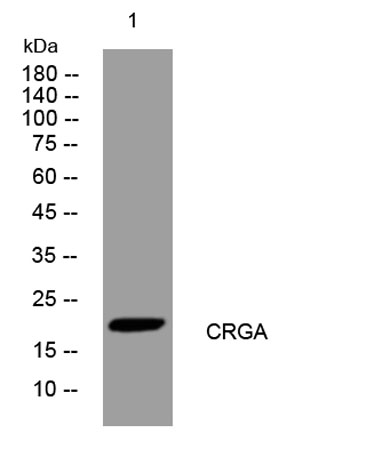
| Molecular Weight (Da) | 19kD |
| Observed band (KD) | |
| Background | Crystallins are separated into two classes: taxon-specific, or enzyme, and ubiquitous. The latter class constitutes the major proteins of vertebrate eye lens and maintains the transparency and refractive index of the lens. Since lens central fiber cells lose their nuclei during development, these crystallins are made and then retained throughout life, making them extremely stable proteins. Mammalian lens crystallins are divided into alpha, beta, and gamma families; beta and gamma crystallins are also considered as a superfamily. Alpha and beta families are further divided into acidic and basic groups. Seven protein regions exist in crystallins: four homologous motifs, a connecting peptide, and N- and C-terminal extensions. Gamma-crystallins are a homogeneous group of highly symmetrical, monomeric proteins typically lacking connecting peptides and terminal extensions. They are differentially regulated after early development. Four gamma-crystallin genes (gamma-A through gamma-D) and three pseudogenes (gamma-E, gamma-F, gamma-G) are tandemly organized in a genomic segment as a gene cluster. Whether due to aging or mutations in specific genes, gamma-crystallins have been involved in cataract formation. [provided by RefSeq, Jul 2008], |
| Function | domain:Has a two-domain beta-structure, folded into four very similar Greek key motifs.,function:Crystallins are the dominant structural components of the vertebrate eye lens.,similarity:Belongs to the beta/gamma-crystallin family.,similarity:Contains 4 beta/gamma crystallin 'Greek key' domains.,subunit:Monomer., |
| Subcellular location | |
| Expression |

Use collapsible tabs for more detailed information that will help customers make a purchasing decision.
Ex: Shipping and return policies, size guides, and other common questions.