 Français
 English

| ELK.No | ES17232 |
| Product name | CRBB3 rabbit pAb |
| Reactivity | Human; Mouse;Rat |
| Applications | WB |
| Other name | |
| Size | 100μL |
| Unit price ($) | 248 |
| Human gene ID | 1417 |
| Human Swiss-Prot | P26998 |
| Source | Rabbit |
| Isotype | IgG |
| Target | CRBB3 |
| Fields | |
| Gene name | CRYBB3 CRYB3 |
| Protein name | CRBB3 |
| Human gene link | View Human Gene |
| Human Swiss link | View Human Swiss-Prot |
| Mouse gene ID | 12962 |
| Mouse gene link | View Mouse Gene |
| Mouse Swiss-Prot | Q9JJU9 |
| Mouse Swiss link | View Mouse Swiss-Prot |
| Rat gene ID | 64349 |
| Rat gene link | View Rat Gene |
| Rat Swiss-Prot | P02524 |
| Rat Swiss link | View Rat Swiss-Prot |
| Immunogen | Synthesized peptide derived from human CRBB3 AA range: 110-160 |
| Specificity | This antibody detects endogenous levels of CRBB3 at Human/Mouse/Rat |
| Formulation | Liquid in PBS containing 50% glycerol, 0.5% BSA and 0.02% sodium azide. |
| Clonality | Polyclonal |
| Dilution | WB 1:500-2000 |
| Purification | The antibody was affinity-purified from rabbit serum by affinity-chromatography using specific immunogen. |
| Concentration | 1 mg/ml |
| Storage stability | -20°C/1 year |
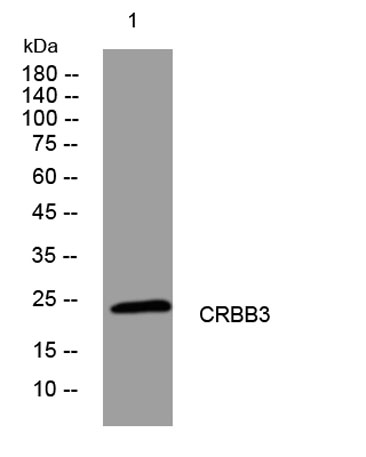
| Molecular Weight (Da) | 23kD |
| Observed band (KD) | |
| Background | Crystallins are separated into two classes: taxon-specific, or enzyme, and ubiquitous. The latter class constitutes the major proteins of vertebrate eye lens and maintains the transparency and refractive index of the lens. Since lens central fiber cells lose their nuclei during development, these crystallins are made and then retained throughout life, making them extremely stable proteins. Mammalian lens crystallins are divided into alpha, beta, and gamma families; beta and gamma crystallins are also considered as a superfamily. Alpha and beta families are further divided into acidic and basic groups. Seven protein regions exist in crystallins: four homologous motifs, a connecting peptide, and N- and C-terminal extensions. Beta-crystallins, the most heterogeneous, differ by the presence of the C-terminal extension (present in the basic group, none in the acidic group). Beta-crystallins form aggregates of different sizes and are able to self-associate to form dimers or to form heterodimers with other beta-crystallins. This gene, a beta basic group member, is part of a gene cluster with beta-A4, beta-B1, and beta-B2. Mutations in this gene result in cataract congenital nuclear autosomal recessive type 2. [provided by RefSeq, Feb 2013], |
| Function | disease:Crystallins do not turn over as the lens ages, providing ample opportunity for post-translational modifications or oxidations. These modifications may change crystallin solubility properties and favor senile cataract.,disease:Defects in CRYBB3 are the cause of autosomal recessive congenital nuclear cataract 2 (CATCN2) [MIM:609741]. CATCN2 is a form of non-syndromic congenital cataract. Non-syndromic congenital cataracts vary markedly in severity and morphology, affecting the nuclear, cortical, polar, or subcapsular parts of the lens or, in severe cases, the entire lens, with a variety of types of opacity. They are one of the major causes of vision loss in children worldwide and are responsible for approximately one third of blindness in infants. Congenital cataracts can lead to permanent blindness by interfering with the sharp focus of light on the retina during critical developm |
| Subcellular location | |
| Expression |

Use collapsible tabs for more detailed information that will help customers make a purchasing decision.
Ex: Shipping and return policies, size guides, and other common questions.