 Français
 English

| ELK.No | ES17374 |
| Product name | CLIC5 rabbit pAb |
| Reactivity | Human; Mouse;Rat |
| Applications | WB |
| Other name | |
| Size | 50μL |
| Unit price ($) | 148 |
| Human gene ID | 53405 |
| Human Swiss-Prot | Q9NZA1 |
| Source | Rabbit |
| Isotype | IgG |
| Target | CLIC5 |
| Fields | |
| Gene name | CLIC5 |
| Protein name | CLIC5 |
| Human gene link | View Human Gene |
| Human Swiss link | View Human Swiss-Prot |
| Mouse gene ID | 224796 |
| Mouse gene link | View Mouse Gene |
| Mouse Swiss-Prot | Q8BXK9 |
| Mouse Swiss link | View Mouse Swiss-Prot |
| Rat gene ID | 94272 |
| Rat gene link | View Rat Gene |
| Rat Swiss-Prot | Q9EPT8 |
| Rat Swiss link | View Rat Swiss-Prot |
| Immunogen | Synthesized peptide derived from human CLIC5 AA range: 156-206 |
| Specificity | This antibody detects endogenous levels of CLIC5 at Human/Mouse/Rat |
| Formulation | Liquid in PBS containing 50% glycerol, 0.5% BSA and 0.02% sodium azide. |
| Clonality | Polyclonal |
| Dilution | WB 1:500-2000 |
| Purification | The antibody was affinity-purified from rabbit serum by affinity-chromatography using specific immunogen. |
| Concentration | 1 mg/ml |
| Storage stability | -20°C/1 year |
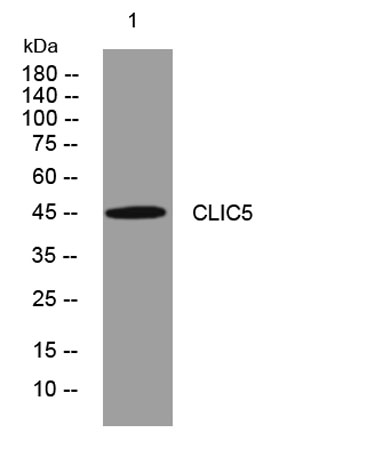
| Molecular Weight (Da) | 45kD |
| Observed band (KD) | |
| Background | This gene encodes a member of the chloride intracellular channel (CLIC) family of chloride ion channels. The encoded protein associates with actin-based cytoskeletal structures and may play a role in multiple processes including hair cell stereocilia formation, myoblast proliferation and glomerular podocyte and endothelial cell maintenance. Alternatively spliced transcript variants encoding multiple isoforms have been observed for this gene. [provided by RefSeq, Dec 2011], |
| Function | domain:Members of this family may change from a globular, soluble state to a state where the N-terminal domain is inserted into the membrane and functions as chloride channel. A conformation change of the N-terminal domain is thought to expose hydrophobic surfaces that trigger membrane insertion.,function:Can insert into membranes and form poorly selective ion channels that may also transport chloride ions. May play a role in the regulation of transepithelial ion absorption and secretion. Required for normal formation of stereocilia in the inner ear and normal development of the organ of Corti.,similarity:Belongs to the chloride channel CLIC family.,similarity:Contains 1 GST C-terminal domain.,subcellular location:Associates with the cortical actin cytoskeleton. Exists both as soluble cytoplasmic protein and as membrane protein with probably a single transmembrane domain.,subcellular loc |
| Subcellular location | [Isoform 1]: Cytoplasm, cytoskeleton . Cytoplasm, cell cortex . Membrane ; Single-pass membrane protein . Apical cell membrane ; Single-pass membrane protein . Cytoplasm . Associates with the cortical actin cytoskeleton (PubMed:10793131, PubMed:15184393). Localizes to the apical region of cochlear hair cells, at the base of the actin-rich hair bundle (By similarity). Colocalizes with podocalyxin at the apical cell membrane in renal glomeruli (PubMed:20335315). May localize to the centrosome in lens epithelial cells (By similarity). Exists both as soluble cytoplasmic protein and as membrane protein with probably a single transmembrane domain (By similarity). .; [Isoform 2]: Golgi apparatus . Cytoplasm, cytoskeleton, microtubule organizing center, centrosome . Colocalizes with AKAP9 at the G |
| Expression | Widely expressed in both fetal and adult human tissues (PubMed:24781754). Isoform 1 is expressed in renal glomeruli endothelial cells and podocytes (at protein level). |

Use collapsible tabs for more detailed information that will help customers make a purchasing decision.
Ex: Shipping and return policies, size guides, and other common questions.