 Français
 English
Caspase 10 (p23/17, Cleaved-Val220) Rabbit pAb
AO-06-ES17852-50

| ELK.No | ES17852 |
| Product name | Caspase 10 (p23/17, Cleaved-Val220) Rabbit pAb |
| Reactivity | Human; Mouse; Rat |
| Applications | WB; ELISA |
| Other name | Caspase-10 (CASP-10;EC 3.4.22.63;Apoptotic protease Mch-4;FAS-associated death domain protein interleukin-1B-converting enzyme 2;FLICE2;ICE-like apoptotic protease 4) [Cleaved into: Caspase-10 subunit p23/17; Caspase-10 subunit p12] |
| Size | 50μL |
| Unit price ($) | 148 |
| Human gene ID | 843 |
| Human Swiss-Prot | Q92851 |
| Source | Rabbit |
| Isotype | IgG |
| Target | Caspase-10 |
| Fields | >>Apoptosis;>>RIG-I-like receptor signaling pathway;>>TNF signaling pathway;>>Tuberculosis;>>Hepatitis B |
| Gene name | CASP10 MCH4 |
| Protein name | Caspase10 |
| Human gene link | |
| Human Swiss link | View Human Swiss-Prot |
| Mouse gene ID | |
| Mouse gene link | |
| Mouse Swiss-Prot | |
| Mouse Swiss link | |
| Rat gene ID | |
| Rat gene link | |
| Rat Swiss-Prot | |
| Rat Swiss link | |
| Immunogen | Synthesized peptide derived from human Caspase 10 (p23/17, Cleaved-Val220) |
| Specificity | This antibody detects endogenous levels of human Caspase 10 (p23/17, Cleaved-Val220) |
| Formulation | Liquid in PBS containing 50% glycerol, 0.5% BSA and 0.02% sodium azide. |
| Clonality | Polyclonal |
| Dilution | WB 1:500-2000, ELISA(peptide)1:5000-20000 |
| Purification | The antibody was affinity-purified from mouse ascites by affinity-chromatography using specific immunogen. |
| Concentration | 1 mg/ml |
| Storage stability | -20°C/1 year |
| Molecular Weight (Da) | |
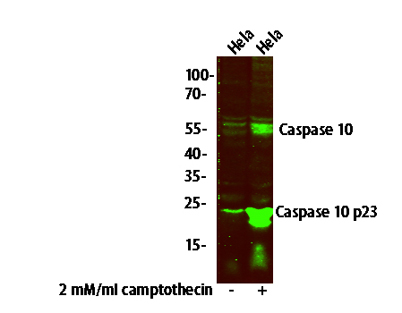
| Observed band (KD) | 58+23kD |
| Background | This gene encodes a protein which is a member of the cysteine-aspartic acid protease (caspase) family. Sequential activation of caspases plays a central role in the execution-phase of cell apoptosis. Caspases exist as inactive proenzymes which undergo proteolytic processing at conserved aspartic residues to produce two subunits, large and small, that dimerize to form the active enzyme. This protein cleaves and activates caspases 3 and 7, and the protein itself is processed by caspase 8. Mutations in this gene are associated with type IIA autoimmune lymphoproliferative syndrome, non-Hodgkin lymphoma and gastric cancer. Alternatively spliced transcript variants encoding different isoforms have been described for this gene. [provided by RefSeq, Apr 2011], |
| Function | catalytic activity:Strict requirement for Asp at position P1 and has a preferred cleavage sequence of Leu-Gln-Thr-Asp-|-Gly.,disease:Defects in CASP10 are a cause of familial non-Hodgkin lymphoma (NHL) [MIM:605027]. NHL is a cancer that starts in cells of the lymph system, which is part of the body's immune system. NHLs can occur at any age and are often marked by enlarged lymph nodes, fever and weight loss.,disease:Defects in CASP10 are a cause of gastric cancers [MIM:137215].,disease:Defects in CASP10 are the cause of autoimmune lymphoproliferative syndrome type 2A (ALPS2A) [MIM:603909]. ALPS2 is characterized by abnormal lymphocyte and dendritic cell homeostasis and immune regulatory defects.,function:Involved in the activation cascade of caspases responsible for apoptosis execution. Recruited to both Fas- and TNFR-1 receptors in a FADD dependent manner. May participate in the granzym |
| Subcellular location | cytosol,CD95 death-inducing signaling complex,ripoptosome, |
| Expression | Detectable in most tissues. Lowest expression is seen in brain, kidney, prostate, testis and colon. |

Use collapsible tabs for more detailed information that will help customers make a purchasing decision.
Ex: Shipping and return policies, size guides, and other common questions.