 Français
 English
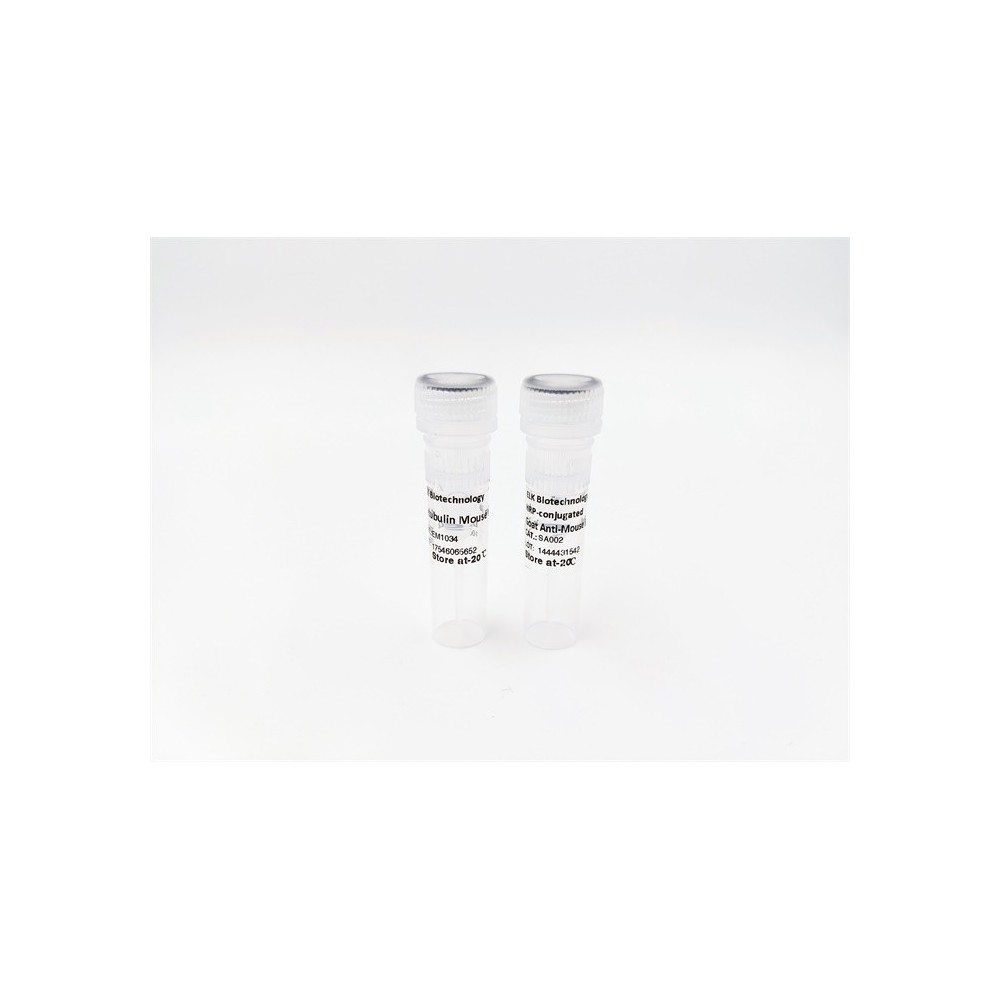

| ELK.No | ES17938 |
| Product name | BYST rabbit pAb |
| Reactivity | Human; Mouse;Rat |
| Applications | WB |
| Other name | |
| Size | 100μL |
| Unit price ($) | 248 |
| Human gene ID | 705 |
| Human Swiss-Prot | Q13895 |
| Source | Rabbit |
| Isotype | IgG |
| Target | BYST |
| Fields | |
| Gene name | BYSL |
| Protein name | BYST |
| Human gene link | View Human Gene |
| Human Swiss link | View Human Swiss-Prot |
| Mouse gene ID | 53414 |
| Mouse gene link | View Mouse Gene |
| Mouse Swiss-Prot | O54825 |
| Mouse Swiss link | View Mouse Swiss-Prot |
| Rat gene ID | 359727 |
| Rat gene link | View Rat Gene |
| Rat Swiss-Prot | Q80WL2 |
| Rat Swiss link | View Rat Swiss-Prot |
| Immunogen | Synthesized peptide derived from human BYST AA range: 127-177 |
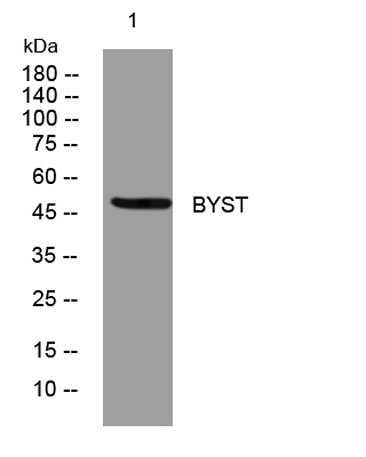
| Specificity | This antibody detects endogenous levels of BYST at Human/Mouse/Rat |
| Formulation | Liquid in PBS containing 50% glycerol, 0.5% BSA and 0.02% sodium azide. |
| Clonality | Polyclonal |
| Dilution | WB 1:500-2000 |
| Purification | The antibody was affinity-purified from rabbit serum by affinity-chromatography using specific immunogen. |
| Concentration | 1 mg/ml |
| Storage stability | -20°C/1 year |
| Molecular Weight (Da) | 48kD |
| Observed band (KD) | |
| Background | Bystin is expressed as a 2-kb major transcript and a 3.6-kb minor transcript in SNG-M cells and in human trophoblastic teratocarcinoma HT-H cells. Protein binding assays determined that bystin binds directly to trophinin and tastin, and that binding is enhanced when cytokeratins 8 and 18 are present. Immunocytochemistry of HT-H cells showed that bystin colocalizes with trophinin, tastin, and the cytokeratins, suggesting that these molecules form a complex in trophectoderm cells at the time of implantation. Using immunohistochemistry it was determined that trophinin and bystin are found in the placenta from the sixth week of pregnancy. Both proteins were localized in the cytoplasm of the syncytiotrophoblast in the chorionic villi and in endometrial decidual cells at the uteroplacental interface. After week 10, the levels of trophinin, tastin, and bystin decreased and then disappeared from placental villi. [provided by RefSeq, Jul 2008], |
| Function | function:Required for processing of 20S pre-rRNA precursor and biogenesis of 40S ribosomal subunits. May be required for trophinin-dependent regulation of cell adhesion during implantation of human embryos.,miscellaneous:HeLa cells lacking BYSL show a delay in the processing of the 18S rRNA component of the 40S ribosomal subunit. HT-H cells lacking BYSL show trophinin-independent signaling through ERBB4.,similarity:Belongs to the bystin family.,subcellular location:Associated with 40S ribosomal subunits.,subunit:Binds trophinin, tastin and cytokeratins.,tissue specificity:Found in the placenta from the sixth week of pregnancy. Was localized in the cytoplasm of the syncytiotrophoblast in the chorionic villi and in endometrial decidual cells at the uteroplacental interface. After week 10, the level decreased and then disappeared from placental villi., |
| Subcellular location | Cytoplasm . Nucleus, nucleolus . Associated with 40S ribosomal subunits. |
| Expression | Found in the placenta from the sixth week of pregnancy. Was localized in the cytoplasm of the syncytiotrophoblast in the chorionic villi and in endometrial decidual cells at the uteroplacental interface. After week 10, the level decreased and then disappeared from placental villi. |

Use collapsible tabs for more detailed information that will help customers make a purchasing decision.
Ex: Shipping and return policies, size guides, and other common questions.