 Français
 English

| ELK.No | ES17945 |
| Product name | BTBD9 rabbit pAb |
| Reactivity | Human; Mouse;Rat |
| Applications | WB |
| Other name | |
| Size | 100μL |
| Unit price ($) | 248 |
| Human gene ID | 114781 |
| Human Swiss-Prot | Q96Q07 |
| Source | Rabbit |
| Isotype | IgG |
| Target | BTBD9 |
| Fields | |
| Gene name | BTBD9 KIAA1880 |
| Protein name | BTBD9 |
| Human gene link | View Human Gene |
| Human Swiss link | View Human Swiss-Prot |
| Mouse gene ID | 224671 |
| Mouse gene link | View Mouse Gene |
| Mouse Swiss-Prot | Q8C726 |
| Mouse Swiss link | View Mouse Swiss-Prot |
| Rat gene ID | 294318 |
| Rat gene link | View Rat Gene |
| Rat Swiss-Prot | Q5PQR3 |
| Rat Swiss link | View Rat Swiss-Prot |
| Immunogen | Synthesized peptide derived from human BTBD9 AA range: 424-474 |
| Specificity | This antibody detects endogenous levels of BTBD9 at Human/Mouse/Rat |
| Formulation | Liquid in PBS containing 50% glycerol, 0.5% BSA and 0.02% sodium azide. |
| Clonality | Polyclonal |
| Dilution | WB 1:500-2000 |
| Purification | The antibody was affinity-purified from rabbit serum by affinity-chromatography using specific immunogen. |
| Concentration | 1 mg/ml |
| Storage stability | -20°C/1 year |
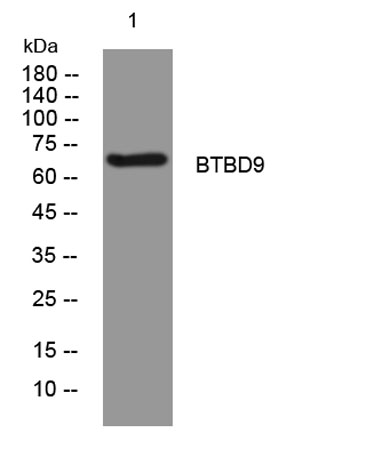
| Molecular Weight (Da) | 67kD |
| Observed band (KD) | |
| Background | This locus encodes a BTB/POZ domain-containing protein. This domain is known to be involved in protein-protein interactions. Polymorphisms at this locus have been reported to be associated with susceptibility to Restless Legs Syndrome and may also be associated with Tourette Syndrome. Alternatively spliced transcript variants have been described. [provided by RefSeq, Aug 2011], |
| Function | disease:Genetic variations in BTBD9 are associated with susceptibility to restless legs syndrome type 6 (RLS6) [MIM:611185]; also called periodic limb movements in sleep. Restless legs syndrome (RLS) is a neurologic disorder characterized by an uncontrollable urge to move the legs during periods of rest. The majority of patients with RLS also have periodic limb movements in sleep, which are characterized by involuntary, highly stereotypical, regularly occurring limb movements that occur during sleep.,similarity:Contains 1 BACK (BTB/Kelch associated) domain.,similarity:Contains 1 BTB (POZ) domain.,tissue specificity:Highly expressed in kidney and moderately expressed in all other adult and fetal tissues. Moderately expressed in all specific brain regions examined., |
| Subcellular location | cytoplasm,SCF ubiquitin ligase complex, |
| Expression | Detected in the brain (at protein level) (PubMed:22658601). Moderately expressed in all specific brain regions examined (PubMed:11572484). Expressed in the dopaminergic neurons of the substantia nigra and A11 neurons (PubMed:22658601). Highly expressed in kidney and moderately expressed in all other adult and fetal tissues (PubMed:11572484). |

Use collapsible tabs for more detailed information that will help customers make a purchasing decision.
Ex: Shipping and return policies, size guides, and other common questions.