 Français
 English
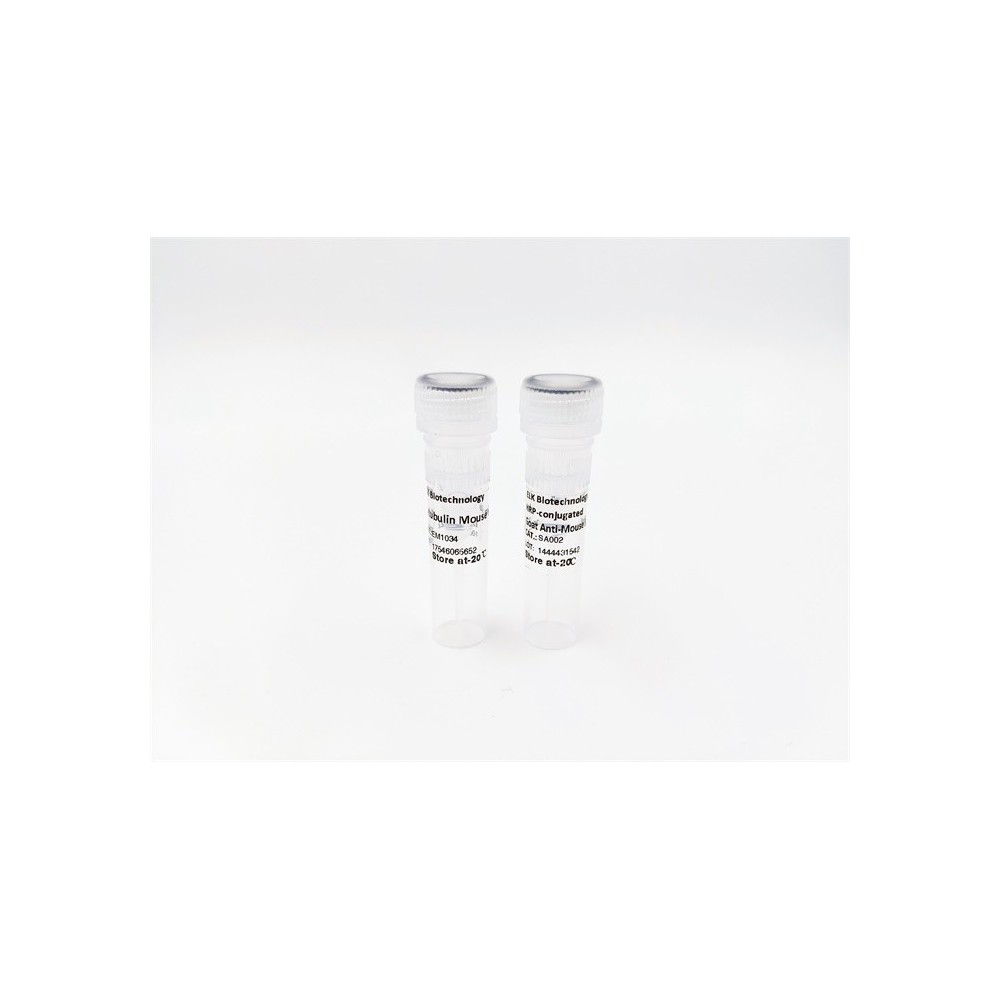

| ELK.No | ES1799 |
| Product name | BTR1 rabbit pAb |
| Reactivity | Human;Rat;Mouse; |
| Applications | WB;ELISA |
| Other name | SLC4A11; BTR1; Sodium bicarbonate transporter-like protein 11; Bicarbonate transporter-related protein 1; Sodium borate cotransporter 1; NaBC1; Solute carrier family 4 member 11 |
| Size | 50μL |
| Unit price ($) | 148 |
| Human gene ID | 83959 |
| Human Swiss-Prot | Q8NBS3 |
| Source | Rabbit |
| Isotype | IgG |
| Target | BTR1 |
| Fields | |
| Gene name | SLC4A11 |
| Protein name | Sodium bicarbonate transporter-like protein 11 |
| Human gene link | View Human Gene |
| Human Swiss link | View Human Swiss-Prot |
| Mouse gene ID | |
| Mouse gene link | |
| Mouse Swiss-Prot | A2AJN7 |
| Mouse Swiss link | View Mouse Swiss-Prot |
| Rat gene ID | |
| Rat gene link | |
| Rat Swiss-Prot | |
| Rat Swiss link | |
| Immunogen | The antiserum was produced against synthesized peptide derived from human SLC4A11. AA range:291-340 |
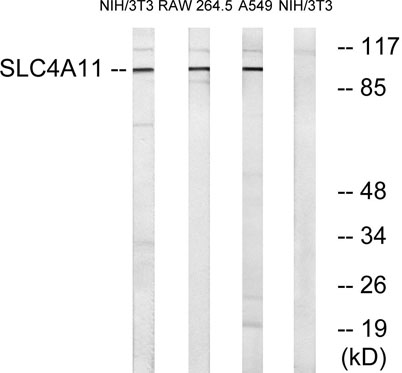
| Specificity | BTR1 Polyclonal Antibody detects endogenous levels of BTR1 protein. |
| Formulation | Liquid in PBS containing 50% glycerol, 0.5% BSA and 0.02% sodium azide. |
| Clonality | Polyclonal |
| Dilution | Western Blot: 1/500 - 1/2000. ELISA: 1/20000. Not yet tested in other applications. |
| Purification | The antibody was affinity-purified from rabbit antiserum by affinity-chromatography using epitope-specific immunogen. |
| Concentration | 1 mg/ml |
| Storage stability | -20°C/1 year |
| Molecular Weight (Da) | |
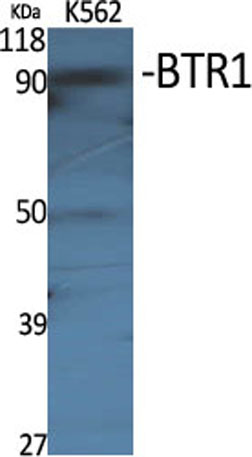
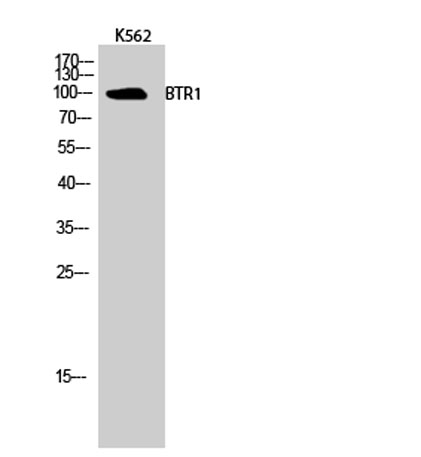
| Observed band (KD) | 100kD |
| Background | This gene encodes a voltage-regulated, electrogenic sodium-coupled borate cotransporter that is essential for borate homeostasis, cell growth and cell proliferation. Mutations in this gene have been associated with a number of endothelial corneal dystrophies including recessive corneal endothelial dystrophy 2, corneal dystrophy and perceptive deafness, and Fuchs endothelial corneal dystrophy. Multiple transcript variants encoding different isoforms have been described. [provided by RefSeq, Mar 2010], |
| Function | disease:Defects in SLC4A11 are the cause of corneal dystrophy and perceptive deafness (CDPD) [MIM:217400]; also known as corneal dystrophy and sensorineural deafness or Harboyan syndrome. CDPD consists of congenital corneal endothelial dystrophy and progressive perceptive deafness. Inheritance is autosomal recessive.,disease:Defects in SLC4A11 are the cause of corneal endothelial dystrophy type 2 (CHED2) [MIM:217700]; also known as congenital hereditary endothelial dystrophy of cornea. This bilateral corneal dystrophy is characterized by corneal opacification and nystagmus. Inheritance is autosomal recessive.,function:Transporter involved in borate homeostasis. In the absence of borate, it functions as a Na(+) and OH(-)(H(+)) channel. In the presence of borate functions as an electrogenic Na(+) coupled borate cotransporter.,PTM:Glycosylated.,similarity:Belongs to the anion exchanger (TC |
| Subcellular location | Cell membrane ; Multi-pass membrane protein . Basolateral cell membrane ; Multi-pass membrane protein . |
| Expression | Widely expressed. Highly expressed in kidney, testis, salivary gland, thyroid, trachea and corneal endothelium. Not detected in retina and lymphocytes. ; [Isoform 3]: Expressed in corneal endothelium (at protein level). ; [Isoform 5]: The predominant isoform in corneal endothelium (at protein level). |

Use collapsible tabs for more detailed information that will help customers make a purchasing decision.
Ex: Shipping and return policies, size guides, and other common questions.