 Français
 English
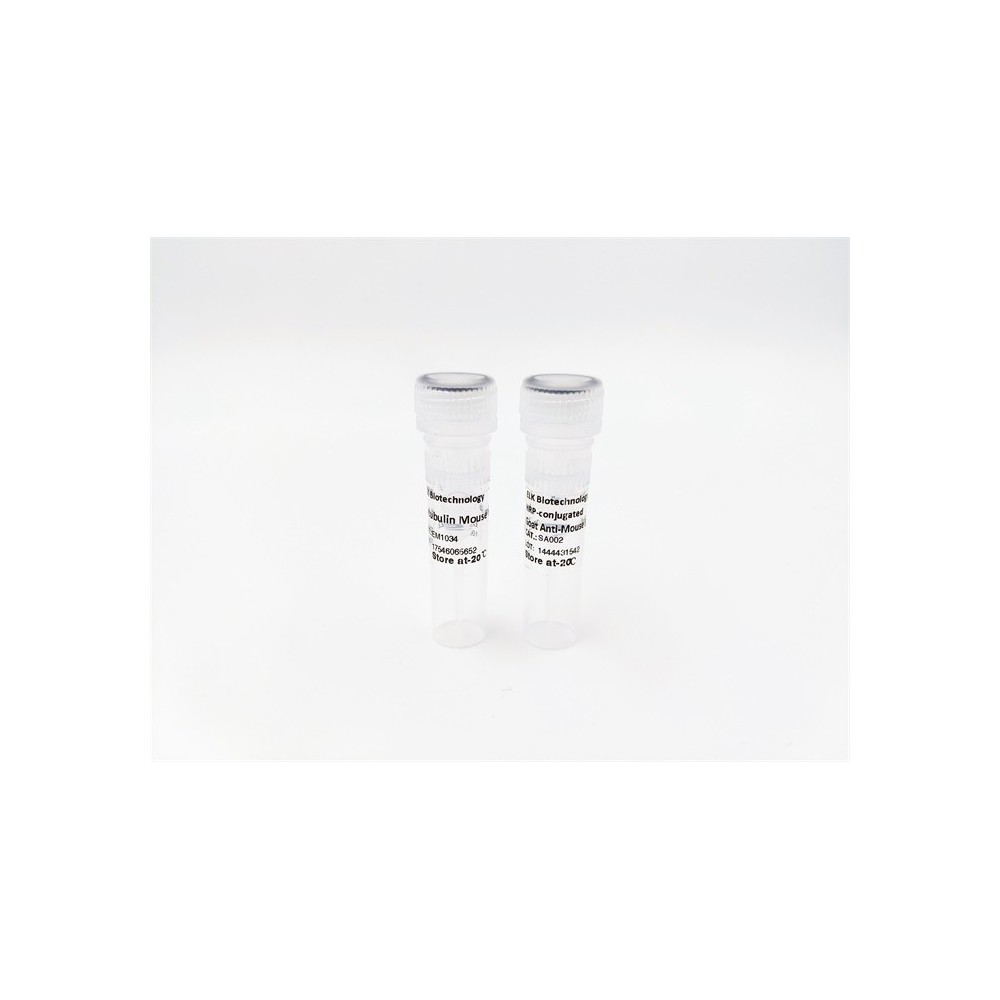

| ELK.No | ES18112 |
| Product name | B3GL1 rabbit pAb |
| Reactivity | Human; Mouse;Rat |
| Applications | WB |
| Other name | |
| Size | 50μL |
| Unit price ($) | 148 |
| Human gene ID | 8706 |
| Human Swiss-Prot | O75752 |
| Source | Rabbit |
| Isotype | IgG |
| Target | B3GL1 |
| Fields | >>Glycosphingolipid biosynthesis - lacto and neolacto series;>>Glycosphingolipid biosynthesis - globo and isoglobo series;>>Metabolic pathways |
| Gene name | B3GALNT1 B3GALT3 UNQ531/PRO1074 |
| Protein name | B3GL1 |
| Human gene link | View Human Gene |
| Human Swiss link | View Human Swiss-Prot |
| Mouse gene ID | 26879 |
| Mouse gene link | View Mouse Gene |
| Mouse Swiss-Prot | Q920V1 |
| Mouse Swiss link | View Mouse Swiss-Prot |
| Rat gene ID | 310508 |
| Rat gene link | View Rat Gene |
| Rat Swiss-Prot | Q6AY39 |
| Rat Swiss link | View Rat Swiss-Prot |
| Immunogen | Synthesized peptide derived from human B3GL1 AA range: 24-74 |
| Specificity | This antibody detects endogenous levels of B3GL1 at Human/Mouse/Rat |
| Formulation | Liquid in PBS containing 50% glycerol, 0.5% BSA and 0.02% sodium azide. |
| Clonality | Polyclonal |
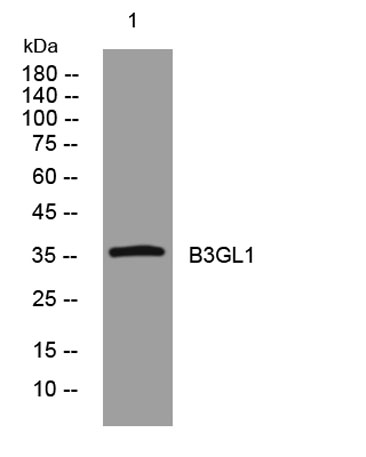
| Dilution | WB 1:500-2000 |
| Purification | The antibody was affinity-purified from rabbit serum by affinity-chromatography using specific immunogen. |
| Concentration | 1 mg/ml |
| Storage stability | -20°C/1 year |
| Molecular Weight (Da) | 36kD |
| Observed band (KD) | |
| Background | This gene is a member of the beta-1,3-galactosyltransferase (beta3GalT) gene family. This family encodes type II membrane-bound glycoproteins with diverse enzymatic functions using different donor substrates (UDP-galactose and UDP-N-acetylglucosamine) and different acceptor sugars (N-acetylglucosamine, galactose, N-acetylgalactosamine). The beta3GalT genes are distantly related to the Drosophila Brainiac gene and have the protein coding sequence contained in a single exon. The beta3GalT proteins also contain conserved sequences not found in the beta4GalT or alpha3GalT proteins. The carbohydrate chains synthesized by these enzymes are designated as type 1, whereas beta4GalT enzymes synthesize type 2 carbohydrate chains. The ratio of type 1:type 2 chains changes during embryogenesis. By sequence similarity, the beta3GalT genes fall into at least two groups: beta3GalT4 and 4 other beta3GalT genes (beta3GalT1-3, beta3GalT5). The encoded protein of this gene does not use N-acetylglucosamine as an acceptor sugar at all. Multiple transcript variants that are alternatively spliced in the 5' UTR have been described; they all encode the same protein. [provided by RefSeq, Jul 2008], |
| Function | catalytic activity:UDP-N-acetyl-D-galactosamine + alpha-D-galactosyl-(1->4)-beta-D-galactosyl-(1->4)-beta-D-glucosyl-(11)-ceramide = UDP + N-acetyl-beta-D-galactosaminyl-(1->3)-alpha-D-galactosyl-(1->4)-beta-D-galactosyl-(1->4)-beta-D-glucosyl-(11)-ceramide.,cofactor:Magnesium.,function:Transfers N-acetylgalactosamine onto globotriaosylceramide.,online information:Beta-1,3-galactosyltransferase 3,online information:Blood group antigen gene mutation database,online information:GlycoGene database,pathway:Protein modification; protein glycosylation.,polymorphism:Different combinations or absence of the P blood group system antigens define 5 different phenotypes: P1, P2, P1(k), P2(k), and P. Genetic variation in B3GALT3 determines the P1(k) and P2(k) phenotype, which is rare and lack the capability to synthesize P antigen identified as globoside.,similarity:Belongs to the glycosyltrans |
| Subcellular location | Golgi apparatus membrane; Single-pass type II membrane protein. |
| Expression | Higher expression in heart and brain, and to a lesser extent in lung, placenta, kidney and testis. Lower expression in liver, spleen and stomach. No expression in skeletal muscle. |

Use collapsible tabs for more detailed information that will help customers make a purchasing decision.
Ex: Shipping and return policies, size guides, and other common questions.