 Français
 English
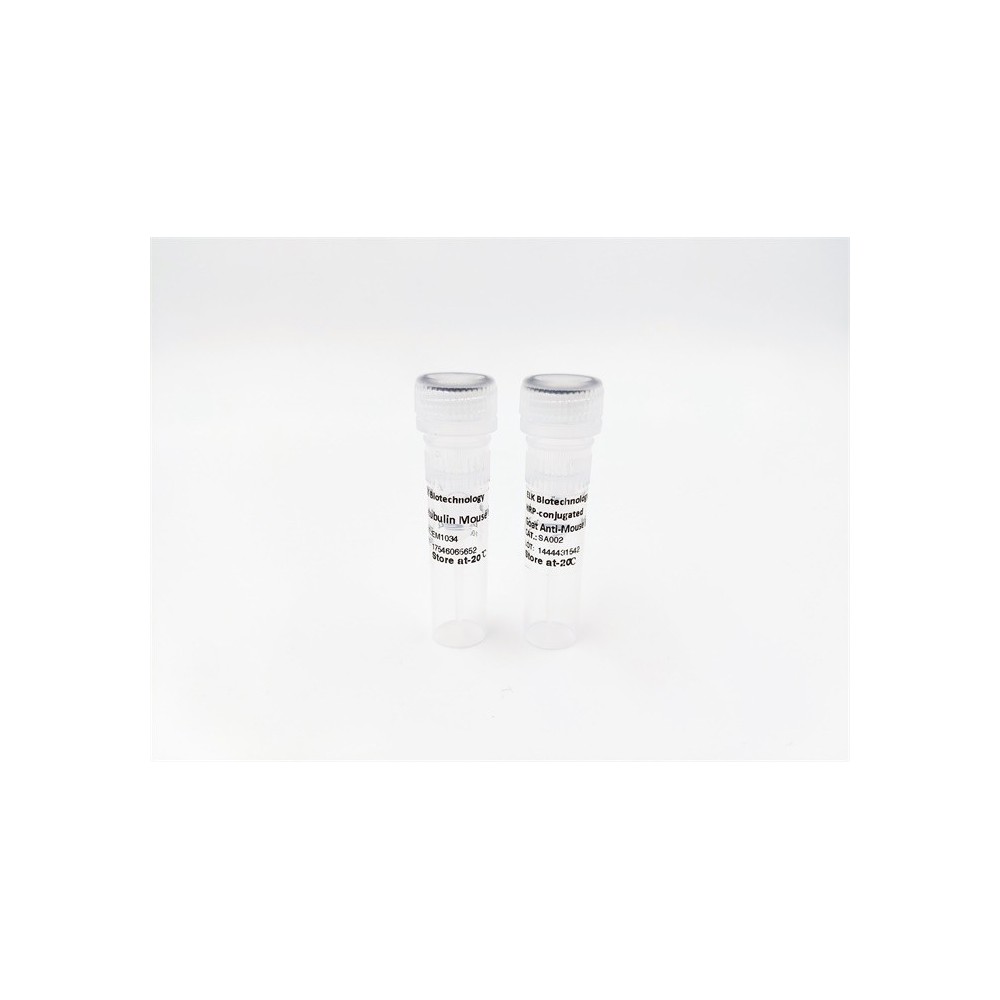

| ELK.No | ES1812 |
| Product name | CA IX rabbit pAb |
| Reactivity | Human;Rat;Mouse; |
| Applications | WB;ELISA |
| Other name | CA9; G250; MN; Carbonic anhydrase 9; Carbonate dehydratase IX; Carbonic anhydrase IX; CA-IX; CAIX; Membrane antigen MN; P54/58N; Renal cell carcinoma-associated antigen G250; RCC-associated antigen G250; pMW1 |
| Size | 100μL |
| Unit price ($) | 248 |
| Human gene ID | 768 |
| Human Swiss-Prot | Q16790 |
| Source | Rabbit |
| Isotype | IgG |
| Target | CA IX |
| Fields | >>Nitrogen metabolism;>>Metabolic pathways |
| Gene name | CA9 |
| Protein name | Carbonic anhydrase 9 |
| Human gene link | View Human Gene |
| Human Swiss link | View Human Swiss-Prot |
| Mouse gene ID | |
| Mouse gene link | |
| Mouse Swiss-Prot | Q8VHB5 |
| Mouse Swiss link | View Mouse Swiss-Prot |
| Rat gene ID | |
| Rat gene link | |
| Rat Swiss-Prot | |
| Rat Swiss link | |
| Immunogen | The antiserum was produced against synthesized peptide derived from human CA IX. AA range:33-82 |
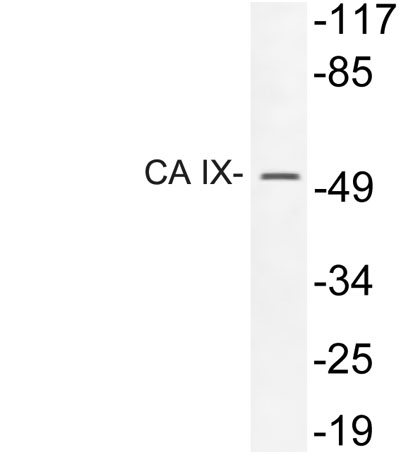
| Specificity | CA IX Polyclonal Antibody detects endogenous levels of CA IX protein. |
| Formulation | Liquid in PBS containing 50% glycerol, 0.5% BSA and 0.02% sodium azide. |
| Clonality | Polyclonal |
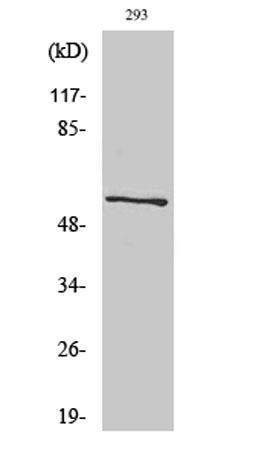
| Dilution | Western Blot: 1/500 - 1/2000. ELISA: 1/10000. Not yet tested in other applications. |
| Purification | The antibody was affinity-purified from rabbit antiserum by affinity-chromatography using epitope-specific immunogen. |
| Concentration | 1 mg/ml |
| Storage stability | -20°C/1 year |
| Molecular Weight (Da) | |
| Observed band (KD) | 58kD |
| Background | Carbonic anhydrases (CAs) are a large family of zinc metalloenzymes that catalyze the reversible hydration of carbon dioxide. They participate in a variety of biological processes, including respiration, calcification, acid-base balance, bone resorption, and the formation of aqueous humor, cerebrospinal fluid, saliva, and gastric acid. They show extensive diversity in tissue distribution and in their subcellular localization. CA IX is a transmembrane protein and is one of only two tumor-associated carbonic anhydrase isoenzymes known. It is expressed in all clear-cell renal cell carcinoma, but is not detected in normal kidney or most other normal tissues. It may be involved in cell proliferation and transformation. This gene was mapped to 17q21.2 by fluorescence in situ hybridization, however, radiation hybrid mapping localized it to 9p13-p12. [provided by RefSeq, Jun 2014], |
| Function | catalytic activity:H(2)CO(3) = CO(2) + H(2)O.,cofactor:Zinc.,function:Reversible hydration of carbon dioxide. Participates in pH regulation. May be involved in the control of cell proliferation and transformation. Appears to be a novel specific biomarker for a cervical neoplasia.,induction:By hypoxia.,PTM:Asn-346 bears high-mannose type glycan structures.,similarity:Belongs to the alpha-carbonic anhydrase family.,subcellular location:Found on the surface microvilli and in the nucleus, particularly in nucleolus.,subunit:Forms oligomers linked by disulfide bonds.,tissue specificity:Expressed primarily in carcinoma cells lines. Expression is restricted to very few normal tissues and the most abundant expression is found in the epithelial cells of gastric mucosa., |
| Subcellular location | Nucleus . Nucleus, nucleolus . Cell membrane ; Single-pass type I membrane protein . Cell projection, microvillus membrane ; Single-pass type I membrane protein . Found on the surface microvilli and in the nucleus, particularly in nucleolus. |
| Expression | Expressed primarily in carcinoma cells lines. Expression is restricted to very few normal tissues and the most abundant expression is found in the epithelial cells of gastric mucosa. |

Use collapsible tabs for more detailed information that will help customers make a purchasing decision.
Ex: Shipping and return policies, size guides, and other common questions.