 Français
 English

| ELK.No | ES18299 |
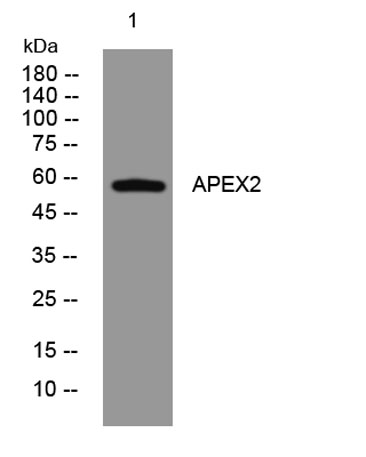
| Product name | APEX2 rabbit pAb |
| Reactivity | Human; Mouse |
| Applications | WB |
| Other name | |
| Size | 50μL |
| Unit price ($) | 148 |
| Human gene ID | 27301 |
| Human Swiss-Prot | Q9UBZ4 |
| Source | Rabbit |
| Isotype | IgG |
| Target | APEX2 |
| Fields | >>Base excision repair |
| Gene name | APEX2 APE2 APEXL2 XTH2 |
| Protein name | APEX2 |
| Human gene link | View Human Gene |
| Human Swiss link | View Human Swiss-Prot |
| Mouse gene ID | 77622 |
| Mouse gene link | View Mouse Gene |
| Mouse Swiss-Prot | Q68G58 |
| Mouse Swiss link | View Mouse Swiss-Prot |
| Rat gene ID | |
| Rat gene link | |
| Rat Swiss-Prot | |
| Rat Swiss link | |
| Immunogen | Synthesized peptide derived from human APEX2 AA range: 196-246 |
| Specificity | This antibody detects endogenous levels of APEX2 at Human/Mouse |
| Formulation | Liquid in PBS containing 50% glycerol, 0.5% BSA and 0.02% sodium azide. |
| Clonality | Polyclonal |
| Dilution | WB 1:500-2000 |
| Purification | The antibody was affinity-purified from rabbit serum by affinity-chromatography using specific immunogen. |
| Concentration | 1 mg/ml |
| Storage stability | -20°C/1 year |
| Molecular Weight (Da) | 57kD |
| Observed band (KD) | |
| Background | Apurinic/apyrimidinic (AP) sites occur frequently in DNA molecules by spontaneous hydrolysis, by DNA damaging agents or by DNA glycosylases that remove specific abnormal bases. AP sites are pre-mutagenic lesions that can prevent normal DNA replication so the cell contains systems to identify and repair such sites. Class II AP endonucleases cleave the phosphodiester backbone 5' to the AP site. This gene encodes a protein shown to have a weak class II AP endonuclease activity. Most of the encoded protein is located in the nucleus but some is also present in mitochondria. This protein may play an important role in both nuclear and mitochondrial base excision repair. Alternatively spliced transcript variants encoding multiple isoforms have been observed for this gene. [provided by RefSeq, Nov 2012], |
| Function | catalytic activity:The C-O-P bond 3' to the apurinic or apyrimidinic site in DNA is broken by a beta-elimination reaction, leaving a 3'-terminal unsaturated sugar and a product with a terminal 5'-phosphate.,function:May participate in both nuclear and mitochondrial post-replicative base excision repair (BER). In the nucleus functions in the PCNA-dependent BER pathway.,similarity:Belongs to the DNA repair enzymes AP/exoA family.,subcellular location:Colocalized partly with PCNA in nuclear foci.,subunit:Interacts with PCNA. This interaction is increased by misincorporation of uracil in nuclear DNA.,tissue specificity:Highly expressed in cells, adult brain and kidney. Weakly expressed in the fetal brain., |
| Subcellular location | Nucleus. Cytoplasm. Mitochondrion . Together with PCNA, is redistributed in discrete nuclear foci in presence of oxidative DNA damaging agents. |
| Expression | Highly expressed in brain and kidney. Weakly expressed in the fetal brain. |

Use collapsible tabs for more detailed information that will help customers make a purchasing decision.
Ex: Shipping and return policies, size guides, and other common questions.