 Français
 English
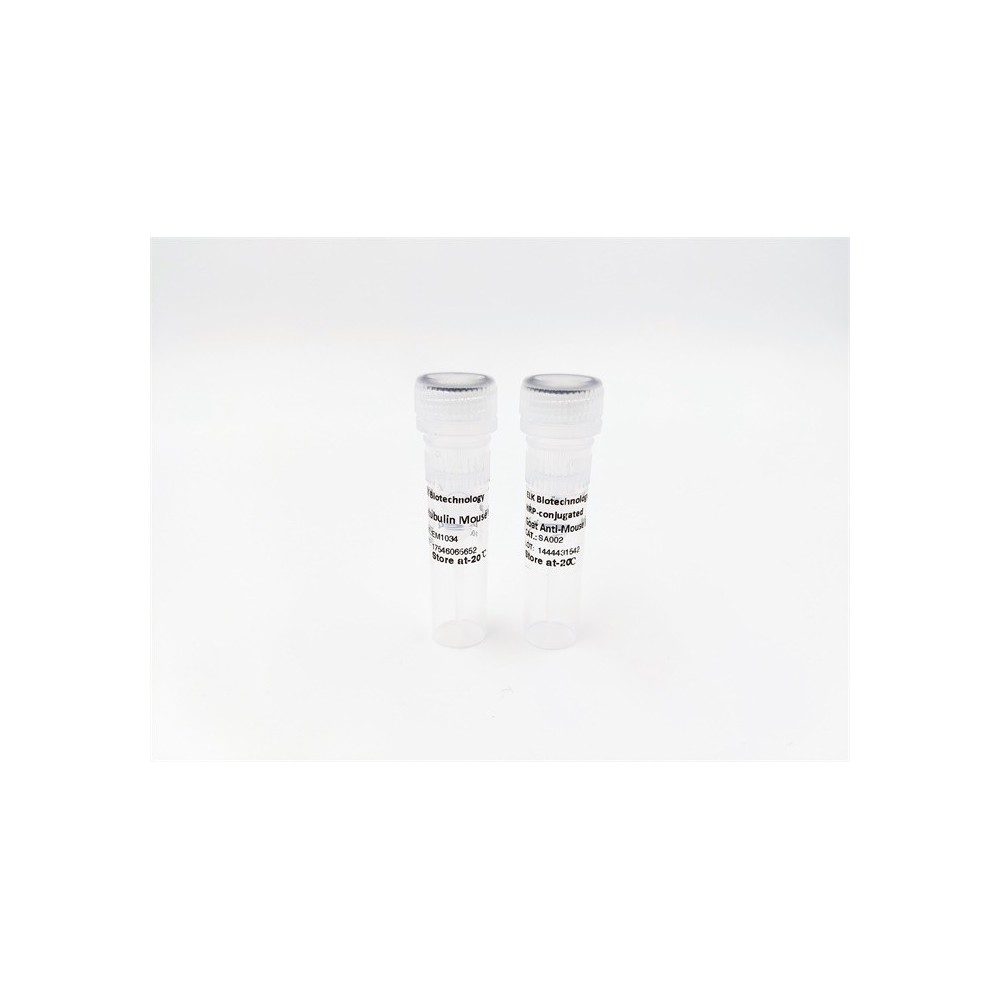

| ELK.No | ES1839 |
| Product name | CARD 10 rabbit pAb |
| Reactivity | Human;Mouse |
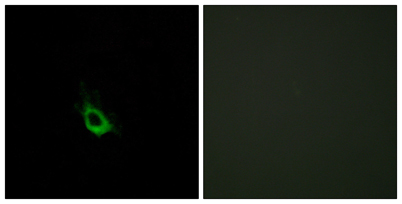
| Applications | WB;IHC;IF;ELISA |
| Other name | CARD10; CARMA3; Caspase recruitment domain-containing protein 10; CARD-containing MAGUK protein 3; Carma 3 |
| Size | 100μL |
| Unit price ($) | 248 |
| Human gene ID | 29775 |
| Human Swiss-Prot | Q9BWT7 |
| Source | Rabbit |
| Isotype | IgG |
| Target | CARD 10 |
| Fields | >>NF-kappa B signaling pathway |
| Gene name | CARD10 |
| Protein name | Caspase recruitment domain-containing protein 10 |
| Human gene link | View Human Gene |
| Human Swiss link | View Human Swiss-Prot |
| Mouse gene ID | 105844 |
| Mouse gene link | View Mouse Gene |
| Mouse Swiss-Prot | P58660 |
| Mouse Swiss link | View Mouse Swiss-Prot |
| Rat gene ID | |
| Rat gene link | |
| Rat Swiss-Prot | |
| Rat Swiss link | |
| Immunogen | The antiserum was produced against synthesized peptide derived from human CARD10. AA range:481-530 |
| Specificity | CARD 10 Polyclonal Antibody detects endogenous levels of CARD 10 protein. |
| Formulation | Liquid in PBS containing 50% glycerol, 0.5% BSA and 0.02% sodium azide. |
| Clonality | Polyclonal |
| Dilution | Western Blot: 1/500 - 1/2000. Immunohistochemistry: 1/100 - 1/300. Immunofluorescence: 1/200 - 1/1000. ELISA: 1/10000. Not yet tested in other applications. |
| Purification | The antibody was affinity-purified from rabbit antiserum by affinity-chromatography using epitope-specific immunogen. |
| Concentration | 1 mg/ml |
| Storage stability | -20°C/1 year |
| Molecular Weight (Da) | |
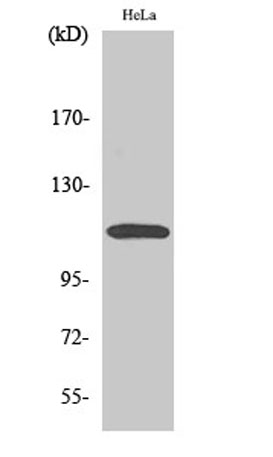
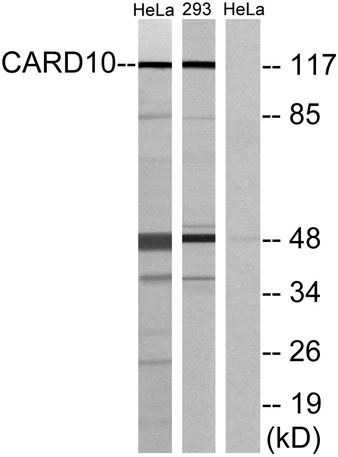
| Observed band (KD) | 120kD |
| Background | The caspase recruitment domain (CARD) is a protein module that consists of 6 or 7 antiparallel alpha helices. It participates in apoptosis signaling through highly specific protein-protein homophilic interactions. Like several other CARD proteins, CARD10 belongs to the membrane-associated guanylate kinase (MAGUK) family and activates NF-kappa-B (NFKB; see MIM 164011) through BCL10 (MIM 603517) (Wang et al., 2001 [PubMed 11259443]).[supplied by OMIM, Mar 2008], |
| Function | caution:Supposed to contain a SH3, a PDZ and a guanylate kinase-like domain. But none of these 3 domains are detected by PROSITE, Pfam or SMART.,function:Activates NF-kappa-B via BCL10 and IKK.,similarity:Contains 1 CARD domain.,subunit:CARD10 and BCL10 bind to each other by CARD-CARD interaction. They both participate in a complex with MALT1, where MALT1 binds to BCL10.,tissue specificity:Detected in adult heart, kidney and liver; lower levels in intestine, placenta, muscle and lung. Also found in fetal lung, liver and kidney., |
| Subcellular location | Cytoplasm . |
| Expression | Detected in adult heart, kidney and liver; lower levels in intestine, placenta, muscle and lung. Also found in fetal lung, liver and kidney. |

Use collapsible tabs for more detailed information that will help customers make a purchasing decision.
Ex: Shipping and return policies, size guides, and other common questions.