 Français
 English

| ELK.No | ES18395 |
| Product name | Alix rabbit pAb |
| Reactivity | Human;Rat;Mouse; |
| Applications | WB; ELISA |
| Other name | Programmed cell death 6-interacting protein (PDCD6-interacting protein;ALG-2-interacting protein 1;Hp95) |
| Size | 50μL |
| Unit price ($) | 148 |
| Human gene ID | 10015 |
| Human Swiss-Prot | Q8WUM4 |
| Source | Rabbit |
| Isotype | IgG |
| Target | Alix |
| Fields | >>Viral life cycle - HIV-1;>>Endocytosis |
| Gene name | PDCD6IP AIP1 ALIX KIAA1375 |
| Protein name | Alix |
| Human gene link | |
| Human Swiss link | View Human Swiss-Prot |
| Mouse gene ID | |
| Mouse gene link | |
| Mouse Swiss-Prot | |
| Mouse Swiss link | |
| Rat gene ID | |
| Rat gene link | |
| Rat Swiss-Prot | |
| Rat Swiss link | |
| Immunogen | Synthesized peptide derived from human Alix AA range: 410-490 |
| Specificity | This antibody detects endogenous levels of human Alix |
| Formulation | Liquid in PBS containing 50% glycerol, 0.5% BSA and 0.02% sodium azide. |
| Clonality | Polyclonal |
| Dilution | WB 1:500-2000, ELISA(peptide)1:5000-20000 |
| Purification | The antibody was affinity-purified from mouse ascites by affinity-chromatography using specific immunogen. |
| Concentration | 1 mg/ml |
| Storage stability | -20°C/1 year |
| Molecular Weight (Da) | |
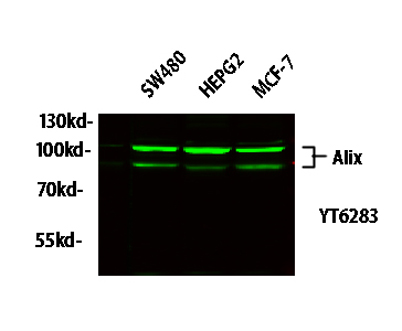
| Observed band (KD) | 85-100kD |
| Background | This gene encodes a protein that functions within the ESCRT pathway in the abscission stage of cytokinesis, in intralumenal endosomal vesicle formation, and in enveloped virus budding. Studies using mouse cells have shown that overexpression of this protein can block apoptosis. In addition, the product of this gene binds to the product of the PDCD6 gene, a protein required for apoptosis, in a calcium-dependent manner. This gene product also binds to endophilins, proteins that regulate membrane shape during endocytosis. Overexpression of this gene product and endophilins results in cytoplasmic vacuolization, which may be partly responsible for the protection against cell death. Several alternatively spliced transcript variants encoding different isoforms have been found for this gene. Related pseudogenes have been identified on chromosome 15. [provided by RefSeq, Jan 2012], |
| Function | function:Class E VPS protein involved in concentration and sorting of cargo proteins of the multivesicular body (MVB) for incorporation into intralumenal vesicles (ILVs) that are generated by invagination and scission from the limiting membrane of the endosome. Binds to the phospholipid lysobisphosphatidic acid (LBPA) which is abundant in MVBs internal membranes. The MVB pathway appears to require the sequential function of ESCRT-O, -I,-II and -III complexes. The ESCRT machinery also functions in topologically equivalent membrane fission events, such as the terminal stages of cytokinesis and enveloped virus budding (HIV-1 and other lentiviruses). Appears to be an adapter for a subset of ESCRT-III proteins, such as CHMP4, to function at distinct membranes. Required for completion of cytokinesis. Involved in HIV-1 virus budding. Can replace TSG101 it its role of supporting HIV-1 release; t |
| Subcellular location | Cytoplasm, cytosol . Melanosome . Cytoplasm, cytoskeleton, microtubule organizing center, centrosome . Secreted, extracellular exosome . Cell junction, tight junction . Midbody, Midbody ring . Identified by mass spectrometry in melanosome fractions from stage I to stage IV. Colocalized with CEP55 at centrosomes of non-dividing cells. Component of the actomyosin-tight junction complex (By similarity). PDCD6IP targeting to the midbody requires the interaction with CEP55 (PubMed:18641129). . |
| Expression | Brain,Lymph,Osteosarcoma,Placenta,Testis, |

Use collapsible tabs for more detailed information that will help customers make a purchasing decision.
Ex: Shipping and return policies, size guides, and other common questions.