 Français
 English
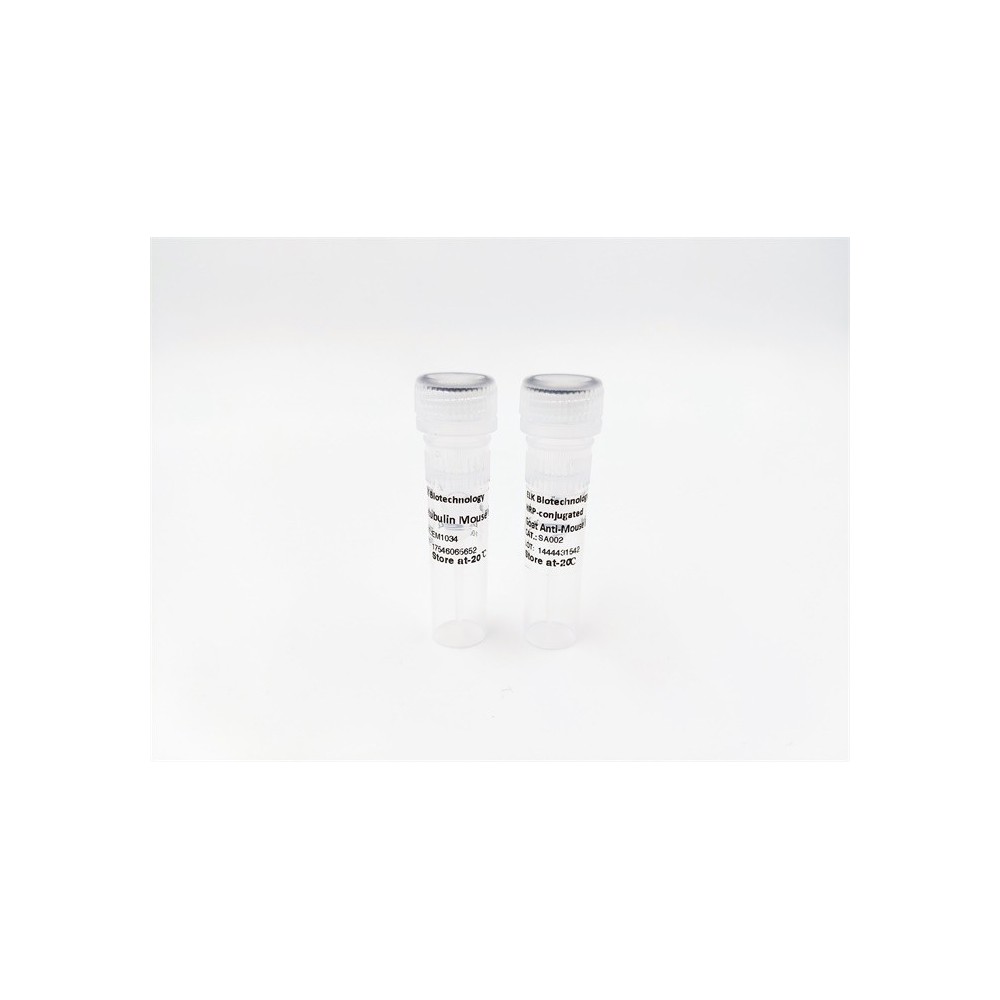

| ELK.No | ES18406 |
| Product name | AL7A1 rabbit pAb |
| Reactivity | Human; Mouse;Rat |
| Applications | WB |
| Other name | |
| Size | 100μL |
| Unit price ($) | 248 |
| Human gene ID | 501 |
| Human Swiss-Prot | P49419 |
| Source | Rabbit |
| Isotype | IgG |
| Target | AL7A1 |
| Fields | >>Glycolysis / Gluconeogenesis;>>Ascorbate and aldarate metabolism;>>Fatty acid degradation;>>Glycine, serine and threonine metabolism;>>Valine, leucine and isoleucine degradation;>>Lysine degradation;>>Arginine and proline metabolism;>>Histidine metabolism;>>Tryptophan metabolism;>>beta-Alanine metabolism;>>Glycerolipid metabolism;>>Pyruvate metabolism;>>Metabolic pathways;>>Alcoholic liver disease |
| Gene name | ALDH7A1 ATQ1 |
| Protein name | AL7A1 |
| Human gene link | View Human Gene |
| Human Swiss link | View Human Swiss-Prot |
| Mouse gene ID | 110695 |
| Mouse gene link | View Mouse Gene |
| Mouse Swiss-Prot | Q9DBF1 |
| Mouse Swiss link | View Mouse Swiss-Prot |
| Rat gene ID | 291450 |
| Rat gene link | View Rat Gene |
| Rat Swiss-Prot | Q64057 |
| Rat Swiss link | View Rat Swiss-Prot |
| Immunogen | Synthesized peptide derived from human AL7A1 AA range: 229-279 |
| Specificity | This antibody detects endogenous levels of AL7A1 at Human/Mouse/Rat |
| Formulation | Liquid in PBS containing 50% glycerol, 0.5% BSA and 0.02% sodium azide. |
| Clonality | Polyclonal |
| Dilution | WB 1:500-2000 |
| Purification | The antibody was affinity-purified from rabbit serum by affinity-chromatography using specific immunogen. |
| Concentration | 1 mg/ml |
| Storage stability | -20°C/1 year |
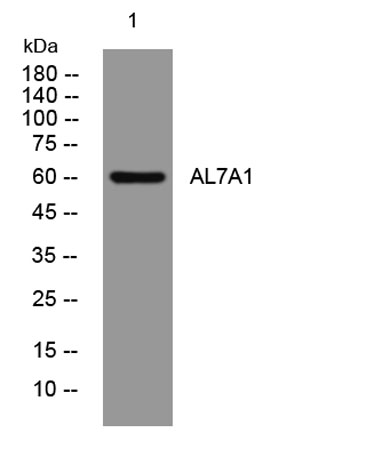
| Molecular Weight (Da) | 59kD |
| Observed band (KD) | |
| Background | The protein encoded by this gene is a member of subfamily 7 in the aldehyde dehydrogenase gene family. These enzymes are thought to play a major role in the detoxification of aldehydes generated by alcohol metabolism and lipid peroxidation. This particular member has homology to a previously described protein from the green garden pea, the 26g pea turgor protein. It is also involved in lysine catabolism that is known to occur in the mitochondrial matrix. Recent reports show that this protein is found both in the cytosol and the mitochondria, and the two forms likely arise from the use of alternative translation initiation sites. An additional variant encoding a different isoform has also been found for this gene. Mutations in this gene are associated with pyridoxine-dependent epilepsy. Several related pseudogenes have also been identified. [provided by RefSeq, Jan 2011], |
| Function | catalytic activity:L-2-aminoadipate 6-semialdehyde + NAD(P)(+) + H(2)O = L-2-aminoadipate + NAD(P)H.,disease:Defects in ALDH7A1 are the cause of pyridoxine-dependent epilepsy (PDE) [MIM:266100]. PDE is characterized by a combination of various seizure types. It usually occurs in the first hours of life and is unresponsive to standard anticonvulsants, responding only to immediate administration of pyridoxine hydrochloride.,similarity:Belongs to the aldehyde dehydrogenase family.,subunit:Homotetramer.,tissue specificity:Abundant in hepatoma cells and fetal cochlea, ovary, eye, heart, adrenal gland, liver and kidney. Low levels present in adult peripheral blood leukocytes and fetal brain, thymus, spleen, skeletal muscle, lung and tongue., |
| Subcellular location | [Isoform 2]: Cytoplasm, cytosol . Nucleus .; [Isoform 1]: Mitochondrion . |
| Expression | Abundant in hepatoma cells and fetal cochlea, ovary, eye, heart, adrenal gland, liver and kidney. Low levels present in adult peripheral blood leukocytes and fetal brain, thymus, spleen, skeletal muscle, lung and tongue. |

Use collapsible tabs for more detailed information that will help customers make a purchasing decision.
Ex: Shipping and return policies, size guides, and other common questions.