 Français
 English

| ELK.No | ES18455 |
| Product name | ADCYA rabbit pAb |
| Reactivity | Human; Mouse;Rat |
| Applications | WB |
| Other name | |
| Size | 50μL |
| Unit price ($) | 148 |
| Human gene ID | 55811 |
| Human Swiss-Prot | Q96PN6 |
| Source | Rabbit |
| Isotype | IgG |
| Target | ADCYA |
| Fields | >>Purine metabolism;>>Metabolic pathways;>>cAMP signaling pathway;>>Apelin signaling pathway;>>Circadian entrainment;>>Thermogenesis;>>Growth hormone synthesis, secretion and action |
| Gene name | ADCY10 SAC |
| Protein name | ADCYA |
| Human gene link | View Human Gene |
| Human Swiss link | View Human Swiss-Prot |
| Mouse gene ID | 271639 |
| Mouse gene link | View Mouse Gene |
| Mouse Swiss-Prot | Q8C0T9 |
| Mouse Swiss link | View Mouse Swiss-Prot |
| Rat gene ID | 59320 |
| Rat gene link | View Rat Gene |
| Rat Swiss-Prot | Q9Z286 |
| Rat Swiss link | View Rat Swiss-Prot |
| Immunogen | Synthesized peptide derived from human ADCYA AA range: 368-418 |
| Specificity | This antibody detects endogenous levels of ADCYA at Human/Mouse/Rat |
| Formulation | Liquid in PBS containing 50% glycerol, 0.5% BSA and 0.02% sodium azide. |
| Clonality | Polyclonal |
| Dilution | WB 1:500-2000 |
| Purification | The antibody was affinity-purified from rabbit serum by affinity-chromatography using specific immunogen. |
| Concentration | 1 mg/ml |
| Storage stability | -20°C/1 year |
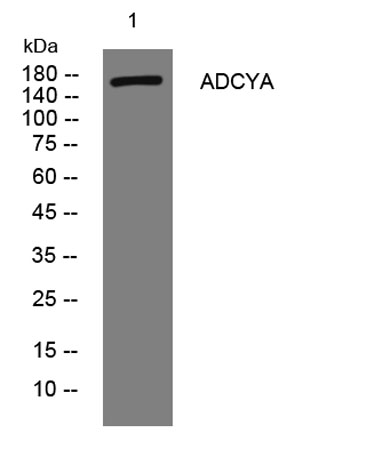
| Molecular Weight (Da) | 177kD |
| Observed band (KD) | |
| Background | The protein encoded by this gene belongs to a distinct class of adenylyl cyclases that is soluble and insensitive to G protein or forskolin regulation. Activity of this protein is regulated by bicarbonate. Variation at this gene has been observed in patients with absorptive hypercalciuria. Alternatively spliced transcript variants encoding different isoforms have been observed. There is a pseudogene of this gene on chromosome 6. [provided by RefSeq, Jul 2014], |
| Function | catalytic activity:ATP = 3',5'-cyclic AMP + diphosphate.,cofactor:Binds 2 magnesium ions per subunit.,disease:Genetic variations in ADCY10 are associated with absorptive hypercalciuria type 2 (HCA2) [MIM:143870]. Absorptive hypercalciuria (AH) is a common cause of calcium oxalate nephrolithiasis. Clinically, AH is characterized by intestinal hyperabsorption of calcium in the presence of normal serum calcium and immunoreactive PTH (iPTH). It is often accompanied by low bone mineral density (BMD), particularly of the lumbar spine. About 50% of patients with AH present with a family history of calcium oxalate nephrolithiasis and hypercalciuria.,enzyme regulation:Activated by manganese or magnesium ions. In the presence of magnesium ions, the enzyme is activated by bicarbonate while in the presence of manganese ions, the enzyme is inhibited by bicarbonate. In the absence of magnesium and bic |
| Subcellular location | Cell membrane ; Peripheral membrane protein ; Cytoplasmic side . Cytoplasm, cytoskeleton . Cytoplasm, perinuclear region . Nucleus . Cell projection, cilium . Cytoplasm . Mitochondrion . Distributed to subcellular compartments containing cAMP targets. Found as a plasma membrane-associated protein, protein concentrated in the perinuclear region and protein colocalized with actin or tubulin. . |
| Expression | Detected in airway epithelial cells and testis (at protein level) (PubMed:17591988). Weakly expressed in multiple tissues. Expressed in brain, heart, kidney, liver, lung, pancreas, peripheral blood leukocytes, placenta, skeletal muscle, stomach, thymus, airway epithelial cells, duodenum, jejunum and ileum. Very low level of expression in bone. |

Use collapsible tabs for more detailed information that will help customers make a purchasing decision.
Ex: Shipping and return policies, size guides, and other common questions.