 Français
 English

| ELK.No | ES18516 |
| Product name | ABC3F rabbit pAb |
| Reactivity | Human;Rat;Mouse; |
| Applications | WB |
| Other name | |
| Size | 100μL |
| Unit price ($) | 248 |
| Human gene ID | 200316 |
| Human Swiss-Prot | Q8IUX4 |
| Source | Rabbit |
| Isotype | IgG |
| Target | ABC3F |
| Fields | >>Viral life cycle - HIV-1;>>Human immunodeficiency virus 1 infection |
| Gene name | APOBEC3F |
| Protein name | ABC3F |
| Human gene link | View Human Gene |
| Human Swiss link | View Human Swiss-Prot |
| Mouse gene ID | |
| Mouse gene link | |
| Mouse Swiss-Prot | |
| Mouse Swiss link | |
| Rat gene ID | |
| Rat gene link | |
| Rat Swiss-Prot | |
| Rat Swiss link | |
| Immunogen | Synthesized peptide derived from human ABC3F AA range: 112-162 |
| Specificity | This antibody detects endogenous levels of ABC3F at Human |
| Formulation | Liquid in PBS containing 50% glycerol, 0.5% BSA and 0.02% sodium azide. |
| Clonality | Polyclonal |
| Dilution | WB 1:500-2000 |
| Purification | The antibody was affinity-purified from rabbit serum by affinity-chromatography using specific immunogen. |
| Concentration | 1 mg/ml |
| Storage stability | -20°C/1 year |
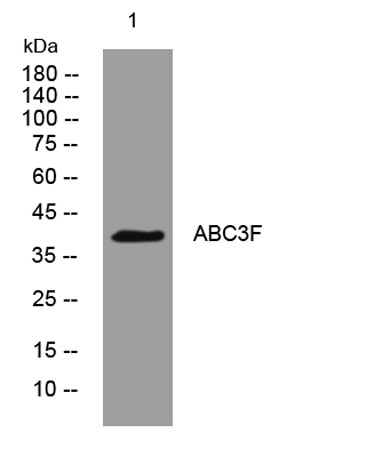
| Molecular Weight (Da) | 41kD |
| Observed band (KD) | |
| Background | This gene is a member of the cytidine deaminase gene family. It is one of seven related genes or pseudogenes found in a cluster, thought to result from gene duplication, on chromosome 22. Members of the cluster encode proteins that are structurally and functionally related to the C to U RNA-editing cytidine deaminase APOBEC1. It is thought that the proteins may be RNA editing enzymes and have roles in growth or cell cycle control. Alternatively spliced transcript variants encoding different isoforms have been identified. [provided by RefSeq, Jul 2008], |
| Function | cofactor:Zinc.,function:After being packaged into HIV-1 virions, blocks productive infection by massively editing dC residues to dU on the DNA minus strand during reverse transcription. The editing of the minus strand DNA of HIV-1 during reverse transcription leads to G-to-A transitions in the plus strand. The inhibition of viral replication is either due to the degradation of the minus strand before its integration or to the lethality of the hypermutations.,function:DNA deaminase (cytidine deaminase) that mediates a form of innate resistance to retroviral infections (at least to HIV-1 infection) by triggering G-to-A hypermutation in the newly synthesized viral DNA. The replacements C-to-U in the minus strand DNA of HIV-1 during reverse transcription, leads to G-to-A transitions in the plus strand. The inhibition of viral replication is either due to the degradation of the minus strand b |
| Subcellular location | Cytoplasm. Cytoplasm, P-body. |
| Expression | Widely expressed. Highly expressed in ovary. |

Use collapsible tabs for more detailed information that will help customers make a purchasing decision.
Ex: Shipping and return policies, size guides, and other common questions.