 Français
 English
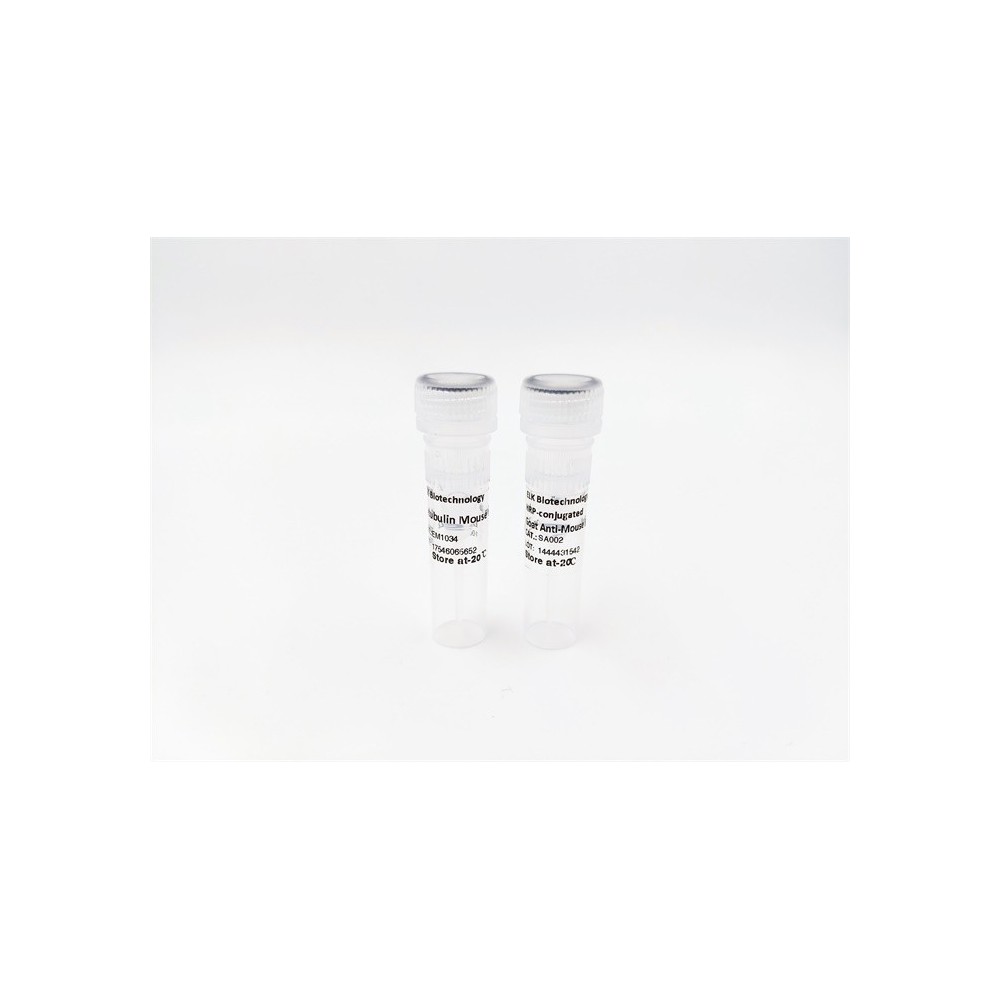

| ELK.No | ES1993 |
| Product name | CLC-7 rabbit pAb |
| Reactivity | Human;Mouse;Rat |
| Applications | WB;ELISA |
| Other name | CLCN7; H(+)/Cl(-) exchange transporter 7; Chloride channel 7 alpha subunit; Chloride channel protein 7; ClC-7 |
| Size | 50μL |
| Unit price ($) | 148 |
| Human gene ID | 1186 |
| Human Swiss-Prot | P51798 |
| Source | Rabbit |
| Isotype | IgG |
| Target | CLC-7 |
| Fields | |
| Gene name | CLCN7 |
| Protein name | H(+)/Cl(-) exchange transporter 7 |
| Human gene link | View Human Gene |
| Human Swiss link | View Human Swiss-Prot |
| Mouse gene ID | 26373 |
| Mouse gene link | View Mouse Gene |
| Mouse Swiss-Prot | O70496 |
| Mouse Swiss link | View Mouse Swiss-Prot |
| Rat gene ID | 29233 |
| Rat gene link | View Rat Gene |
| Rat Swiss-Prot | P51799 |
| Rat Swiss link | View Rat Swiss-Prot |
| Immunogen | The antiserum was produced against synthesized peptide derived from human CLCN7. AA range:10-59 |
| Specificity | CLC-7 Polyclonal Antibody detects endogenous levels of CLC-7 protein. |
| Formulation | Liquid in PBS containing 50% glycerol, 0.5% BSA and 0.02% sodium azide. |
| Clonality | Polyclonal |
| Dilution | Western Blot: 1/500 - 1/2000. ELISA: 1/40000. Not yet tested in other applications. |
| Purification | The antibody was affinity-purified from rabbit antiserum by affinity-chromatography using epitope-specific immunogen. |
| Concentration | 1 mg/ml |
| Storage stability | -20°C/1 year |
| Molecular Weight (Da) | |
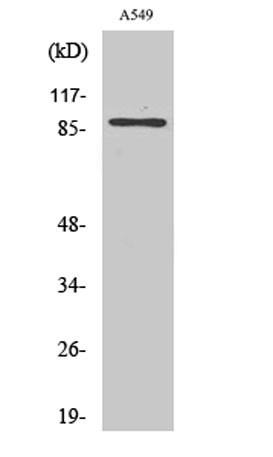
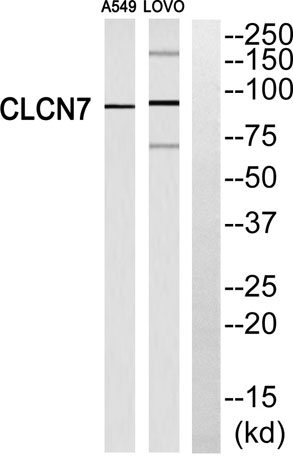
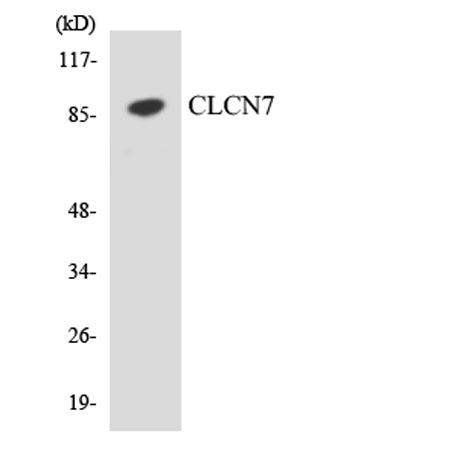
| Observed band (KD) | 90kD |
| Background | chloride voltage-gated channel 7(CLCN7) Homo sapiens The product of this gene belongs to the CLC chloride channel family of proteins. Chloride channels play important roles in the plasma membrane and in intracellular organelles. This gene encodes chloride channel 7. Defects in this gene are the cause of osteopetrosis autosomal recessive type 4 (OPTB4), also called infantile malignant osteopetrosis type 2 as well as the cause of autosomal dominant osteopetrosis type 2 (OPTA2), also called autosomal dominant Albers-Schonberg disease or marble disease autosoml dominant. Osteopetrosis is a rare genetic disease characterized by abnormally dense bone, due to defective resorption of immature bone. OPTA2 is the most common form of osteopetrosis, occurring in adolescence or adulthood. [provided by RefSeq, Jul 2008], |
| Function | disease:Defects in CLCN7 are a cause of autosomal dominant osteopetrosis type 2 (OPTA2) [MIM:166600]; also called autosomal dominant Albers-Schonberg disease or marble disease autosoml dominant. OPTA2 is the most common form of osteopetrosis, occurring in adolescence or adulthood. It is characterized by sclerosis, predominantly involving the spine, the pelvis, and the skull base.,disease:Defects in CLCN7 are the cause of osteopetrosis autosomal recessive type 4 (OPTB4) [MIM:611490]; also called infantile malignant osteopetrosis type 2. Osteopetrosis is a rare genetic disease characterized by abnormally dense bone, due to defective resorption of immature bone. The disorder occurs in two forms: a severe autosomal recessive form occurring in utero, infancy, or childhood, and a benign autosomal dominant form occurring in adolescence or adulthood.,function:Mediates the exchange of chloride io |
| Subcellular location | Lysosome membrane ; Multi-pass membrane protein . |
| Expression | Brain and kidney. |

Use collapsible tabs for more detailed information that will help customers make a purchasing decision.
Ex: Shipping and return policies, size guides, and other common questions.