 Français
 English

| ELK.No | ES2024 |
| Product name | COL4A6 rabbit pAb |
| Reactivity | Human;Rat;Mouse; |
| Applications | WB;IHC;IF;ELISA |
| Other name | COL4A6; Collagen alpha-6(IV) chain |
| Size | 50μL |
| Unit price ($) | 148 |
| Human gene ID | 1288 |
| Human Swiss-Prot | Q14031 |
| Source | Rabbit |
| Isotype | IgG |
| Target | COL4A6 |
| Fields | >>PI3K-Akt signaling pathway;>>Focal adhesion;>>ECM-receptor interaction;>>Relaxin signaling pathway;>>AGE-RAGE signaling pathway in diabetic complications;>>Protein digestion and absorption;>>Amoebiasis;>>Human papillomavirus infection;>>Pathways in cancer;>>Small cell lung cancer |
| Gene name | COL4A6 |
| Protein name | Collagen alpha-6(IV) chain |
| Human gene link | View Human Gene |
| Human Swiss link | View Human Swiss-Prot |
| Mouse gene ID | |
| Mouse gene link | |
| Mouse Swiss-Prot | |
| Mouse Swiss link | |
| Rat gene ID | |
| Rat gene link | |
| Rat Swiss-Prot | |
| Rat Swiss link | |
| Immunogen | The antiserum was produced against synthesized peptide derived from human Collagen IV alpha6. AA range:1201-1250 |
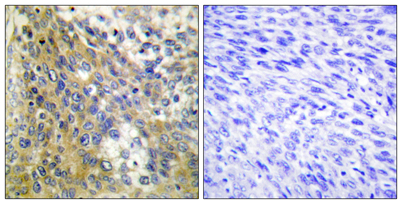
| Specificity | COL4A6 Polyclonal Antibody detects endogenous levels of COL4A6 protein. |
| Formulation | Liquid in PBS containing 50% glycerol, 0.5% BSA and 0.02% sodium azide. |
| Clonality | Polyclonal |
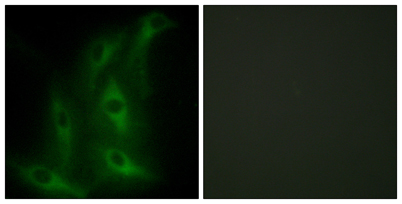
| Dilution | Western Blot: 1/500 - 1/2000. Immunohistochemistry: 1/100 - 1/300. Immunofluorescence: 1/200 - 1/1000. ELISA: 1/40000. Not yet tested in other applications. |
| Purification | The antibody was affinity-purified from rabbit antiserum by affinity-chromatography using epitope-specific immunogen. |
| Concentration | 1 mg/ml |
| Storage stability | -20°C/1 year |
| Molecular Weight (Da) | |
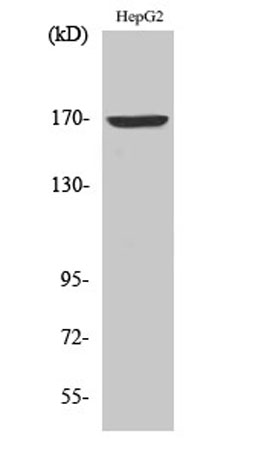
| Observed band (KD) | 160kD |
| Background | This gene encodes one of the six subunits of type IV collagen, the major structural component of basement membranes. Like the other members of the type IV collagen gene family, this gene is organized in a head-to-head conformation with another type IV collagen gene, alpha 5 type IV collagen, so that the gene pair shares a common promoter. Deletions in the alpha 5 gene that extend into the alpha 6 gene result in diffuse leiomyomatosis accompanying the X-linked Alport syndrome caused by the deletion in the alpha 5 gene. Alternative splicing results in multiple transcript variants encoding different isoforms. [provided by RefSeq, Dec 2013], |
| Function | disease:Deletions covering the N-terminal regions of COL4A6 and COL4A5, which are localized in a head-to-head manner, are the cause of diffuse leiomyomatosis with Alport syndrome (DL-ATS) [MIM:308940]; also known as esophageal and vulval leiomyomatosis with nephropathy or Alport syndrome and diffuse leiomyomatosis (ATS-DL). DL-ATS is the combination of Alport syndrome (AS) and diffuse leiomyomatosis (DL). AS is characterized by progressive glomerulonephritis, often associated with high-tone sensorineural deafness, specific eye abnormalities (lenticonous and macular flecks), and glomerular basement membrane defects. DL is a tumorous process involving smooth muscle cells, mostly of the esophagus, but also of the tracheobronchial tree and the female genital tract.,domain:Alpha chains of type IV collagen have a non-collagenous domain (NC1) at their C-terminus, frequent interruptions of the G |
| Subcellular location | Secreted, extracellular space, extracellular matrix, basement membrane. |
| Expression | Eye,Kidney,Prostate, |

Use collapsible tabs for more detailed information that will help customers make a purchasing decision.
Ex: Shipping and return policies, size guides, and other common questions.