 Français
 English

| ELK.No | ES2031 |
| Product name | COT rabbit pAb |
| Reactivity | Human;Mouse;Rat |
| Applications | WB;IHC;IF;ELISA |
| Other name | MAP3K8; COT; ESTF; Mitogen-activated protein kinase kinase kinase 8; Cancer Osaka thyroid oncogene; Proto-oncogene c-Cot; Serine/threonine-protein kinase cot; Tumor progression locus 2; TPL-2 |
| Size | 50μL |
| Unit price ($) | 148 |
| Human gene ID | 1326 |
| Human Swiss-Prot | P41279 |
| Source | Rabbit |
| Isotype | IgG |
| Target | COT |
| Fields | >>MAPK signaling pathway;>>Toll-like receptor signaling pathway;>>T cell receptor signaling pathway;>>TNF signaling pathway |
| Gene name | MAP3K8 |
| Protein name | Mitogen-activated protein kinase kinase kinase 8 |
| Human gene link | View Human Gene |
| Human Swiss link | View Human Swiss-Prot |
| Mouse gene ID | 26410 |
| Mouse gene link | View Mouse Gene |
| Mouse Swiss-Prot | Q07174 |
| Mouse Swiss link | View Mouse Swiss-Prot |
| Rat gene ID | 116596 |
| Rat gene link | View Rat Gene |
| Rat Swiss-Prot | Q63562 |
| Rat Swiss link | View Rat Swiss-Prot |
| Immunogen | The antiserum was produced against synthesized peptide derived from human COT. AA range:256-305 |
| Specificity | COT Polyclonal Antibody detects endogenous levels of COT protein. |
| Formulation | Liquid in PBS containing 50% glycerol, 0.5% BSA and 0.02% sodium azide. |
| Clonality | Polyclonal |
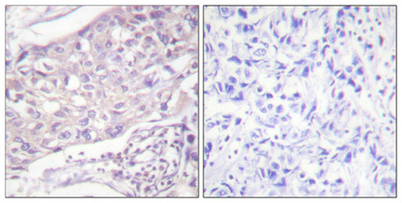
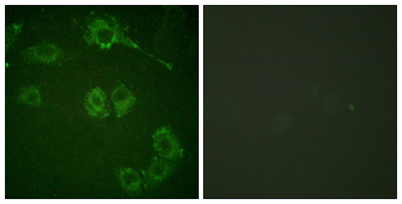
| Dilution | Western Blot: 1/500 - 1/2000. Immunohistochemistry: 1/100 - 1/300. Immunofluorescence: 1/200 - 1/1000. ELISA: 1/40000. Not yet tested in other applications. |
| Purification | The antibody was affinity-purified from rabbit antiserum by affinity-chromatography using epitope-specific immunogen. |
| Concentration | 1 mg/ml |
| Storage stability | -20°C/1 year |
| Molecular Weight (Da) | |
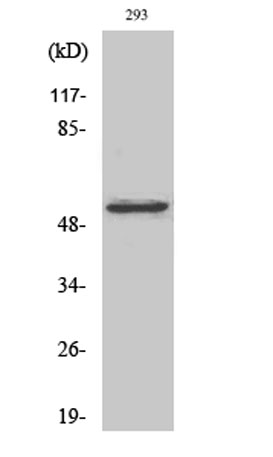
| Observed band (KD) | 60kD |
| Background | This gene is an oncogene that encodes a member of the serine/threonine protein kinase family. The encoded protein localizes to the cytoplasm and can activate both the MAP kinase and JNK kinase pathways. This protein was shown to activate IkappaB kinases, and thus induce the nuclear production of NF-kappaB. This protein was also found to promote the production of TNF-alpha and IL-2 during T lymphocyte activation. This gene may also utilize a downstream in-frame translation start codon, and thus produce an isoform containing a shorter N-terminus. The shorter isoform has been shown to display weaker transforming activity. Alternate splicing results in multiple transcript variants that encode the same protein. [provided by RefSeq, Sep 2011], |
| Function | catalytic activity:ATP + a protein = ADP + a phosphoprotein.,cofactor:Magnesium.,developmental stage:Isoform 1 is activated specifically during the S and G2/M phases of the cell cycle.,function:Required for TLR4 activation of the MEK/ERK pathway. Able to activate NF-kappa-B 1 by stimulating proteasome-mediated proteolysis of NF-kappa-B 1/p105. Plays a role in the cell cycle. The longer form has some transforming activity, although it is much weaker than the activated cot oncoprotein.,PTM:Autophosphorylated. Isoform 1 undergoes phosphorylation mainly on Ser residues, and isoform 2 on both Ser and Thr residues.,similarity:Belongs to the protein kinase superfamily. STE Ser/Thr protein kinase family. MAP kinase kinase kinase subfamily.,similarity:Contains 1 protein kinase domain.,subunit:Forms a ternary complex with NFKB1 and TNIP2.,tissue specificity:Expressed in several normal tissues and |
| Subcellular location | Cytoplasm . |
| Expression | Expressed in several normal tissues and human tumor-derived cell lines. |

Use collapsible tabs for more detailed information that will help customers make a purchasing decision.
Ex: Shipping and return policies, size guides, and other common questions.