 Français
 English

| ELK.No | ES2206 |
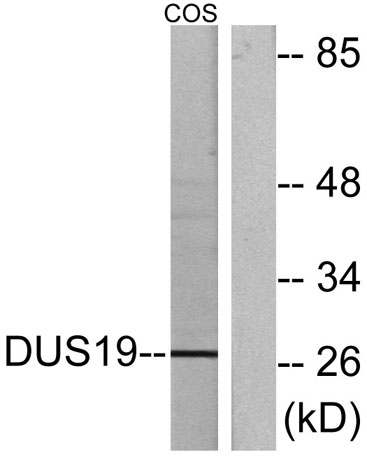
| Product name | DUSP19 rabbit pAb |
| Reactivity | Human;Monkey |
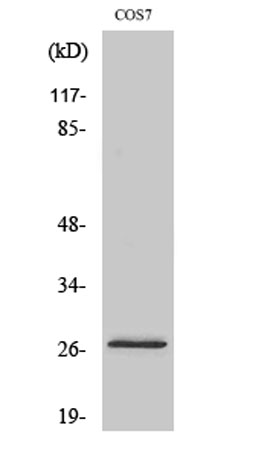
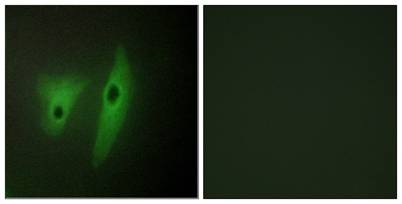
| Applications | WB;IF;ELISA |
| Other name | DUSP19; DUSP17; LMWDSP3; SKRP1; Dual specificity protein phosphatase 19; Dual specificity phosphatase TS-DSP1; Low molecular weight dual specificity phosphatase 3; LMW-DSP3; Protein phosphatase SKRP1; Stress-activated protein kinase pathway |
| Size | 50μL |
| Unit price ($) | 148 |
| Human gene ID | 142679 |
| Human Swiss-Prot | Q8WTR2 |
| Source | Rabbit |
| Isotype | IgG |
| Target | DUSP19 |
| Fields | |
| Gene name | DUSP19 |
| Protein name | Dual specificity protein phosphatase 19 |
| Human gene link | View Human Gene |
| Human Swiss link | View Human Swiss-Prot |
| Mouse gene ID | |
| Mouse gene link | |
| Mouse Swiss-Prot | Q8K4T5 |
| Mouse Swiss link | View Mouse Swiss-Prot |
| Rat gene ID | |
| Rat gene link | |
| Rat Swiss-Prot | |
| Rat Swiss link | |
| Immunogen | The antiserum was produced against synthesized peptide derived from human DUSP19. AA range:111-160 |
| Specificity | DUSP19 Polyclonal Antibody detects endogenous levels of DUSP19 protein. |
| Formulation | Liquid in PBS containing 50% glycerol, 0.5% BSA and 0.02% sodium azide. |
| Clonality | Polyclonal |
| Dilution | Western Blot: 1/500 - 1/2000. Immunofluorescence: 1/200 - 1/1000. ELISA: 1/20000. Not yet tested in other applications. |
| Purification | The antibody was affinity-purified from rabbit antiserum by affinity-chromatography using epitope-specific immunogen. |
| Concentration | 1 mg/ml |
| Storage stability | -20°C/1 year |
| Molecular Weight (Da) | |
| Observed band (KD) | 28kD |
| Background | dual specificity phosphatase 19(DUSP19) Homo sapiens Dual-specificity phosphatases (DUSPs) constitute a large heterogeneous subgroup of the type I cysteine-based protein-tyrosine phosphatase superfamily. DUSPs are characterized by their ability to dephosphorylate both tyrosine and serine/threonine residues. They have been implicated as major modulators of critical signaling pathways. DUSP19 contains a variation of the consensus DUSP C-terminal catalytic domain, with the last serine residue replaced by alanine, and lacks the N-terminal CH2 domain found in the MKP (mitogen-activated protein kinase phosphatase) class of DUSPs (see MIM 600714) (summary by Patterson et al., 2009 [PubMed 19228121]).[supplied by OMIM, Dec 2009], |
| Function | catalytic activity:A phosphoprotein + H(2)O = a protein + phosphate.,catalytic activity:Protein tyrosine phosphate + H(2)O = protein tyrosine + phosphate.,function:Has a dual specificity toward Ser/Thr and Tyr-containing proteins.,similarity:Belongs to the protein-tyrosine phosphatase family. Non-receptor class dual specificity subfamily.,similarity:Contains 1 tyrosine-protein phosphatase domain.,tissue specificity:Expressed in the heart, lung, liver, and pancreas. The expression level in the pancreas is the highest., |
| Subcellular location | |
| Expression | Expressed in the heart, lung, liver, and pancreas. The expression level in the pancreas is the highest. |

Use collapsible tabs for more detailed information that will help customers make a purchasing decision.
Ex: Shipping and return policies, size guides, and other common questions.