 Français
 English


| ELK.No | ES2255 |
| Product name | ELOVL4 rabbit pAb |
| Reactivity | Human;Mouse |
| Applications | WB;ELISA |
| Other name | ELOVL4; Elongation of very long chain fatty acids protein 4; 3-keto acyl-CoA synthase ELOVL4; ELOVL fatty acid elongase 4; ELOVL FA elongase 4 |
| Size | 100μL |
| Unit price ($) | 248 |
| Human gene ID | 6785 |
| Human Swiss-Prot | Q9GZR5 |
| Source | Rabbit |
| Isotype | IgG |
| Target | ELOVL4 |
| Fields | >>Fatty acid elongation;>>Biosynthesis of unsaturated fatty acids;>>Metabolic pathways;>>Fatty acid metabolism |
| Gene name | ELOVL4 |
| Protein name | Elongation of very long chain fatty acids protein 4 |
| Human gene link | View Human Gene |
| Human Swiss link | View Human Swiss-Prot |
| Mouse gene ID | 83603 |
| Mouse gene link | View Mouse Gene |
| Mouse Swiss-Prot | Q9EQC4 |
| Mouse Swiss link | View Mouse Swiss-Prot |
| Rat gene ID | |
| Rat gene link | |
| Rat Swiss-Prot | |
| Rat Swiss link | |
| Immunogen | The antiserum was produced against synthesized peptide derived from human ELOVL4. AA range:41-90 |
| Specificity | ELOVL4 Polyclonal Antibody detects endogenous levels of ELOVL4 protein. |
| Formulation | Liquid in PBS containing 50% glycerol, 0.5% BSA and 0.02% sodium azide. |
| Clonality | Polyclonal |
| Dilution | Western Blot: 1/500 - 1/2000. ELISA: 1/40000. Not yet tested in other applications. |
| Purification | The antibody was affinity-purified from rabbit antiserum by affinity-chromatography using epitope-specific immunogen. |
| Concentration | 1 mg/ml |
| Storage stability | -20°C/1 year |
| Molecular Weight (Da) | |
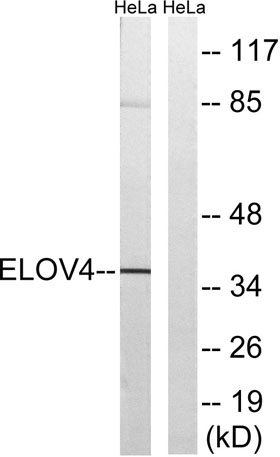
| Observed band (KD) | 37kD |
| Background | This gene encodes a membrane-bound protein which is a member of the ELO family, proteins which participate in the biosynthesis of fatty acids. Consistent with the expression of the encoded protein in photoreceptor cells of the retina, mutations and small deletions in this gene are associated with Stargardt-like macular dystrophy (STGD3) and autosomal dominant Stargardt-like macular dystrophy (ADMD), also referred to as autosomal dominant atrophic macular degeneration. [provided by RefSeq, Jul 2008], |
| Function | disease:Defects in ELOVL4 are the cause of macular dystrophy autosomal dominant chromosome 6-linked (ADMD) [MIM:600110]. A form of macular degeneration characterized by decreased visual acuity, macular atrophy and extensive fundus flecks.,disease:Defects in ELOVL4 are the cause of Stargardt disease type 3 (STGD3) [MIM:600110]. STGD is one of the most frequent causes of macular degeneration in childhood. It is characterized by macular dystrophy with juvenile-onset, rapidly progressive course, alterations of the peripheral retina, and subretinal deposition of lipofuscin-like material. STGD3 inheritance is autosomal dominant.,domain:The di-lysine motif confers endoplasmic reticulum localization for type I membrane proteins.,function:Involved in the biosynthesis of very long chain fatty acids. Seems to represent a photoreceptor-specific component of the fatty acid elongation system residing |
| Subcellular location | Endoplasmic reticulum membrane ; Multi-pass membrane protein . |
| Expression | Expressed in the retina and at much lower level in the brain. Ubiquitous, highest expression in thymus, followed by testis, small intestine, ovary, and prostate. Little or no expression in heart, lung, liver, or leukocates. |


Use collapsible tabs for more detailed information that will help customers make a purchasing decision.
Ex: Shipping and return policies, size guides, and other common questions.