 Français
 English
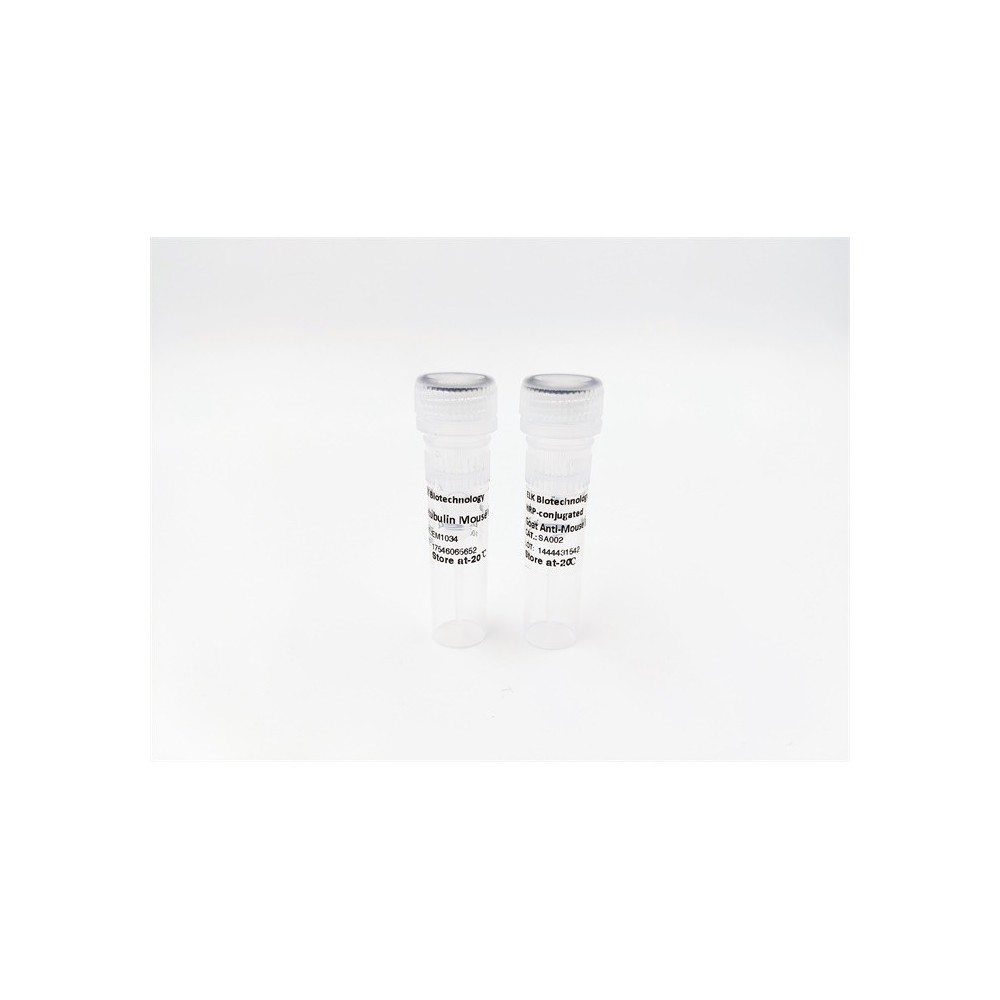

| ELK.No | ES2263 |
| Product name | Endoplasmin rabbit pAb |
| Reactivity | Human;Mouse |
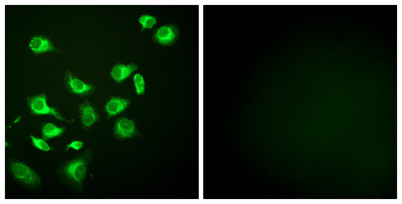
| Applications | WB;IHC;IF;ELISA |
| Other name | HSP90B1; GRP94; TRA1; Endoplasmin; 94 kDa glucose-regulated protein; GRP-94; Heat shock protein 90 kDa beta member 1; Tumor rejection antigen 1; gp96 homolog |
| Size | 50μL |
| Unit price ($) | 148 |
| Human gene ID | 7184 |
| Human Swiss-Prot | P14625 |
| Source | Rabbit |
| Isotype | IgG |
| Target | Endoplasmin |
| Fields | >>Protein processing in endoplasmic reticulum;>>PI3K-Akt signaling pathway;>>IL-17 signaling pathway;>>Estrogen signaling pathway;>>Thyroid hormone synthesis;>>Salmonella infection;>>Pathways in cancer;>>Chemical carcinogenesis - receptor activation;>>Prostate cancer;>>Lipid and atherosclerosis;>>Fluid shear stress and atherosclerosis |
| Gene name | HSP90B1 |
| Protein name | Endoplasmin |
| Human gene link | View Human Gene |
| Human Swiss link | View Human Swiss-Prot |
| Mouse gene ID | 22027 |
| Mouse gene link | View Mouse Gene |
| Mouse Swiss-Prot | P08113 |
| Mouse Swiss link | View Mouse Swiss-Prot |
| Rat gene ID | |
| Rat gene link | |
| Rat Swiss-Prot | |
| Rat Swiss link | |
| Immunogen | The antiserum was produced against synthesized peptide derived from human GRP94. AA range:754-803 |
| Specificity | Endoplasmin Polyclonal Antibody detects endogenous levels of Endoplasmin protein. |
| Formulation | Liquid in PBS containing 50% glycerol, 0.5% BSA and 0.02% sodium azide. |
| Clonality | Polyclonal |
| Dilution | Western Blot: 1/500 - 1/2000. Immunohistochemistry: 1/100 - 1/300. Immunofluorescence: 1/200 - 1/1000. ELISA: 1/20000. Not yet tested in other applications. |
| Purification | The antibody was affinity-purified from rabbit antiserum by affinity-chromatography using epitope-specific immunogen. |
| Concentration | 1 mg/ml |
| Storage stability | -20°C/1 year |
| Molecular Weight (Da) | |
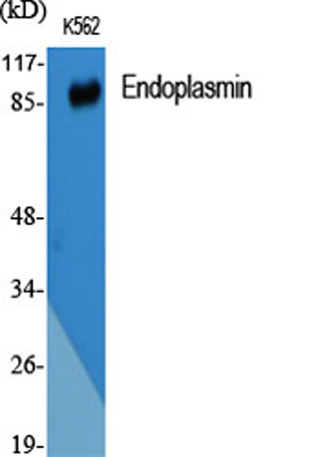
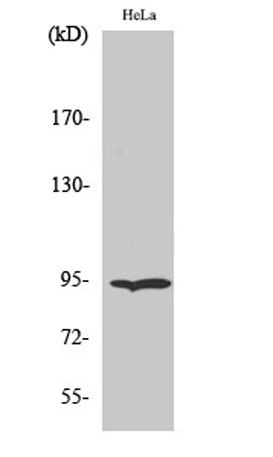
| Observed band (KD) | 92kD |
| Background | This gene encodes a member of a family of adenosine triphosphate(ATP)-metabolizing molecular chaperones with roles in stabilizing and folding other proteins. The encoded protein is localized to melanosomes and the endoplasmic reticulum. Expression of this protein is associated with a variety of pathogenic states, including tumor formation. There is a microRNA gene located within the 5' exon of this gene. There are pseudogenes for this gene on chromosomes 1 and 15. [provided by RefSeq, Aug 2012], |
| Function | function:Molecular chaperone that functions in the processing and transport of secreted proteins. Has ATPase activity.,PTM:Phosphorylated.,similarity:Belongs to the heat shock protein 90 family.,subcellular location:Identified by mass spectrometry in melanosome fractions from stage I to stage IV.,subunit:Homodimer; disulfide-linked. Component of an EIF2 complex at least composed of CUGBP1, CALR, CALR3, EIF2S1, EIF2S2, HSP90B1 and HSPA5 (By similarity). Part a large chaperone multiprotein complex comprising CABP1, DNAJB11, HSP90B1, HSPA5, HYOU, PDIA2, PDIA4, PPIB, SDF2L1, UGT1A1 and very small amounts of ERP29, but not, or at very low levels, CALR nor CANX., |
| Subcellular location | Endoplasmic reticulum lumen . Sarcoplasmic reticulum lumen . Melanosome . Identified by mass spectrometry in melanosome fractions from stage I to stage IV. . |
| Expression | Blood,Brain,Liver,Lung,Platelet,Skin, |

Use collapsible tabs for more detailed information that will help customers make a purchasing decision.
Ex: Shipping and return policies, size guides, and other common questions.